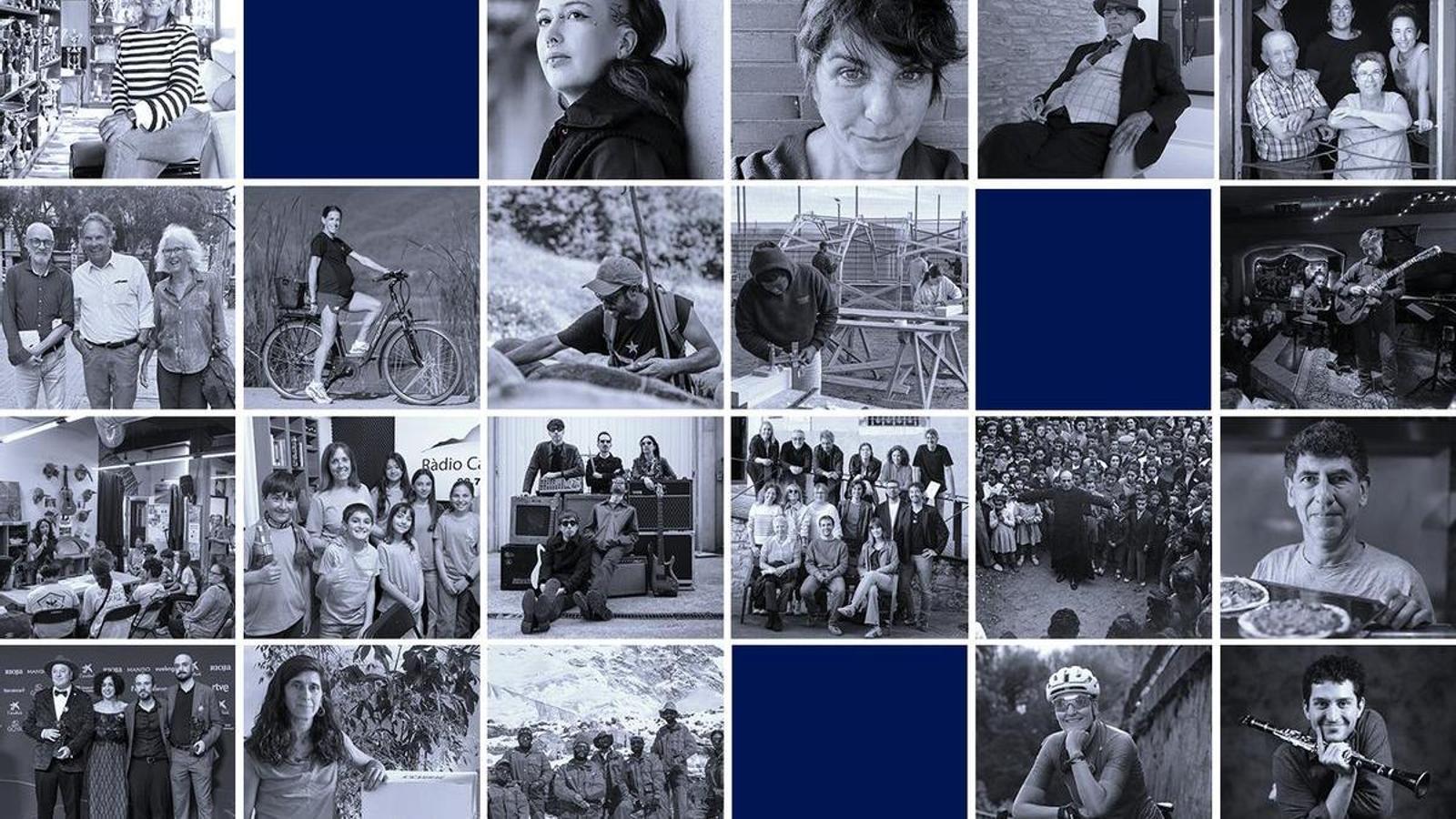
The 20 people from Girona of 2026
The protagonists of a group of powerful and inspiring stories, often anonymous, will be recognized at the second edition of the ARA Girona awards, which will be held on November 24, at 7 p.m., at the Antic Teatre Odeon in the Old Quarter (Velòdrom)
-
CAT -
CAST
GironaDo not expect big shots, celebrities, or trivial influencers. These are open and plural awards that anyone could receive (as long as they are unique); because everyone has a powerful and inspiring personal story inside them. The jury is our readers, who by reading and sharing the stories they like and are moved by, increase visits to an article and put the spotlight on the winners. It is the second year of these ARA awards in Girona, which we unofficially call "the clever fox awards". In 2023 we began to highlight the names that had marked the year in the Girona regions, and we repeated it in 2024. Finally, in 2025 we turned it into public awards that this year we celebrate in the same format. We also see it as a thank you to the protagonists of the best stories we have published this year.
She runs marathons because she says she is not one to stay at home

Quima Casas, 74 years old, is a woman who has made perseverance and freedom a way of life. With 166 marathons under her belt, she continues running because she does not understand life without movement or adventure. She started almost by chance, without technique or coaches, but with a determination that has led her to complete five 100-kilometer races and to set extraordinary marks. A pioneer in a world then dominated by men, she has never let anyone set the pace for her, not even stopwatches: “The stopwatch is my boss”. Independent, stubborn, and not fond of impositions, she finds her space of freedom in the forests and mountains of La Garrotxa. She prefers moonlight to headlamps and running for the pleasure of feeling alive, far from asphalt and conventions. She knows that one day she will have to give up marathons, but not activity. Because Quima is not one to stay at home: if she cannot run, she will walk or go by bicycle. Always moving forward.
The titanic struggle of young people with mental illness and their families
With two suicide attempts, young Íngrid knows all too well what it is like to live with the fear that at any moment that moment will reappear when she feels everything is falling apart, when she stops being herself and wishes to die, when she secretly grabs a box of antipsychotics and swallows one pill after another. Aware that her life hangs by a very thin thread due to the mental illness she has been carrying since she was 12 years old, with diverse diagnoses but without an assistance response that prevents dangerous relapses, Íngrid has chosen to go into debt and pay out of her own pocket for admission to a private day center where she finally received the therapy she needed. Behind every youth suicide attempt there is immense suffering and the desperation of the young people themselves, but also of their families, who beg for more resources so that the administrations “do not let their children die” and provide more resources to the child and adolescent mental health care system. Sònia Cebrian, mother of a young woman with a mental illness, expresses it this way: “The families who live with an adolescent in crisis end up assuming functions for which no one has prepared us. We are not heroes. We are survivors. We act as therapists, mediators, and a containment wall, and we do it because we have no alternative, because there is no public structure. We don't want medals. We want support”.
The fruit of a passion that is already collective heritage
Jordi Gimferrer, a 93-year-old from Banyoles, has turned over six decades of passion for art into an extraordinary gift for his city. A chemist by profession and a collector by vocation, he has gathered an exceptional artistic heritage throughout his life, with works by Miró, Tàpies, Picasso, Dalí, and Fortuny, among many others. But his great gesture has been to renounce keeping it in the private sphere to make it accessible to everyone. In 2023, he bequeathed his works to the Banyoles City Council with the desire that they be exhibited publicly and permanently. A generosity that has made the new Art Center possible and that places the city on the country's cultural map. Discreetly satisfied, Gimferrer feels fulfilled seeing that his legacy is shared by the citizens. His donation is much more than a collection of paintings: it is a commitment to democratizing culture, bringing art closer to new generations, and leaving a living heritage to the city he loves.
A family dedicated to polyculture in the way of their ancestors
The sisters Montse, Núria and Neus Molla are dedicated to polyculture on a farm in Calonge. Theirs is surely the Catalan family that has been working the same land for the most years in the same place as always, from 1338 until now, almost seven centuries. They have fourteen hectares of vineyards and four of fruit trees, and they produce farm wine, cherries, and peaches in the artisanal way they learned from their parents and grandparents. They supply agricultural products to their surroundings and, in addition, contribute to improving the landscape that surrounds them. A landscape that was devastated by the flames in the great fire that burned the Gavarres last July. Although the fire did not reach their plantations, the Molla family raised their voice to denounce the abandonment suffered by the forests and the farming community: “Small farmers are not planned for. But we are here and we are necessary. And they are erasing us from the map”, they lament.. And they cry out: “Let us live as our grandparents did”.
Unearthed own Catalan identity at the Montjoi farmhouse
Larry Williams Pi-Sunyer, a 66-year-old North American builder, has found in the Montjoi valley, in Roses, through his cousin, Joana Burgués Pi-Sunyer, much more than a property: a bond rediscovered with his Catalan roots. Grandson of the Pi-Sunyer lineage from Roses, Larry grew up with an appreciation for a land his mother had passed on to him from the family's exile. In 2023, he made his dream come true of recovering the Montjoi de Baix farmhouse, a 13th-century construction that had been abandoned and in a ruinous state for decades. With patience, enthusiasm, and perseverance, he has driven a restoration respectful of the architectural and natural heritage, which has already allowed for the reconstruction of the 17th-century tower and the recovery of elements of the landscape. His commitment has gone even further: the works have brought to light a Visigothic church and the remains of an ancient monastery. Far from seeking a tourist business, Williams wants to bring life back to the valley and preserve its memory. A way to return home, despite having been born thousands of kilometers away.
Breaking the taboo of pregnancy and high-level sports
“I am breaking taboos about an athlete's pregnancy”. Esther Guerrero (Banyoles, 1990) has turned a personal decision into a challenge that goes beyond her sports career. After three Olympic participations and a consolidated career as one of the best Spanish middle-distance runners, she has decided to become a mother without giving up competing. “I had always believed that I would be a mother once I had retired. I didn't see it as compatible with my sports career,” she explains. But at 36 years old, when she still feels she has potential on the tracks, she wanted to explore this new frontier. During her pregnancy, she maintained her training, adapting it to the changes in her body and with medical monitoring. Now, as a mother, she has resumed training with the challenge of returning to the highest level and with her sights set on the 2028 Olympic Games. “Everything that existed before I have already investigated. It is the new frontier,” she says. A way to pave the way so that female athletes do not have to choose between motherhood and a professional career.
The transhumance shepherd who lives among sheep
Víctor Rojas Orcalla has made transhumance a way of living and understanding the world. Every summer he guides nearly 700 sheep from Cap de Creus to the meadows of Alta Garrotxa, where he spends between three and four months tending to the flock at the foot of Comanegra. He settles in a small hut, alone, accompanied only by his dogs, next to the livestock enclosure. There he lives happily, devoted to his flock, without fixed schedules, adapting at all times to the rhythm of the animals and the mountain. Rojas lives this ancient trade with passion and maintains a deep bond with each of the sheep, to whom he gives names and whose entire lineage he knows. “I don’t say I am 37 years old, I say I have lived through eight generations of sheep,” he explains. His flock, named Arkàdia, spends the autumn and winter at a winery in Alt Empordà, where it helps to fertilize and prune the vineyards, then it heads up to Cap de Creus, contributing to fire prevention strips, and once again makes its way up towards Garrotxa. And so on and so forth.
Students building the playground's shade with their hands
At Vallvera, an institute with more than 1,200 students in Salt, the transformation of the playground began with an idea as simple as it is unusual: that it be the students themselves who build it. A hundred boys and girls have participated in a bioconstruction project promoted with the Orígens workshop school to convert a concrete space, too hot in summer and cold in winter, into a friendlier and more habitable place. They have kneaded earth to build a rammed earth bench, collected reeds in the orchards of Salt, cleaned and woven them, and set up a wooden pergola that provides shade to the playground. Beyond the architectural result, the project advocates for another way of learning: working with one's hands, using local materials, cooperating, and discovering skills that often do not find enough space in the classrooms. It also gives a voice to a diverse student body in a high-complexity center, and reinforces the sense of belonging. The playground is no longer just a space to hang out: it is a collective work that the students can feel is their own.
The small Girona jazz club with worldwide fame
In a small stone cave in the Old Quarter of Girona, with a capacity for about fifty people, the Sunset Jazz Club has become an international jazz reference. Founded by Anna Gisbert in 2001 and managed since 2011 by Alix Levy, a musician, journalist, and artistic director, the club has managed to attract some of the great names of the genre, such as Chano Domínguez, Carles Benavent, and Scott Hamilton. Its trajectory has received recognition from the prestigious American magazine DownBeat, which has included it in its guide of recommended jazz venues around the world, alongside the Jamboree venue in Barcelona. But the Sunset is much more than a stage for great figures: it is also a space for discovery for emerging musicians, a meeting point for the local scene, and a community of members that sustains the project. A small great musical temple that, after almost 25 years, continues to make Girona an essential stop for jazz lovers.
The UdG portrays the Honduran Girona through the eyes of two migrant students
Girona is the host city for one of the largest Honduran communities in Catalonia. But, beyond the numbers, who are these people, how do they live, and what difficulties do they face? Nahomy Martín and Luis Sarmiento, students with Honduran roots linked to the University of Girona, have participated in a research project that puts a face and context to this reality. The study, prepared by the Political Science Research Group of the UdG, is the first qualitative portrait of a community that is already the largest of foreign origin in the city. Based on 322 surveys and about twenty in-depth interviews, the work reveals a population that is predominantly female, young, and marked by economic fragility. For both young people, the research has also had a personal dimension: it has allowed them to delve into their own roots and recognize family stories that are often repeated. Sarmiento discovered experiences similar to those of his mother, who emigrated to Girona when he was a child, while Martín found a way to better understand her origin. A research project that helps to understand an essential part of today's Girona.
The fight so that the Cadaqués dialect does not have its days numbered
Admired for its unique beauty, Cadaqués resists losing one of the most precious distinctive traits for its residents and which makes them feel proudest: its particular 'parlar salat' (a salt-flavored way of speaking), with a vocabulary and expressions so genuine that it is considered a dialectal variety with its own name, Cadaquesenc. Although it is one of the coastal fishing towns in Girona where the 'parlar salat' has been most preserved thanks in large part to its geographical isolation, Cadaqués finds it increasingly difficult to preserve its linguistic singularity due to the homogenizing power of social media, the pressure of tourism, immigration, and demographic changes. For some years now, the town, with the active complicity of the City Council, has been pulling together to preserve its linguistic heritage, inherited from parents and grandparents. And one of the pillars of this effort is the Gent Salada (Salted People) initiative, led by Lluís Gispert, Marga Figueras, Lídia Kontos, and Marga Duran. Through a contest on Ràdio Cap de Creus, it encourages children and young people of the town to speak in Cadaquesenc, the segment of the population that should take over from parents and grandparents and prevent the speech of Cadaqués from having its days numbered.. Although it is one of the fishing villages on the Girona coast where the 'parlar salat' has been preserved the most, thanks in large part to its geographical isolation, Cadaqués finds it increasingly difficult to preserve its linguistic uniqueness due to the standardizing power of social media, the pressure of tourism, immigration, and demographic changes. For a few years now, the town, with the active complicity of the City Council, has been pulling together to preserve its linguistic heritage, inherited from parents and grandparents. And one of the pillars of this unity is the Gent Salada initiative, led by Lluís Gispert, Marga Figueras, Lídia Kontos, and Marga Duran. Through a contest on Ràdio Cap de Creus, it encourages the children and young people of the town—the segment of the population that should take up the mantle from parents and grandparents and prevent the speech of Cadaqués from having its days numbered—to speak in Cadaquesenc.
The unique, uninhibited and psychedelic musical revelation
Minibús Intergalàctic is one of the most unique and uninhibited proposals of the new Catalan music scene. Born in 2021 in the corridors of the University of Girona, the quintet has built its own sonic universe, psychedelic, eccentric, and with few commercial concessions. With runaway guitars, pop melodies, and hypnotic atmospheres, it claims a way of understanding rock that looks back in order to project itself into the future. The Smiths, Spacemen 3, Spiritualized, or Antònia Font are some of the influences of a band that draws from the great musical traditions of the sixties and subsequent decades to create a personal and contemporary reinterpretation. The second album, Moviment oscil·lant polinòmic y=1/x, delves into this identity with a darker and more elaborate sound, yet equally uninhibited. They advocate for creative freedom and over-the-top rock. A rara avis that connects the psychedelia of yesterday with the energy of today.
The great home of writing in Girona
The definitive impulse to start writing, a therapy of self-confidence, the stimulus to tell that story which is kept in a corner of the soul or a creative activity for an active retirement. The students of the Vicenç Pagès Jordà Writing School of the Girona City Council are as diverse and heterogeneous as the motivations that have led them to want to write. But all of them, despite their origins, ages or abilities, are touched by the same passion for writing. And there are not a few: about 250 students learn the art of writing every year and cultivate their talent in the various courses offered at the Mercè Writing School. The one who planted the seed of the current Writing School was the missed Vicenç Pagès, when 26 years ago he began to teach some courses on Saturday mornings, aware of the lack of training in creative writing. Today he would be satisfied to see the success of that initiative of his, turned into the great home of writing in Girona, with a consolidated and encouraging project headed by Glòria Granell, as director, and Mar Bosch as head of studies.
The first apostate priest of Francoism
Joan Vinyes Miralpeix (Anglès, 1918 - Barcelona, 2009) was a man who dared to rebel against the destiny that had been written for him. Son of an integralist Catholicism, he grew up under a severe education that led him to the seminary without a vocation. Ordained a priest in the midst of the post-war period, he soon clashed with the hypocrisy of the Francoist Church, the submission to the regime, and the contradictions of celibacy. Falling in love with Maria Assumpció Vilà gave him the strength to break with that life. On October 1, 1950, in the middle of mass in l'Escala, he announced to the parishioners that he was no longer a priest. An act of freedom that brought him family, ecclesiastical, and political pressures, even attempts to pass him off as insane. A cultured man of firm convictions, he left behind memoirs of striking sincerity, written in stark prose. Now, his children, especially Josep Maria, who has taken care of the edition, have decided to rescue them (published by Gavarres) and make known a personal story that also portrays the wounds of an era.
The Lebanese baker who offers tastes of Beirut in Girona's old quarter
In Lebanon, his country of origin, Roger Nasr was the baker at the establishment Roger Le Boulanger, famous above all for the nomadic bread made from an ancestral recipe. It is the type of bread that Roger Nasr bakes and uses for the various Lebanese cuisine specialties he offers at the establishment Entre Terres, which he has opened in the heart of the Old Town of Girona. Both in this establishment and at the restaurant he runs with his wife in Llagostera, Roger Nasr puts into practice his way of understanding gastronomy as a tool for integration, for meeting between cultures, for discovering the other and strengthening bonds, and as a sign of respect for the wisdom of tradition. Typical Lebanese dishes such as falafel or hummus are made with chickpeas from Artesa de Segre, Siurana oil, or beef from the Pyrenees. It is his way of putting Lebanon and Catalonia on the plate, and of bringing the two shores of the Mediterranean closer together through food.
From cook for homeless people to winning a Goya
Jordi Jiménez, a resident of Salt, is a creator who has found in artisanal animation a way to tell stories. In a course on stop-motion for unemployed people in L'Hospitalet de Llobregat, he met Arturo Lacal and Álex Salu, with whom he promoted the short film Gilbert. The piece, lasting twelve minutes, is crafted using the technique of cut-out, which combines paper cutouts, transparencies, and 2D animation, and tells a story about friendship and loneliness with great delicacy. After premiering in Shanghai and visiting 65 international festivals, this 2026 has been recognized with the Goya for best animated short film. An absolutely unexpected recognition that Jiménez has received with enthusiasm, but without stopping to keep his feet on the ground. The filmmaker combines his cinematographic vocation with his work as a cook at the La Sopa shelter in Girona, where he prepares meals for homeless people. Two radically different jobs but which, in some way, share the same creative and human dimension.
The largest energy cooperative in Europe takes root in the Devesa
What began in 2010 as an initiative linked to the University of Girona to stand up to the oligopoly of the large electric companies has become the largest energy cooperative in Europe. Based in Girona, Som Energia has managed to gather tens of thousands of members and consolidate a model based on renewable energies, citizen participation, and democratic management. The growth has been possible thanks to a network of people committed to another way of consuming and producing electricity, which has gone far beyond the Girona regions. Fifteen years after being born, the cooperative has opened a new headquarters in the Devesa neighborhood and has launched a strategic plan to continue growing. The goal is to reach 200,000 contracts by 2030 and expand its own production of renewable energy. Som Energia is today an example of how a project born from the local level can become a European reference actor without giving up putting people at the center of the energy model.
The feat of reaching the third highest peak in the world
On October 24, 1986, an expedition born in Girona achieved a historic milestone for Catalan and Spanish mountaineering: summiting Kanchenjunga, at 8,586 meters, the third highest mountain in the world. After almost two years of preparation, they faced a three-and-a-half-month expedition marked by logistical difficulties, a lack of information about the route, and particularly harsh, almost winter-like weather conditions. The team, made up of nine mountaineers, had to overcome a first failed attempt to reach the summit, until, on October 24, Pep Permañé, born in Sant Hilari Sacalm, succeeded and became the first mountaineer from the State to conquer this mountain. He did so without using supplemental oxygen and without any ambition for competition, as none of the members were professional mountaineers: everyone balanced their passion for high-altitude mountaineering with their respective jobs. Upon their return, they were received in Girona with a great celebration and their milestone undoubtedly contributed to boosting mountaineering in the Girona region.
The Girona cycling club where the bicycle is just an excuse
What began in 2021 with a WhatsApp group of seven friends has turned into a community of more than 500 women who share the same passion: going out to pedal. The Girona Gravel Girls (GGG) have made the bicycle a tool to create bonds, gain confidence, and build spaces of complicity among women. The definition of sisterhood. Every second Sunday of the month they meet at the Pont de Pedra in Girona for a joint ride, but the activity goes far beyond the sport. There are those who have approached it to discover cycling, those who have found a way to recover after motherhood, and those who have discovered a new network of friendships or a way to integrate into the city and discover local traditions, from the 'castanyada' to making the 'tió' poop. The bicycle is the starting point, but what keeps them united is the community they have been weaving. Its co-founder, Anna Gibert Sau, sums it up with a phrase that explains the spirit of the group very well: “On a bike you have more intimate conversations than having a coffee”. This year they have celebrated five years, now converted into a club with different subsections, from the youngest, the Young, to the 'graveletes', those who are just starting out.
A musician without borders who makes jazz dialogue with Mediterranean traditions
Clarinetist and composer Oriol Marès has made curiosity and dialogue between cultures the hallmark of his artistic career. Trained musically in Girona and later at the Codarts school in Rotterdam, he has developed his own language that connects jazz, Mediterranean music, and the traditions of the Middle East. In Rotterdam, he met the Syrian musician Talal Fayad, a player of the Arabic lute, with whom he launched a quartet that explores the possibilities of combining the improvisation and harmony of jazz with the modal systems and rhythms of Arabic music. The project has resulted in the album Estuarium (2025) and Uncivilized (2026), a second work with which he delves deeper into his artistic research and questions cultural boundaries even further. With performances all over the world and an open view towards music from everywhere, Marès, always keeping the bond with Girona alive, claims music as a space for meeting, freedom, and discovery.
