What happens when a clarinettist from Girona and an oud player from Syria meet to make music together?
Oriol Marès and Talal Fayad lead a quartet that fuses jazz, Mediterranean music, and Arab traditions, with concerts around the world and a second album to be released in October

-
CAT -
CAST
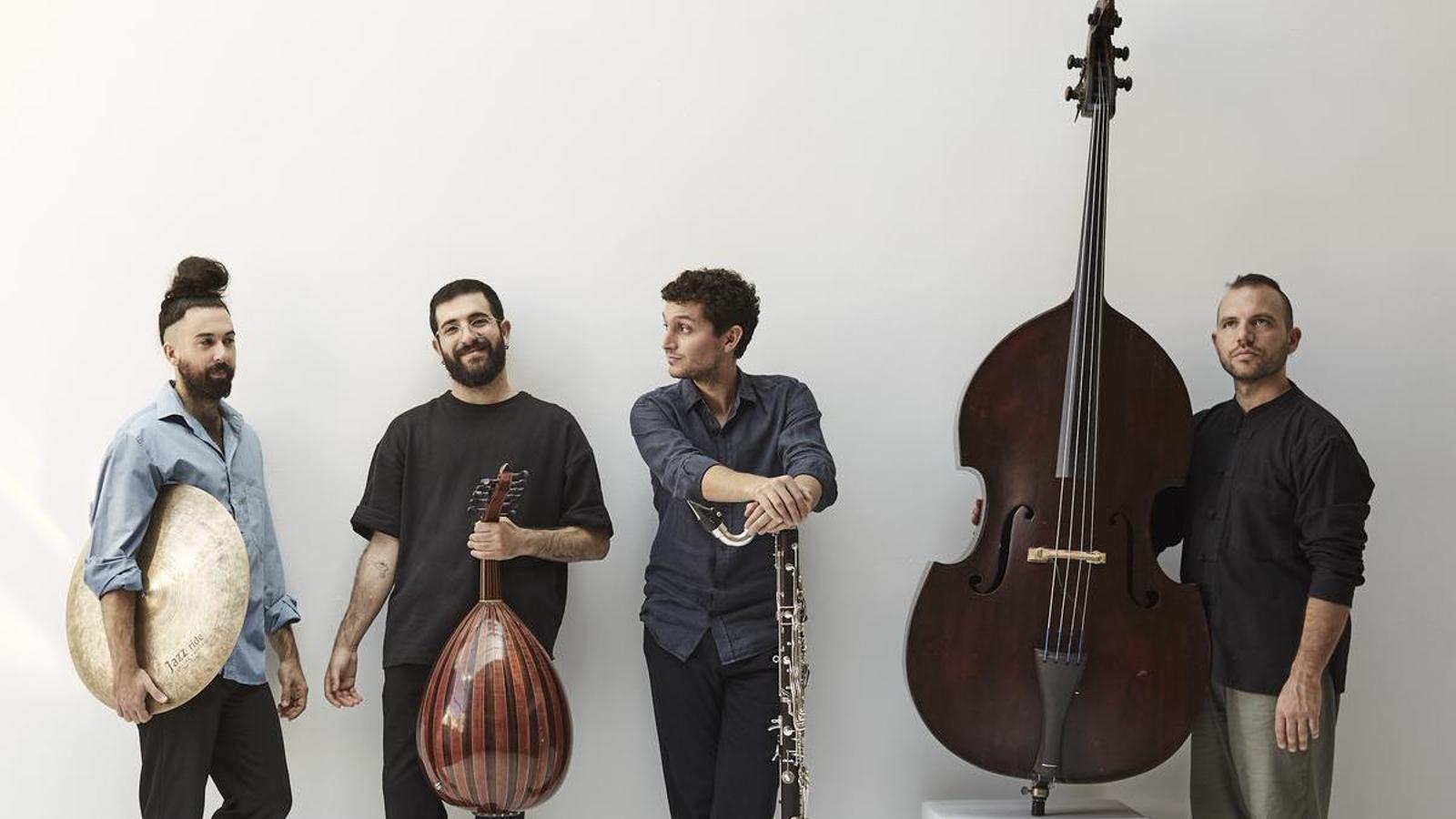
GironaA Catalan clarinettist and a Syrian oud player creating music together. This is the story of Oriol Marès and Talal Fayad, two young musicians who blur the lines between genres and cultures, moving between influences from jazz improvisation, Latin rhythms, and Middle Eastern resonances. With their quartet, in 2025 they released their first album, Estuarium, and are already working on their second, titled Uncivilized, which they will present in October at the Fira Mediterrània in Manresa, after touring China and South Korea.
"Our musical project brings together very different perspectives. All this funnel of information, influences, and identities is channeled and transformed into our own compositions that give us a lot of freedom. We don't fit into any specific genre, and we defend precisely that," explains Oriol Marès. The name of the first album, Estuarium,
in fact, is a very precise metaphor for this spirit: "An estuary is the meeting point between the river and the sea, between fresh water and salt water, and it is an extremely rich ecosystem. The four members of the quartet come from different worlds, and the Mediterranean is, in a way, our common ground," the clarinettist continues.
The seed of Annexa from Girona
Oriol Marès was born in 1998 in Barcelona, but he soon moved to Girona, where he grew up and spent his entire adolescence deeply rooted in the city. Currently, he resides in Rotterdam, in the south of Holland, from where he carries out a large part of his artistic activity, but always keeping a foot and a connection with Catalonia. From his childhood in Girona, he has a very special memory of his time at Escola Annexa, in the Vista Alegre neighborhood. The school, in the early 2000s, promoted a very innovative educational model that, more or less explicitly, has nourished the seed of his current musical project. "They didn't teach us the capitals of countries, but they did teach us to make concept maps. We learned to connect ideas, we constantly asked ourselves the reason for things. There were assemblies, discussions, and a very open way of learning. Seen in perspective, I think we were very lucky," he recalls. In this sense, it is no coincidence that, from his graduating class, artists, doctors, university professors, and European advisors in Brussels have emerged.
Parallel to his primary and secondary studies, Marès trained in music, attending Aula Musical, Claudefaula, and the Girona Conservatory, but following an unconventional path, combining, from adolescence, classical training with jazz.
Rotterdam University where all arts coexist
At the time of making the university step, he entered ESMUC in Barcelona, but his way of understanding and living music did not quite fit in with formal training. Until the doors of the Codarts school in Rotterdam opened for him. "There I found a university where jazz, classical music, world music, Latin music and performing arts coexist. This gave me all the oxygen I was missing. The question they asked me during the entrance exams seemed precious to me: 'What interests you about music?'. A question like those in Annexa. They wanted to know why I wanted to study music and what they could offer me that would fit with me', he recounts.
For Marès, the years of training at Codarts were truly stimulating: "I was fascinated to discover instruments I had never seen before. I didn't even know what they were called, or if they were played by blowing or rubbing the strings. And, on the other hand, there were classmates studying them at a higher level. This horizontality, this idea that there is no hierarchy between a violin, a flute, a bouzoukior a oud, deeply impacted me".
Reciprocal exchange between maqam and jazz
It was at this university that he met Talal Fayad, a student of the Arabic lute named ud. The two met at a festival in Utrecht in 2022 that specifically aimed to bring together musicians from very different traditions. The objective was for them to develop a joint project with absolute creative freedom, they clicked immediately and started getting a lot of concerts. This is how the musician from Girona recalls it: "We started by making some arrangements and discovering how the other person thought about music, out of curiosity and artistic admiration. It wasn't just about putting styles together, but about understanding their languages. Talal thinks within the maqam modal system of Arabic and Turkish music, with microtones and irregular meters. What was strange to me was completely natural to him." And vice versa, as Marès brought him aspects related to jazz harmony, Western chords, or syncopated rhythms.
Musicians and uncivilized cultures
For the first album, they gathered a quartet with a double bassist and a drummer from the same university. They conceived it at La Marfà in Girona in 2024 after obtaining an international residency scholarship. They have prepared the second in Corsica, also in an artistic residency, and continue to explore the same foundational traits of the group: "We wanted to force our own discourse and push this fusion to the limit. When we were looking for a title, this concept of "uncivilized" appeared. It is related to the way certain cultures are often spoken about from the West, especially in the context of conflicts such as those in Ukraine, Palestine, or Yemen. There is a certain double standard. But it is also an artistic reflection, as we are a bit tired of being asked about how we should fit in," argues Marès.
In this latest work, the quartet has collaborated with the Brazilian filmmaker Flávia Moraes, who discovered Estuarium" in a performance in Girona and was fascinated. "We have recorded interviews with people of different ages and backgrounds in Girona, asking them what it means to be uncivilized. The idea is that the album tour will have both a purely musical version and a stage version, which will incorporate all these perspectives and voices within the show," concludes Oriol Marès.

