The students who build the courtyard's shadow with their hands
The Vallvera Institute of Salt transforms the outdoor space by the hand of the Orígens school with a large pergola made by the students with natural materials

-
CAT -
CAST
JumpSalt is known today for being the municipality with the lowest per capita income in Catalonia. Also one of the towns with the highest concentration of migrant population: nearly 40% of its residents are of foreign nationality. But what headlines have overlooked in recent years is that almost half of this town's surface area is still orchards and pastures. The Monar canal, parallel to the Ter river, marks the border between built-up Salt and the agricultural zone. Few facilities surpass it, except for a large high school built on fertile land. Located on the border with Girona, surrounded by greenery and with magnificent views of the Mare de Déu del Mont, lies Vallvera. A secondary and vocational training center with over 1,200 students inaugurated in 2008, it contrasts with its surroundings as a large gray sheet metal building with a concrete-filled courtyard. "In winter it's a refrigerator and in summer an oven, there's no middle ground!" laments the director, Ferran Maimir, who started this course with a direction very focused on working towards the renaturalization of the courtyard, but with a different method: having the students themselves build the shade with their hands.
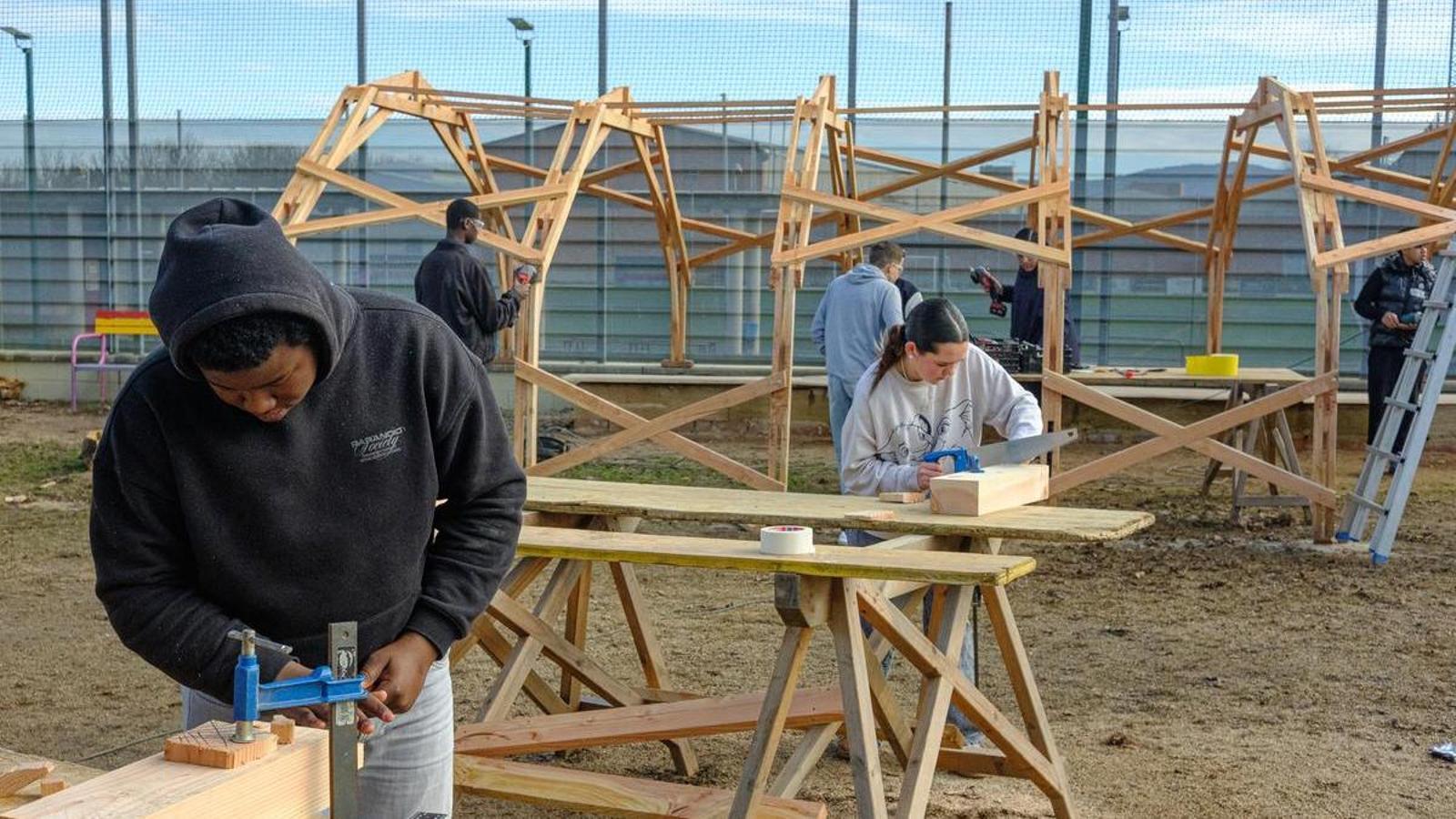
Since this winter, students have a new bench to rest on. It's not like the others: it's made with rammed earth, an ancient construction technique using raw earth. And on top of it stands a large pergola of wooden joinery covered with reed panels. It's the result of a collaborative project woven with Orígens, a bioconstruction workshop school, which throughout a whole term has driven a tailor-made training in response to the center's concerns. "This idea stems from the collection of student opinions –explains Isabel Mora, science teacher and quality coordinator at Institut Vallvera–. There were different complaints, contributions, where the courtyard had a great need for shaded areas and spaces to sit and be more relaxed during break time."

A hundred students have participated in the project, from kneading earth for the bench to sewing the reeds they have collected in the orchards, as well as making the wooden joinery for the structure. “I think this opportunity opens many doors for us students –reflects Oumaima, a student who has built the pergola–. We have to be free to decide on our center. Our institute is like a second home because we spend six hours a day here and it is very important that our voice is heard”. Sheila Cobos, a trainer at the Orígens school, highlights the fact that the students have been able to participate in “making the courtyard their own” and also “using the natural resources we have in the environment”. The reeds were collected by the students themselves in Pla dels Socs, in the orchards, and they were cleaned, cut, and woven one by one as a team to make the panels.
Inclusion and sense of belonging
The pergola, made of wood, has become a perfect metaphor for the process of team construction. As Joan Pascual, from the Orígens workshop school, explains, the fact of being a “structure with many small elements, but fitted together, has allowed for some tolerance in the margins of error when making cuts, because in the end all the pieces together act as a whole and that is what has made it possible to create a large piece with students who were handling natural tools for the first time.” The fact of encountering the reality of the workshop and the real pieces is what Hidaya, a student in the crafts subject for 4th year of ESO, liked the most. “I thought we would do technology –she explains while building the reed panel roof–. But here we build things with our hands without computers or notes, helping each other and collaborating among ourselves.”
The reality in the classrooms of Institut Vallvera is very diverse. They were the first center in the demarcation of Girona to have the basic vocational training cycle, which is done in what would be 3rd and 4th year of ESO and should allow them to obtain their degree. Like the rest of the primary and secondary schools in Salt, it is classified by the Generalitat as having maximum complexity. In practical terms, this translates into the fact that, while nine out of ten students from Girona obtain their ESO, at Vallvera this only happens in 60% of cases. Difficulties at home are very often added. Tired of experiencing student evictions every week, the educational community of the institute is part of the platform Teachers for the Right to Decent Housing, which denounces the educational drama of minors who lose their homes. “Many of the students are better off here than at home –explains Joan Collet, technology teacher, while thinking about all the other projects that can complement this one–. But they are not very academic. They would spend all day here building, they have loved it”.

After the workshop hour, Maria would now have tutoring. Juan asks her if she prefers to stay, and she confidently nods. She determinedly grabs the steering wheel and starts peeling canes: "I like to work," she says. "Not all of us are suited for the same thing," reflects Sheila Cobos, who actually studied a higher vocational training in Vallvera and considers the project to be super powerful as a social action within the institute. Diverse students from all ESO courses have participated in the process: from students with disorders who have the intensive support of inclusive education to those who take the optional course in gardening and horticulture, as well as students in trades, environmental delegates, and students in the basic vocational training cycle. "This is inclusion, it is inclusion, and it is participation – adds Conxa Planas, SIEI tutor, proudly. It's that we are all capable of seeing capabilities.
A meeting space
The first heatwaves arrive, and the bench has already become a new meeting space. “It has been very well received and no one has damaged them,” explains Maimir. The management is so happy with the project, which they have been able to finance thanks to a European project, that they are already thinking about the next academic year. Beyond the pergola, two benches next to the basketball and football court have also been covered. “Now we have to finish building porches for all the benches,” adds the director of Vallvera. In the meantime, they are already thinking about how to use the pergola as a space for tutoring as well, to get out of the classrooms. And also other actions to re-naturalize the patio with the help of the Orígenes school. This winter, the garden has also been planted, and technology students have repaired a fleet of twenty bicycles that the center has for outings. “The Vallvera Institute is part of the network of green schools, a program of the Department of Education that aims to encourage, help, and collaborate so that educational centers undertake actions to face the challenge of sustainability,” says Marta Guillaumes, professor of biology and geology and member of the Escola Verda commission.
The objective is to gradually re-green the large block of concrete and sheet metal of the Salt orchards, while the students make the patio their own, football is not prioritized as much, and new student talents are also discovered. To the diversity and complexity of the centers, the problem of heat in classrooms and patios due to the effects of climate change has been added in recent years, leading to extreme situations. Last June, different educational centers in Girona reached 30 degrees and some teachers opted to hold classes in the patio. But not everywhere there are porches or enough shade from trees. "It's very hot in summer," lament Maria and Hidaya in unison. Diago, while playing ball with his classmates, looks towards the bench and assures: "Surely we will be fine here, we will come to rest; we feel it is ours".
