The Molla family, seven centuries producing country wine, peaches and cherries in Calonge
The traditional polyculture method is threatened and instead it is very beneficial for its environment
-
CAT -
CAST
CalongeIf people worked with half the enthusiasm and energy of Montserrat Molla, we could achieve whatever we set our minds to. The most curious thing is that I discovered the extraordinary work of this farming family from Calonge in Bilbao. I was visiting a highly recommended wine bar, Taska Beltz, and a very lively young man offered me a Catalan wine: "We only have it here and at El Celler de Can Roca," he said. I thought he was pulling my leg. But no. A few days later, I had the good fortune to meet Josep Roca. And he confirmed that at El Celler they have the wine from Mas Molla. His eyes lit up and he told me: "You have to go there! They are real farmers!" And now it is I who tell you: go to Mas Molla to buy wine and fruit. And if not, you will also find them at the Sant Antoni Market and the one in Palamós. They are surely the Catalan family that has been working the same land in the same place for the longest time, from 1338 until now, almost 7 centuries.

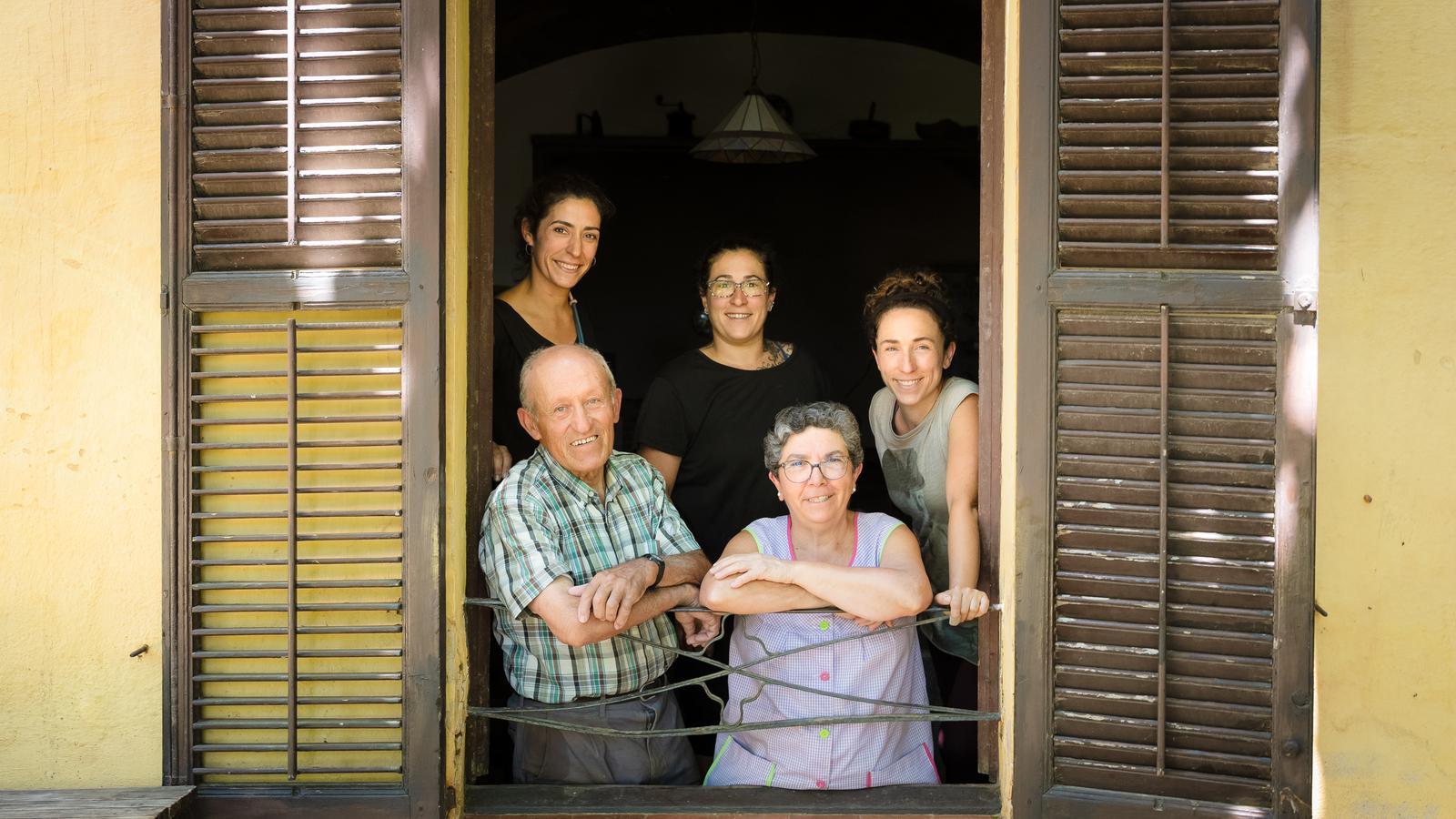
When I arrive, I see a piece of paper on the farmhouse door with a phone number to call them if they are in the fields, a price list on a blackboard, and a sign reminding us that they only accept cash. “There are times when we put that we are napping,” says Montserrat. Of course, you are at her home. In fact, when I arrive, Montserrat is picking cherries. Her sister alerts her with a loud whistle. She appears, shortly after, with contagious enthusiasm. I go into the kitchen and she offers me a glass of water. What a beautiful kitchen. The round table in front of the farmhouse is a bucolic scene, surrounded by trees. There, some Dutch tourists are tasting wines. Next to them, a lush white mulberry tree already has fruit. “Try one!”, Montse tells me. And she takes me to see her lands. They – I say they because the three Molla sisters, Montse, Núria, and Neus, run it – are dedicated to polyculture. Their parents, Lluís and Maria, are around because there are always things to do on a farmhouse. They have 14 hectares of vineyards and 4 of fruit trees. Their family – who are remença peasants – has been doing this work since 1338. Probably before, but it's the first document they have. Montserrat talks about the War of the Remences in the 15th century and the sentence that says that once the peasant gains freedom from the feudal lord, he is free to sell his products directly. “We execute a right from the Middle Ages – she says –. And we are fighting for it. When you buy from us, you are not buying wine, oil, or jam. You are buying resistance, landscape, and ethnographic heritage. If there are farmers, you are taking them with you”. And may words like veïmar, which is what she calls harvesting, survive.
When we are in the vineyard, Montse explains that tourists come here “looking for La Rioja”, the idea of large extensions of vineyards, or Lleida, fields and fields of fruit trees. But no. This landscape is different. There are olive trees, almond trees, cherry trees, peach trees, pear trees, and apricot trees. Margins full of flowers. Biodiversity. “What was normal before the arrival of agribusiness, supermarkets, and distributors,” she says. They are a small island of artisanal agriculture, which supplies its surroundings. And which, moreover, improves it. “People come here to walk, we are the Central Park of Calonge!”, she says. This small farmer is besieged by bureaucracy and European regulations, she says. She gives examples that verge on the paroxysm.
How the grandparents did it
“Small farmers are not foreseen. But we are here and we are necessary. And they are erasing us from the map. If you said that the other system is good for farmers... But they are blocking the roads because they are paid misery,” he says, and finishes like this: “Let us live as my grandparents did”.
The wines they make are not within any designation of origin. In Calonge alone there are 56 grape varieties, 15 of which are unique. “It’s like having a Jurassic Park with live dinosaurs.” Now she wonders what she will plant for her grandchildren. “I live off what my grandparents and parents did,” she explains. She vinifies by vineyard. Each one in a barrel. With chalk she notes how many bottles each person will keep. The barrels are full of family surnames that have already bought in advance. Then she bottles, but she doesn't put a label. “The label is me. You deal with the person and see what they like.” The wines change a lot from year to year and she makes about 50,000 bottles on average. They have a section of dusty bottles, those that are aged. The nickname is self-explanatory. “The more dust, the better,” says Montserrat. I taste her wines and I had never drunk anything like it. She speaks of “the marvelous imperfection,” and I think it is a perfect description. “Now they call it natural, minimal intervention..., for me it is country wine.”
In all these years the farmhouse has undergone only two changes. The arrival of electricity and the arrival of the internet. I would add a third: the arrival of tourism. Visiting the farmhouse is very worthwhile and can be booked online. It allows you to understand many things. Montserrat is surprised to see people asking for cherries in January. “Ignorance makes us worse consumers. We have the false sensation that we know more things than before, and it is not true. There are people who look at their mobile phone instead of the sky to see if it will rain.”
