Esther Guerrero: "I am breaking taboos about the pregnancy of an Olympic athlete"
Olympic athlete
-
CAT -
CAST
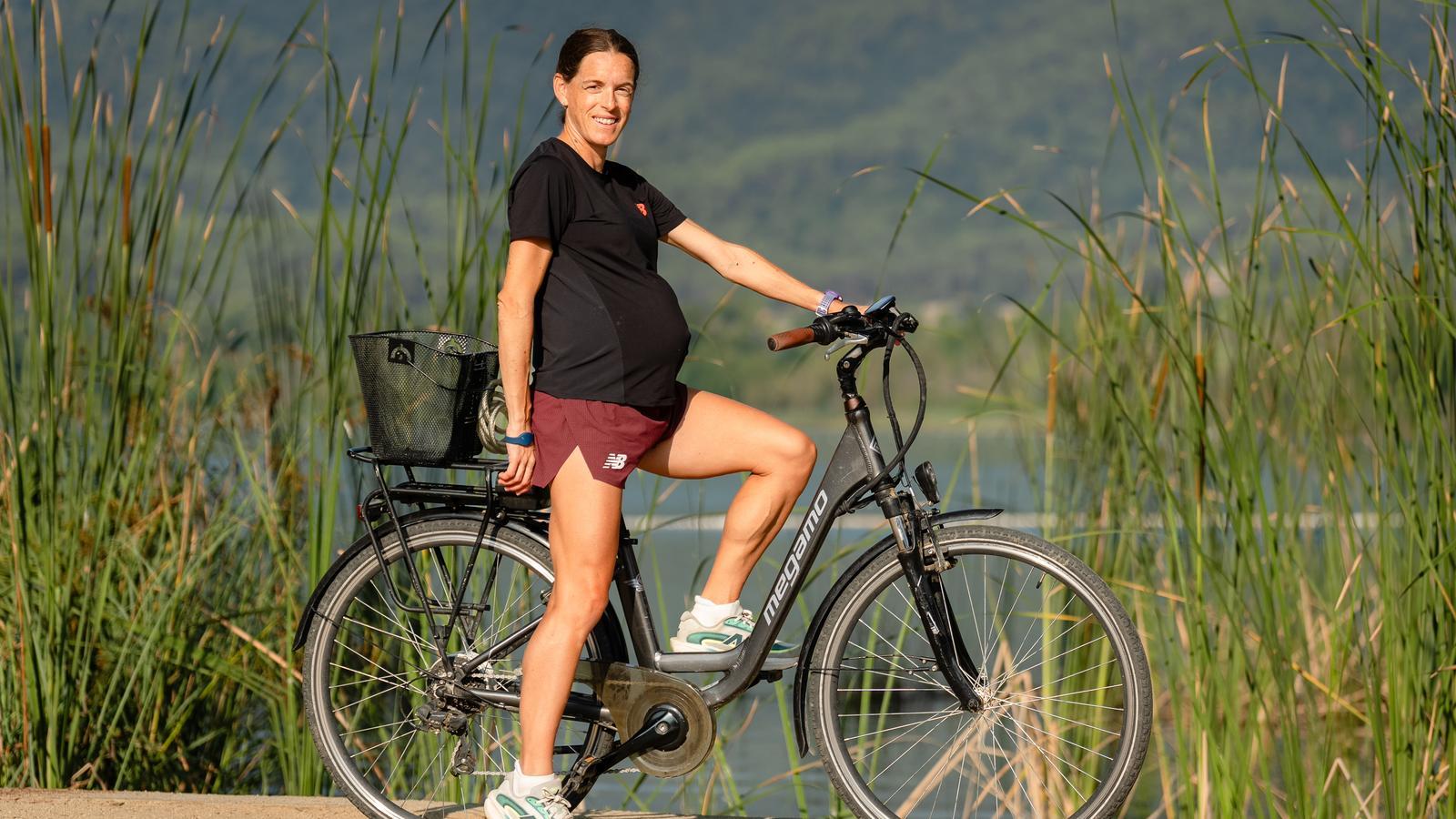
BanyolesAt first glance, it could seem like the exterior of a school in the Netherlands or Denmark. On both sides of the street, dozens of bicycles are accumulated. There are also some tied to fences and traffic signs around. It's nine in the morning and the large parking lot has been filling up as children arrived at the summer camp. But we are not in Northern Europe. We are at the Banyoles lake. And this large bicycle parking lot belongs to one of the city's institutions: the Banyoles Swimming Club. Esther Guerrero (Banyoles, 1990) has also arrived by bike. It's the end of July, she is 33 weeks pregnant – at the time of the interview, she is now 37 – and she has come from the Can Puig neighborhood. “The Club is like my home; it's where I grew up, where I trained, and where I've spent my daily life for many years. Without exaggeration, twenty-five years,” she explains.
The Swimming Club is much more than the place where she trains: it's the space from which she has built a career that has taken her to three Olympic Games and to become one of the best Spanish middle-distance runners of her generation. Spanish champion in 800 and 1,500 meters on several occasions, Ibero-American champion, and European cross-country medalist, Guerrero has also been a finalist in major international championships and has competed at the highest level well into her thirties, a path similar to that of her sister, Marina Guerrero, four years younger. Esther Guerrero started training at the Club, has worked there as a coach, and now serves as coordinator. Most of her training sessions still have the Banyoles landscape as a backdrop. She runs around the lake, and when the track season arrives, she travels to Olot. “It's an environment with a lot of nature, tranquility, and where I feel very comfortable”.
The bicycle is part of this same landscape, but Guerrero has not incorporated it as a usual tool for her training. It is basically her means of transport, because if there is one thing Banyoles has, it is that cycling does not require explanation. She also goes there in winter and when it rains, because it is "more practical", "easier" and "simpler". After twenty-five years of coming and going from the Club, she has seen how this cycling culture has been maintained and even grown with new infrastructures and the rise of cycling and triathlon. But she remembers that it was already there when she was little. Now it is common to see groups of children who meet and come alone to the Club. "It's part of everyday life".
She explains it almost as a physical characteristic of the city. Small, flat and with little parking, Banyoles is designed to get around by pedaling. So much so that the car can become the most complicated option. "In Banyoles, everything is more difficult by car," she says. She grew up going to school alone by bicycle and then getting around with friends. She never had a motorbike. The bicycle allowed her to live her life without having to depend on anyone.

Motherhood
However, the conversation eventually leads us to another type of movement. At 36 years old, after a decade competing at the highest level and with three Olympic participations, Guerrero has decided to become a mother without ending her sports career. For a long time, she explains, she herself had taken for granted that one thing excluded the other. "I had always believed that I would be a mother once I had retired. I didn't see it compatible with my sports career." But the years have gone by and her performance has only grown. "I feel I can still keep running, but I feel that, if not, time is passing."
Now, at 33 weeks pregnant, she doesn't know exactly what will happen after childbirth or how her body will respond. And it is precisely this uncertainty that makes the return a challenge. She has continued training for seven months, adapting each stage to her body's changes and with the support of a sports medical team. "There are no basic standards of what can happen and what cannot happen," she explains. She doesn't know if she can return to her previous level, but she wants to find out. "It's like a personal challenge to say: let's see what you'll be capable of doing afterwards, because I've already investigated everything that came before. It's the new frontier."
She is not the only one who has decided to try to open this path. Guerrero cites Ana Peleteiro and Marta Galimany as role models for a generation that has begun to make visible a possibility that until very recently seemed almost incompatible with elite sport. "I am breaking taboos about an athlete's pregnancy. The challenge is the 2028 Olympics."
- Your first bike memory? I couldn't say, because the bicycle has always been there. Maybe going to school in Can Puig, my neighborhood, already at eight years old. Always by bike.
- Cycling is... More than a hobby, it's my means of transport. I always come to train at the Club Natació Banyoles by bike.
- And during adolescence? We never had a motorcycle, we also went everywhere by bike and had autonomy.
- What makes Banyoles different? Cycling goes hand in hand with the city's sporting culture, and one explains the other.

