The Girona expedition that made history on the third highest peak in the world
40 years ago, Pep Permanyer became the first person in the State to summit Kangchenjunga, at 8,586 meters, in the Himalayas, accompanied by a team of mountaineers from Girona
-
CAT -
CAST
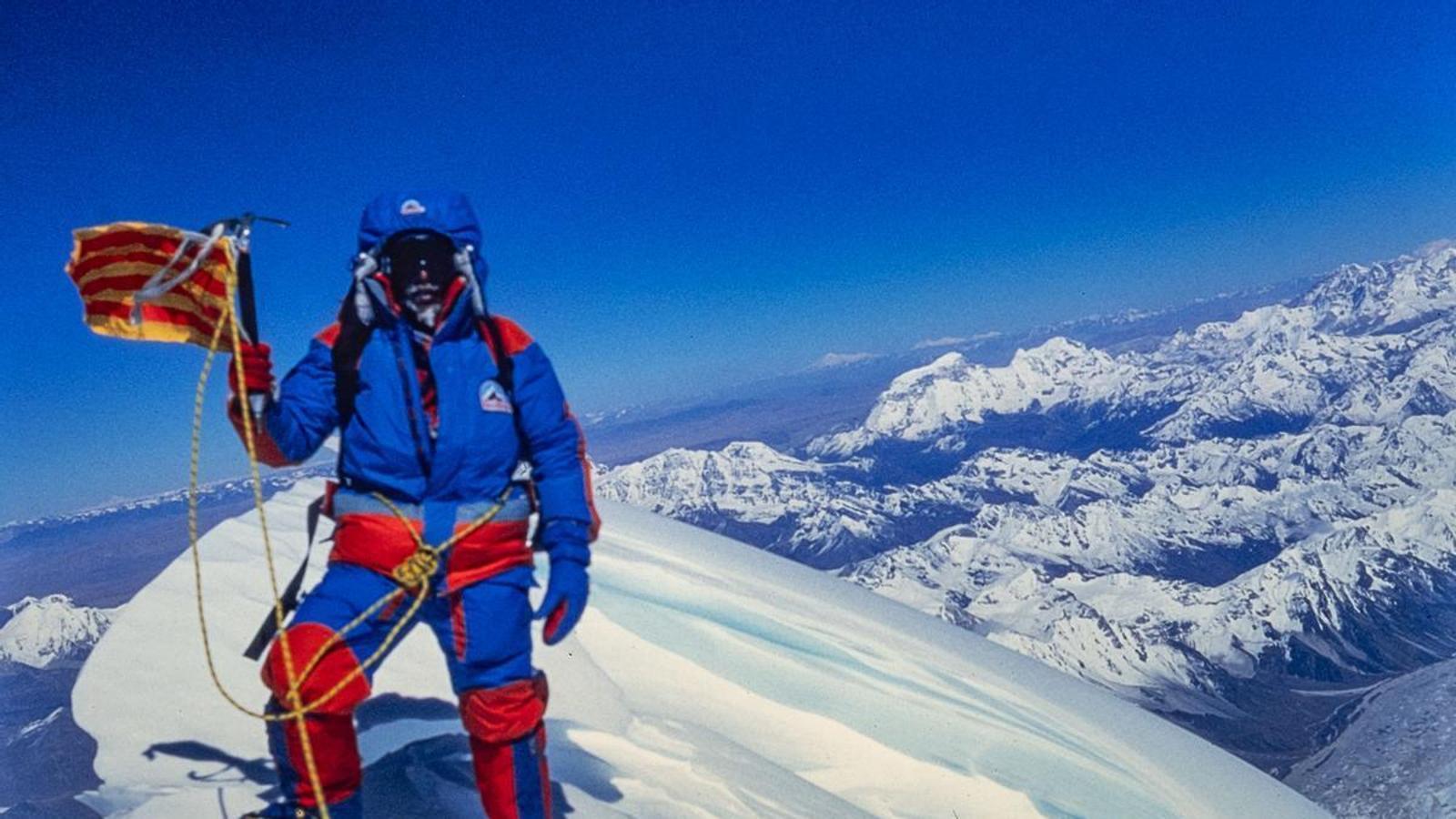
GironaOn October 24, 1986, Catalan mountaineer Pep Permanyer, born in Sant Hilari Sacalm, completed the ascent to the summit of Kanchenjunga in the Himalayas, the third highest mountain in the world, after Everest and K2, with an altitude of 8,586 meters. Permanyer became the first Catalan (and from all of the Spanish State) mountaineer to crown it. He was also the first person from Girona to conquer a summit of over 8,000 meters. The mountaineer was part of a pioneering expedition of 9 members, which left from Girona and lasted approximately three and a half months.
“Upon reaching the summit and communicating with my companions at base camp, I felt a moment of great joy and satisfaction. But immediately I was only thinking about going down; being at over 8,000 meters is not very comfortable, and mountains are climbed the moment you arrive at the bottom; if not, it is of no use,” recounts Permanyer, who climbed without oxygen support. And he adds: “At this altitude, if you are not very well acclimatized and your physique does not accompany you, you do not make it up. There is a lot of oxygen deficit and, starting from 8,000 meters, every 100 meters is paid for very dearly.” In mountaineering terminology, it is called the death zone, where every minute counts.
Joan Hugas, Kim Bover, Jordi Bosch, Salvador Coll, Joan Cardona, Santi Carrillo, Francesc Cases, Ramon Estiu, and Jordi Terrades completed the expedition. They spent almost two years preparing it. In the 80s, without internet or international telephony, detailed maps or accessible information about the orography could not be found in Catalonia. They spent months processing permits and paperwork with the governments of Nepal. “We even had to drive to Austria in two days to buy mountain boots because there weren't any that good here,” recalls Ramon Estiu.
The protagonists themselves financed a good part of the trip out of their own pockets, but they also counted on private sponsorship from the Girona supermarket company Valvi and the economic support of town councils and the Provincial Council of Girona, which in the coming months will publish a book commemorating the anniversary.

Third time's a charm
Once arrived in Nepal, the route was not easy. Reaching the last base camp was an odyssey in itself, as Kangchenjunga is a very isolated peak, with no logistical infrastructure, far from civilization, with very steep passages that require fixed ropes. And, since the whole trip was delayed by bureaucratic difficulties, in October the weather conditions were almost wintry. Once established at the final base camp, the first attempt to summit was thwarted. The team had to turn back due to the onset of frostbite on Ramon Estiu's hand. This is how the protagonist recalls it: “My glasses fogged up, my crampon came off, and when I wanted to strap it on again, my fingers froze. We had to turn back because I could have lost my hand and something more.” Four days later, they attempted the second push successfully. Always accompanied by the renowned Sherpa Ang Rita, who acted as their guide and had already climbed Everest ten times without oxygen.
Despite the setbacks, however, the mountaineers acknowledge that they did not experience any moment of fear, but they did feel respect: “No matter how careful you are, there can be an unforeseen event that catches you. The objective dangers of avalanches or crevasses are there, but you always try to minimize them. We didn't do anything to put ourselves at risk and we were prudent at all times,” explains Permanyer.

“We weren't going to win anything”
The members of the expedition were very, very well prepared, but none were professional mountaineers. Everyone had their jobs and, as mountain enthusiasts, they wanted to follow in the footsteps of the Barcelona alpinists who had just summited Everest. For them, it was not a competition: “The physical act of climbing the mountain with my companions gave me a sense of fulfillment. I felt very complete,” says Estiu. And Permanyer continues: “It was a motivation for personal improvement, to do something big, we weren't going to win.” Nothing to do with the competitiveness of some current professionals or with the theme park that the Everest base camp has become: “It is horrible, it is hard to look at, everything has been commercialized, you pay and they take you wherever you want,” concludes Estiu.
In 40 years, the world of mountaineering has changed a great deal. They brought good equipment, a doctor, and a cook, but the main difference is communication. Now, with a satellite phone, one can be in contact every day, but back then, for more than 3 months, they could barely communicate with friends and family in Girona. This caused a growing sense of anticipation in the city for their return: “We contacted a radio station in Sri Lanka once that connected with Llavaneres and passed on some information, but we knew almost nothing. The welcome was a surprise,” explains Permanyer.
The city waited for them with bated breath, as if they were football players winning a title, and the mayor Quim Nadal received them at City Hall. The media buzz also provided a boost for mountaineering in the Girona regions, as the same core group of protagonists undertook a new journey to Makalu, at 8,485 meters, in 1991. And, months after the Kanchenjunga expedition, the Ribelles camps, in Alta Garrotxa, were born for teenagers eager to enjoy adventure sports, which in 2026 have also celebrated four decades of history.
