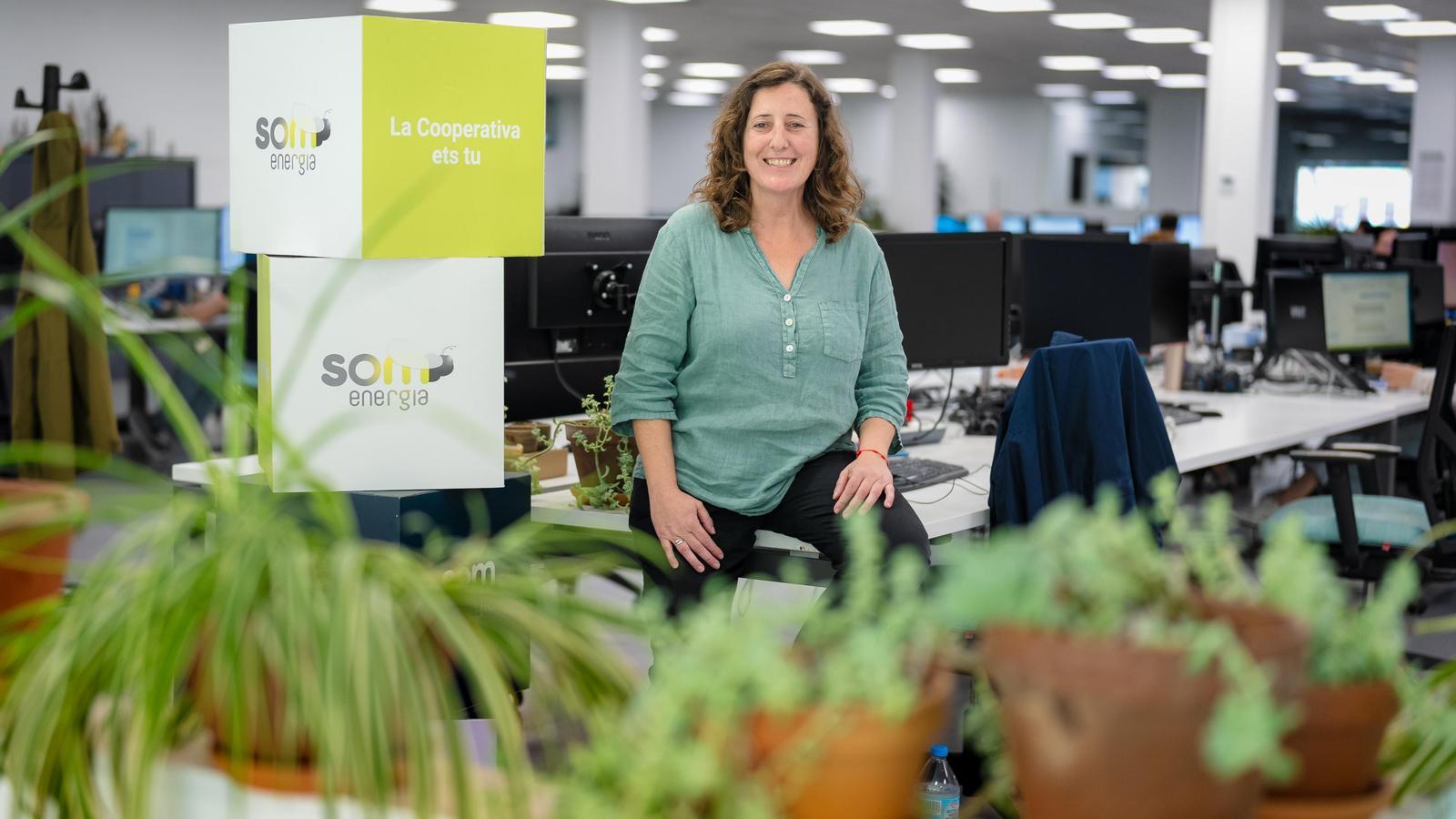
Marta Doncel: "From Som Energia we have a structure to grow twice as much"
General coordinator of Som Energia
-
CAT -
CAST
GironaThe largest energy cooperative in Europe is based in Girona. What began in 2010 as a project linked to the UdG seeking to break the oligopoly of the big electricity companies has managed to become a recognized player in the Catalan energy landscape and also in the State as a whole, with 87,000 members.
The 15th anniversary, celebrated at the end of 2025, has marked a turning point for the cooperative. On the one hand, the offices of the UdG's Science and Technology Park have been moved to a new headquarters in the Devesa neighborhood of Girona, right in the city center. On the other hand, a strategic plan has been launched to double electricity supply contracts in three years.
We interview Marta Doncel (Manresa, 1981), general co-coordinator of Som Energia, on the eve of the Lluumm Festival celebration on May 30th in Plaça Miquel de Palol in Girona, a way to introduce themselves to the neighborhood with a fraternal meal and music. A biologist by training, she began working in the early days of the cooperative as a volunteer, promoting local groups, an essential part of an electricity company that only bets on renewables and has grown thanks to word-of-mouth.
How does one go from being born at the UdG to being the largest energy cooperative in Europe?
— First, with perseverance. With the will to transform the energy model. But, above all, thanks to the people who bet on it from the start. I contributed 100 euros to a bank account when I didn't even know what it was. But it caught my attention that they wanted to promote renewables at a time when no one was doing it, and that it was done through cooperativism. Since then, what has worked for us has been mainly word-of-mouth. People who want to contract electricity, install solar panels, participate in collective self-consumption, create an energy community... And the snowball effect is growing and it's coming from Girona and also from Catalonia.
During this process, has there been a fear of growth?
— There have certainly been moments of fear. I was the fourth person to join the technical team and now there are 132 of us. It's a lot of responsibility. There have been moments of tension, like during the Process, when many people decided to join Som Energia. But beyond fear, there has been the courage to continue with the purpose that made us born, to have another type of energy model in the hands of the citizens. And that's what has brought us here. Now we have a structure ready to grow twice as much. Our goal is to reach 200,000 electricity contracts by 2030. We currently have 119,000.
Own production now accounts for 10%. Is there an intention to grow significantly in this regard as well?
— We want to continue growing, but the fact is that implementing renewable projects is very difficult on a bureaucratic scale. Right now we have bet heavily on photovoltaics, but one of the challenges we have had for years is to diversify our production. We have a hydroelectric power plant in Valladolid, but we want to have more, such as wind power. If we manage to get some wind power project, even if it's two turbines, this could mean a leap in scale. The forecast is 40% by 2030.
Could these windmills be on the Costa Brava?
— Since at Som Energia we do not have a position either for or against, at the moment we do not have renewable energy projects in the province of Girona. I perfectly understand that we are not used to, when we look out the window, next to the Medes seeing a windmill, but right now, where does the electricity we use come from? All fossil fuel, nuclear, and thermal energy projects are in Tarragona. Should we continue like this? It makes no sense. The most important thing for Som Energia is that renewable energy is as close as possible to where consumption is.
Hence the push for energy communities and urban generation projects, right?
— How does Som Energia differ from a multinational in terms of internal organization?

What differentiates Som Energia from a multinational in terms of internal organization?
— As a cooperative, the highest body is the members, who have a say and a vote in the general assembly. The assembly delegates management to nine people, who form the governing council and are volunteers. Therefore, at Som Energia there are no dividends: all profits are reinvested in projects for the energy transition. And finally, the governing council delegates the day-to-day to the technical team, made up of two general coordinators, who do not make decisions directly. We are a horizontal team.
Why is the electricity bill so complex to understand, as well as the functioning of the market?
— It is the fruit of economic interests. The world of energy moves millions of euros and historically it has been associated with monopolistic companies. At an institutional level, they have been promoted and revolving doors have benefited from them and continue to benefit from them. I believe there is no interest in energy truly being a transparent sector where people can contribute. It is being achieved through energy communities, and it had to be a regulation that came from Europe for it to be imposed, because from here it was not being promoted.
Are there many obstacles?
— Yes, constantly. But over the years we have managed to be an actor that is beginning to be heard, by participating every month in the sectoral meetings of the National Commission of Markets and Competition (CNMC).
Where they have indeed become a benchmark is in the world of Catalan cooperativism. Does it have a lot of strength?
— I think it is very strong, very strong indeed. For me the challenge is that we are better known and that everyone, beyond word of mouth, can achieve that in their daily lives their consumption comes from cooperativism, from energy to telecommunications and mobility, through banking and insurance, and even food.
