Quima Casas: "I am 74 years old and have run 166 marathons; I am not one to stay at home"
Runner

-
CAT -
CAST
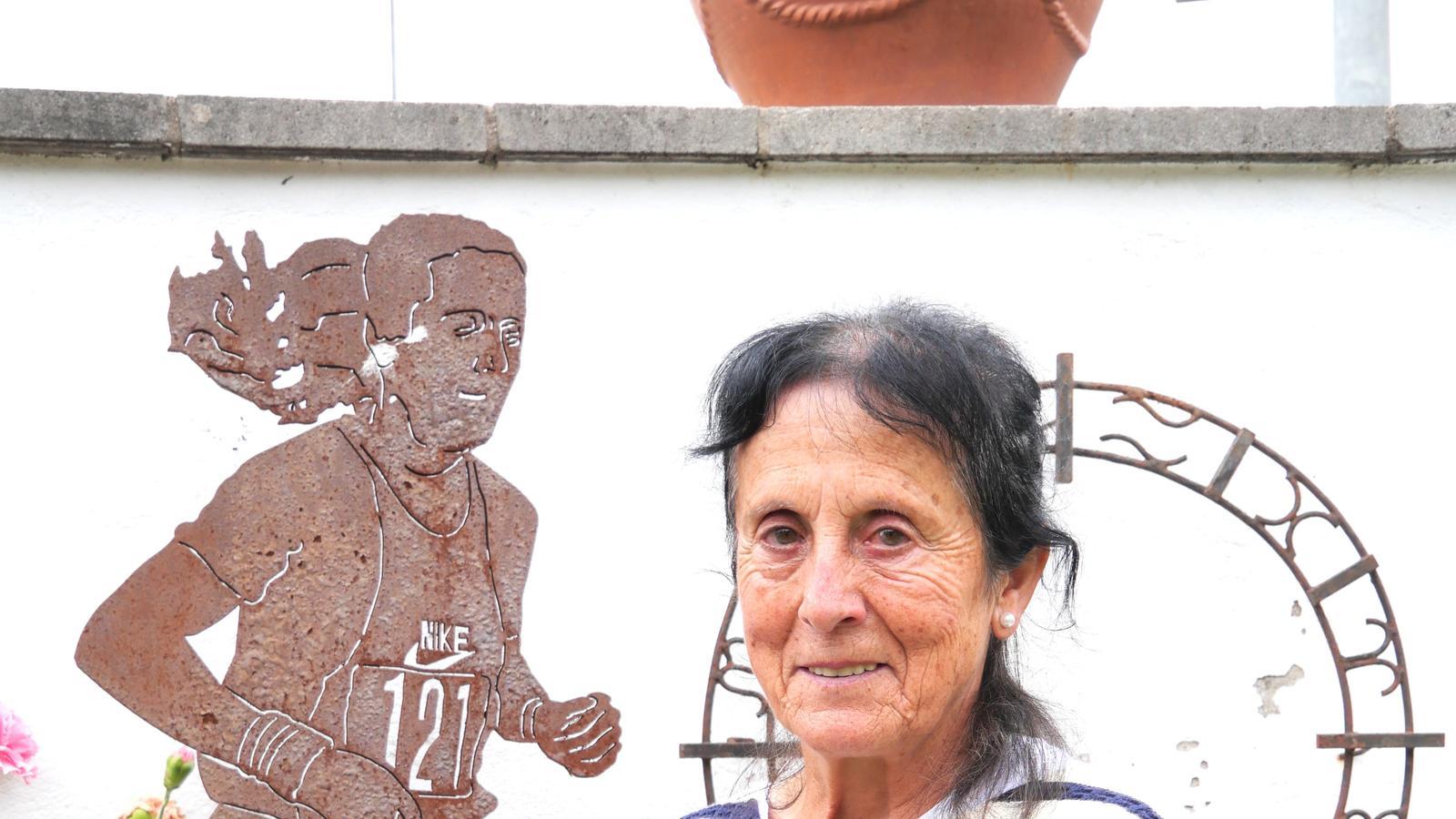
Sant Feliu de Pallerols (Garrotxa)One month before turning 75, and with 166 marathons on her strong legs, Quima Casas (Sant Martí Sacalm, 1951) continues running because she doesn't know how to “stay home sitting on the sofa watching television”. She has finished three marathons this year, although she no longer looks at the stopwatch, but rather follows her impulses trotting through the lush landscapes of Sant Feliu de Pallerols (Garrotxa), the town from which she has built one of the most unique careers in Catalan athletics.
She started running almost by chance. At 28, she had gained weight after getting married and having a child, and decided to start climbing to La Salut to get in shape. Without coaches, without technique, and without knowing what distance she should run, she signed up for the first marathon held in Catalonia, in the late seventies. “I ran in jeans and espadrilles,” she still remembers, laughing. That day there were only 33 women registered and she had never run more than 15 kilometers straight. At twenty kilometers, she ended up exhausted, with her feet blistered, lying on the road. “I was dying,” she admits, but she continued and finished third of the three women who completed the race. A month later, the suffering forgotten, at the Madrid marathon she improved her time by 45 minutes. She had just launched an extraordinary sports career.
"The stopwatch is my boss"
Since then she has run practically everything: from the mile to 100 kilometers. She has completed five 100-kilometer races, has gone under three hours in the marathon more than fifty times, and holds a personal best of 2 hours and 43 minutes. In 2026 she has already run three marathons, the last one in Barcelona, where she finished with a time of 5 hours and 18 minutes. “Now I don’t go for records anymore”, she admits. In fact, she doesn’t even wear a watch. “The stopwatch is my boss”. She has only withdrawn once in her entire sporting career, in Benidorm, due to sciatica. “I am too stubborn. I shouldn’t have gone”, she acknowledges. It is an exception in a career marked by physical, but above all mental, endurance.
In her home, the shine of the cups lining the walls dazzles you: about 4,000 cups, trophies, and plaques, as well as boxes full of medals. She has run for clubs such as GEiEG, Farners, Vic, or Terra de Volcans, although she currently competes independently. Nike sponsored her during her best period, when popular races began to grow and she was chaining competitions all over the country. “Perhaps I am the girl who earned the most money running - she comments -. Not enough to live on, but enough to help my family a lot”. At that time, in addition to the prizes, the brand added bonuses for podiums.

The bad loss of men
She was a pioneer in an era with few female runners and some men did not accept losing to her. “There were those who got very angry,” she recalls. One runner even told her he would drink a bottle of cava the day he managed to beat her. She has worked as a physical education teacher and given courses in gyms. Running has been a therapy. “If you have a bad day or a worry, you put on your tights and running makes everything go away,” she explains. Contact with nature is her refuge. That's why she prefers to train away from the asphalt, in the forests of Garrotxa.
The climb to the sanctuary of La Salut has been her initiatory and favorite route, as has that of Els Àngels, which she managed to win for more than ten consecutive years. When the heat arrives, she goes to Vallter. She leaves the car in Setcases after breakfast and heads uphill. Other days she parks in Sant Joan de les Abadesses and runs to Ogassa. “When those from Barcelona set out, I'm already coming back,” she says mischievously.
The moon rather than headlamps
One day a week she does a long run of three hours. But she also likes to walk and go mountain biking. She admits that she finds it difficult to adapt to the time change, when the sun disappears very early behind the mountains of Sant Feliu de Pallerols and she has to train in the dark. She hates headlamps. “I can’t stand dazzling anyone or being dazzled”. She prefers to run by moonlight in the middle of the night, even if she encounters a wild boar. “I’m not afraid at all, the moonlight gives me a lot of energy”.
Nor has she ever been a friend of strict diets. A doctor who was an athlete and trained her controlled her food a lot. She, starving, would take advantage of nap time to sneak off and eat a paella in secret. “I confessed to him when he was no longer training me”, she recalls, laughing. She advocates the Mediterranean diet without complications: rice, pasta, potatoes, and meat. She doesn't like energy gels. During marathons she eats chocolate, drinks water, energy drinks, and, if she can, also Coca-Cola when it's hot.

What the heart says
She has anecdotes of all kinds. At the Castilla-La Mancha Marathon, after an evening of tapas and small wines with the organization members, she had to go to the bathroom in the middle of a straight, with no tree to hide behind and with a bicycle from the organization following her on the side. “What a shame,” she still says today. In Paris, on the other hand, the eve of a race she got the urge to run up the spiral stairs of the Eiffel Tower and then devoured a steak with butter. And the next day she did quite well.
She knows that one day she will have to give up marathons, but not activity. “When I can’t run, I’ll walk, I’ll cycle, or I’ll do something.” She looks up to Northern Catalonia, where she says there are women over 80 who still run more than her and who even beat her thirty-year-old niece. Quima Casas doesn’t understand a life of standing still.
