The first apostate priest of Francoist Girona
Joan Vinyes announced from the pulpit of the church of L'Escala during Sunday mass that he was ceasing to be Catholic

-
CAT -
CAST
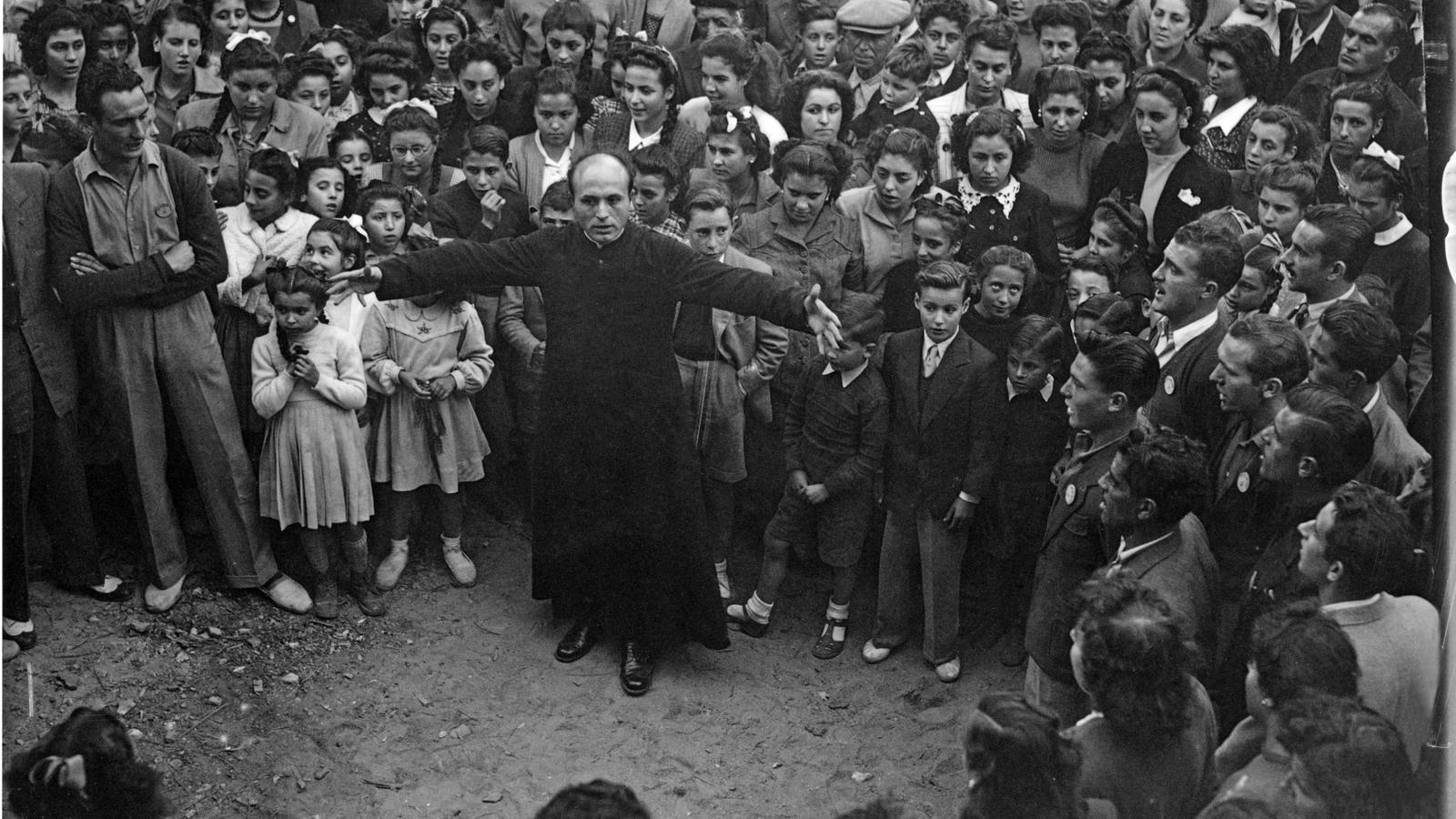
Joan Vinyes Miralpeix (Anglès, 1918 - Barcelona, 2009) could not long resist the hypocrisy of priestly life, the total submission of the Church to Francoism, nor the celibacy (only apparent) that his condition as a priest imposed on him. All these contradictions, and some more, converged in his last mass, on Sunday, October 1, 1950, when from the pulpit of the church of l'Escala he announced to his astonished parishioners that he was ceasing to be a priest. It was the first case of apostasy in Francoist Girona, which tried by all means to bring him back into the fold of the Church, even through institutional conspiracies to make him appear mad and lock him up in a mental asylum. "In the time of national-Catholicism, it was an act of total rebellion and they could not tolerate it, which is why they considered that he could only be mad," explains Josep Maria Vinyes i Vilà, who has taken care of the memoirs written by his father.

A Catholic fundamentalist father
Joan Vinyes suffered the education of a fundamentalist Catholic father who steered him towards the seminary without him having a true vocation. The extremely harsh and surprising life trajectory is explained with precise and stark prose by the protagonist himself in Memoirs of an Apostate Priest (Editorial Gavarres), the result of very diverse writings that his son Josep Maria Vinyes, a psychologist and former editor of Enciclopèdia Catalana, has gathered in a volume of almost 300 pages that skillfully blends personal and collective memory. The future priest's childhood was marked by the death of his mother from an ectopic pregnancy when he was only 10 months old. Family rigidity was exemplified in a chart where the good deeds and faults committed by the two brothers were recorded daily. The faults always won and resulted in punishments: for the brother, the prohibition of drinking wine, and for him, the obligation to drink hot water at meals. They were barred from access to football and cinema and "sex was a bad, horrible thing, and the mere sight of a penis was of absolute gravity." At eleven years old, the two brothers were interned at the Collell seminary school, "a cage where absolutely everything was designed to tame the will of children," where "love was non-existent" and where "the cold was a competitor that had to be faced at every moment." At Collell, he began a priestly career that would continue at the Pontifical University of Comillas, where he also discovered the animosity of many Spaniards: "All Catalan speakers were bothered by hearing Catalan spoken, even if the conversation was strictly between the two speakers."
One Year in Hiding
The outbreak of the Civil War forced him to desert when they were called up. “Neither of the two brothers could go and fight alongside the enemies of religion.” Because of this, they spent more than a year in a hiding place of one and a half meters by two meters. They would leave stealthily to climb a ten-meter-high tower of the house a hundred times a day to be physically prepared for a hypothetical clandestine border crossing, which they did –“We were fed up with hiding like rabbits”– in October ’38. When Joan Vinyes managed to cross into Francoist Spain, he discovered that “the repression of the left in the national zone had been as harsh, if not harsher, than that of which he had been a witness, and, moreover, had been perpetrated not by uncontrolled individuals but by the people of order.” He also realized that “the priests had become stewards of Francoist interests.” He writes: “Franco needed the Church and the Church needed Franco.” Although as a former seminarian he had been promised that he would not be sent to the front, he was only saved by an acute colitis that caused him to have “bloody stools at thirty-nine degrees fever.” Vinyes did not want to humble himself, not even to the lowest rank of corporal, to participate in the army, as he “was imbued with hatred for barracks discipline.” In one passage of his memoirs, he describes how he threw all the pieces of his military uniform from the train, in irretrievable parts, in such a way that no one could use them.

Priestly hypocrisy
In the post-war period, as soon as he is ordained, he realizes the hypocrisy that governed the actions of most priests: “The Church does not ignore the multiple, constant, deplorable infringements of the celibate discipline that its ministers incur; it prefers hypocrisy to sincerity”. And he concludes: "The Church was not a mother: it was a despotic and cruel stepmother towards the children of God”. He even goes to the bishop to denounce a priest who had thrown himself on a woman called to the sacristy. “The episcopal reaction to my complaint showed that his excellency was prepared to hear much more serious accusations against more important dignitaries”, he assures.
Sent to l'Escala as rector of Empúries, he directs the choir l'Oreig de Mar, which was contemptuously called by the integrists of the town as “the choir of the communists”. There he meets Maria Assumpció Vilà Comas (l'Escala, 1924 - Barcelona, 1988), with whom he falls madly in love. “Without her support and without her fortitude and her courage, I would not have had the heart to say goodbye to thirty years marked from their beginnings by the most absolute submission to ecclesiastical authority – he admits –. I was an incomplete being, as an individual and as a priest”, he concludes.

Break forcefully
Joan Vinyes' son, who until he retired did not start to calmly read his father's literary legacy, believes that his father did not feel brave enough to explain many things to the family that now appear clear in his writings. “Now we understand his decision much better. He had to gather a lot of strength to be able to intellectually and emotionally refute the pressure he would receive and he knew he had to be very forceful to break free – he acknowledges. Making it public during mass was a demonstration that he was convinced, and he even wanted to draw up a notarial act,” explains the son. The notary of L'Escala, however, “backed down, alleging that a notary could not attest to indecent or immoral acts,” he writes in his memoirs. He also sent a letter to Bishop Cartañà where he said things like: “In a word: I have lost faith in my condition as a priest and as a Catholic,” “I beg you to refrain from any attempt at reconciliation, which I now qualify as fruitless,” or “I will not take advantage of my condition to promote disorder and scandal; it seems pertinent to me that you adopt an equivalent attitude.”
To Lorda and the psychiatristNeither the ecclesiastical estate nor his father gave up and sent him on spiritual exercises with the Jesuits, stays in Montserrat, Mallorca and Lourdes, and to consult psychiatrists. And amidst these pressures, when the son asks his father if perhaps he would have wanted the Inquisition to exist to burn him at the stake, he replies: “I wish it still existed…!”
His memoirs feature delirious episodes, such as when an eminent specialist in mental illnesses diagnoses in him a sincere hatred for his father, whom he attacks through religion for an Oedipus complex. Or a final conspiracy to lock him up in a lunatic asylum with the acquiescence of the bishop of Girona and the president of the Provincial Council of Barcelona, from which he manages to escape by threatening to reveal everything to the BBC. He had already escaped from a lunatic asylum where they wanted him to stay for a few days under observation and where he feared they intended to drive him truly mad: “The paternal-familial-ecclesiastical-political bloc, not imaginary but quite perceptible, could present me as a paradigm of the paranoia that had impelled me to do the foolish thing I did.” Josep Maria Vinyes explains that “it is not that the grandfather did not love his son, but that he had a furious Catholicism, a faith that took precedence over his own children.”

Joan Vinyes was a member of the Baptist Church for some years and later returned to Catholicism. He worked as a proofreader and editor for the country's main publishing houses and also worked as a translator of Catalan, Spanish, English, French, Latin, and Greek. The proof of his love for his wife is that he married her three times: in the Baptist Church, civilly, and in the Catholic Church.
