To live all summer in a cabin at the foot of Comanegra taking care of 700 sheep
Víctor Rojas Orcalla is a shepherd who from June to September takes his flock to the meadows of Alta Garrotxa following the traditional paths of transhumance.

-
CAT -
CAST
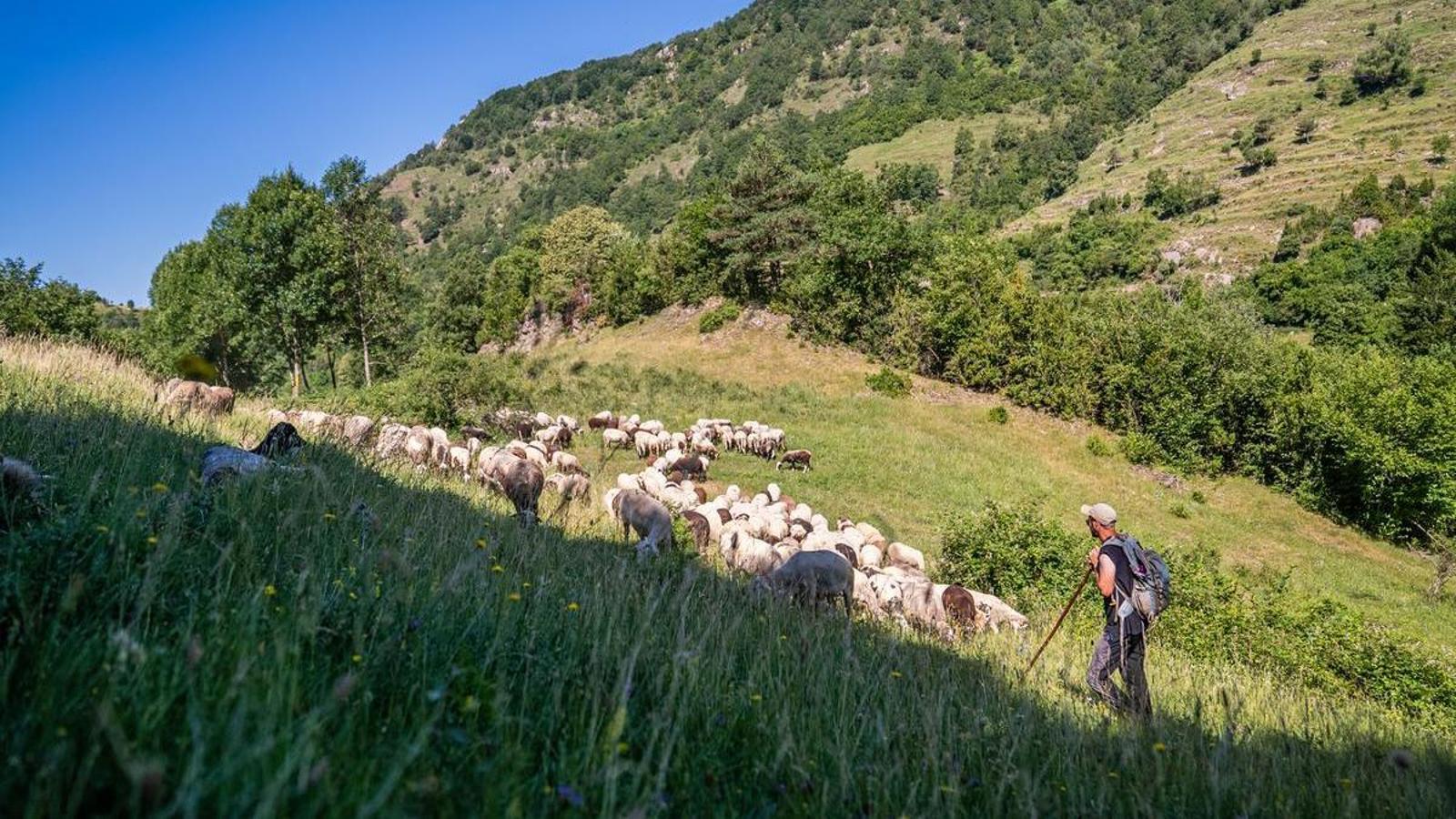
Rocabruna (Ripollès)In early June, when the heat arrives, shepherd Víctor Rojas Orcalla undertakes a long walking route from Cap de Creus to Alta Garrotxa, guiding a flock of nearly 700 sheep along the traditional transhumance paths. He takes them to the green meadows below Comanegra, the peak of Les Bruixes, and the Sant Marc pass, where they stay all summer, sheltered from the high temperatures. The shepherd cares for them in the mountains for three or four months, in the company of nine dogs, and spends most nights in a small, well-equipped modular hut at the base of the summit. Further down, in the village of Rocabruna, Rojas also has a room at the Bocabartella farmhouse where the caretakers welcome him whenever he needs it.
The hut is equipped with a kitchen and solar panels. Rojas brings provisions up and can live self-sufficiently there. Next to it is the enclosure with electric fences where the livestock spends the night. Every morning, the farmer opens the fences and leads the animals to pasture. Without fixed clocks or schedules, the rhythm is set by the sheep and the weather. If necessary, they leave at dawn or stay out until midnight. "This profession has practically not changed in a thousand years. The shepherd is the animal most like man," Rojas says jokingly. The shepherd spends many hours in solitude, with many contemplative moments surrounded by animals and nature, and, over time, has developed a very profound discourse and reflections on his profession.
The name of the flock, Arkàdia, is a good example of this. It refers to the bucolic garden of classical Greek tradition, in which the quintessential human figure was the shepherd. "If Arkàdia is a paradise after death, I am enjoying it in life. The shepherd's job is very demanding, but also full of endorphins. I see the best sunsets and sunrises. I feel privileged, like a king," he explains.

"I am not 37 years old, but I have seen eight generations of sheep"
As a result of living and understanding this vocation so intensely, Rojas' bond with each of the sheep in his flock is strong and special. "I don't just say I live off them. I also live with them and for them. When you raise them and can cross the country from Cap de Creus to Comanegra, you whistle and they all come and follow you, you generate a bond that is very difficult to explain if you haven't lived it in person. It's so close that we don't see them as a profitable thing. If a wolf attacks them, I don't want them to pay me for the sheep they kill. I cry. I give them names," Rojas admits.
Of the 700, she has Bicicleta and Antònia, Antonieta's mother. Also Pitufa, who had Pitufina, and Trufa, who gave birth to Llufa, and so on. "Animals are born, live, and die constantly. We live the cycle of life. I don't say I'm 37 years old, I say I've seen eight generations of sheep. I've known the mother, the daughter, I've chosen them, I've seen them born and die," he concludes.

To the mountains of Garrotxa or the Pyrenees, the majority of herds that practice transhumance are cows. And, at the foot of Comanegra, although it is unusual, good coexistence reigns between bovids and cattle, even though cows need much more water than sheep and sometimes dry up the ponds.
The life of traditional shepherds like Víctor Rojas is essentially nomadic, always on the move following the seasons according to the animals' needs. That's why, this year, his flock bears the mark of the Amazigh people, in a gesture of brotherhood and a claim for a stateless people, linked to traditional forms of agriculture and livestock farming. After spending the summer in Alta Garrotxa and once the young are born, Rojas' flock begins its descent towards Empordà, where it will spend all autumn and all winter, at the Vinyeta winery, in Masarac. There, the sheep help to prune the vines. In spring, they return to Cap de Creus, to help maintain fire prevention strips. And, when the heat returns, they embark once again on the journey towards Garrotxa. And so on, successively.
- 12 m2A person lives here during the summer transhumance months.At the foot of the Comanegra peak (1,557 m).
