Donald Trump has made the first stop of his tour of Asia in the Philippines, where he met with the Quad, the group that brings together the United States, Japan, India, and Australia, and which acts as a counterweight to China's influence in the Indo-Pacific. “We have a great relationship,” Trump maintained. The meeting with the Quad comes after two years in which Trump has imposed tariffs on countries in the Southeast Asian region, even on allies. These measures have reinforced the perception in Asia that the United States is not a reliable partner, but rather a country that prioritizes its commercial interests over security ones. Furthermore, the three Quad partners are also grappling with the consequences of high energy prices caused by the war with Iran, which was triggered by Washington.
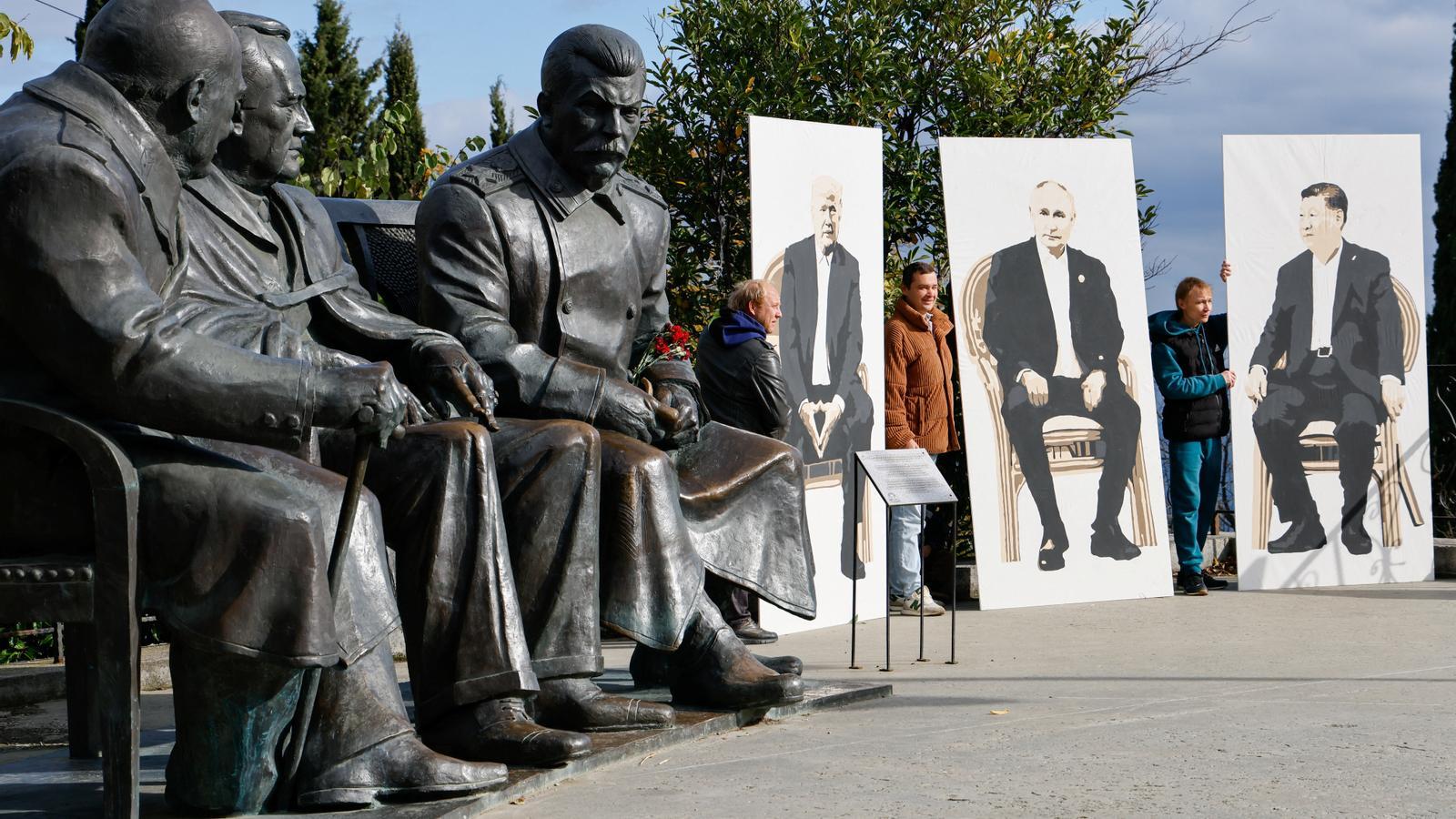
China sticks out its technological chest at an APEC forum marked by the trilateral of Xi, Trump and Putin
Xi Jinping shows his international vocation and will turn the innovative city of Shenzhen into the center of the world

-
CAT -
CAST
BeijingChina has deployed all its soft power diplomacy to shine at this meeting, which presents President Xi Jinping as a global and unifying leader. The broad agenda of Xi's bilateral meetings with invited leaders is quite a demonstration. Xi, in fact, is engaged in frenetic activity with meetings involving figures such as the Mexican President, Claudia Sheinbaum, the President of Peru, Keiko Fujimori, the Canadian Prime Minister, Mark Carney, or the President of Vietnam, To Lam. But the icing on the cake that will close the two-day forum is a trilateral meeting between Xi Jinping, Donald Trump, and Vladimir Putin, scheduled for Thursday. The expectation for this meeting is at its peak.
The 33rd APEC Economic Leaders' Meeting is being held on November 18 and 19, but the leaders arrived days earlier to establish contacts parallel to the official meeting. The slogan of the meeting is "Building an Asia-Pacific community to prosper together." The members of the APEC forum account for 62% of the world's GDP and practically half of the goods and services exchanged globally. Although, rather than countries, 21 economies are mentioned, since there are cases like Taiwan, which are not recognized as a country by most states in the world. Debating trade uncertainties and advancing regional integration among the Pacific Rim countries is the objective of the meeting. In this sense, the development and regulation of artificial intelligence, the fight against protectionism, and governance occupy a large part of the program. It is expected, in fact, that the summit will conclude on Thursday the 19th with the publication of the "Shenzhen Declaration." China has highlighted that the document must focus on innovation, cooperation, and openness in reference to barrier-free trade.

The state news agency Xinhua has not hesitated to highlight Xi Jinping's role as a defender of stability and free trade. In its news reports, it has published that the Chinese organization of the APEC forum "sends a clear signal that competition between major powers should not be a zero-sum game, and that one country's development should not come at the expense of another".
The meeting once again gives Xi Jinping a leading role as a leader of the Global South. It also reinforces China's technological commitment and its innovation as an alternative to what large North American companies are developing.
Shenzhen, the Chinese Silicon Valley
It is the third time that China is organizing an APEC forum and, on this occasion, the Asian giant makes a real statement of intent with the choice of the southern city of Shenzhen to host the APEC. Shenzhen is the jewel of Chinese technology, the great bet of Xi Jinping, and a dazzling showcase of its development and its technological and economic achievements. It is described as the Chinese Silicon Valley, as leading companies such as BYD, Tencent, Huawei or ZTE are installed there. Its skyscrapers, immense avenues and large landscaped areas make it an example of development, although this great city of 18 million inhabitants was just a fishing village four decades ago. In the eighties, its location next to Hong Kong, at that time a British colony, promoted it as one of the special economic zones (SEZ) devised by Deng Xiaoping.
Trade stability and AI development are important, but it cannot be ignored that the most anticipated event will be the trilateral meeting between Xi Jinping, Trump and Putin that will take place at the conclusion of the summit. With more information from Washington than that provided by China, it has been confirmed that the three leaders will talk above all about the reduction of nuclear weapons.
Trump aspires to reach a new strategic pact with Moscow that replaces the Start treaty, which expired in February, and involve China in it. Beijing, although it has fewer weapons, is promoting the modernization of its nuclear arsenal. The Iran war and the energy crisis that has caused the closing of the Strait of Hormuz will also be on the agenda, along with trade and possibly the invasion of Ukraine. It is not confirmed if there will be a meeting with the North Korean leader, Kim Jong-un, who has not even confirmed his attendance at the summit. But Donald Trump has shown interest in holding a meeting with his partner from Pyongyang.
