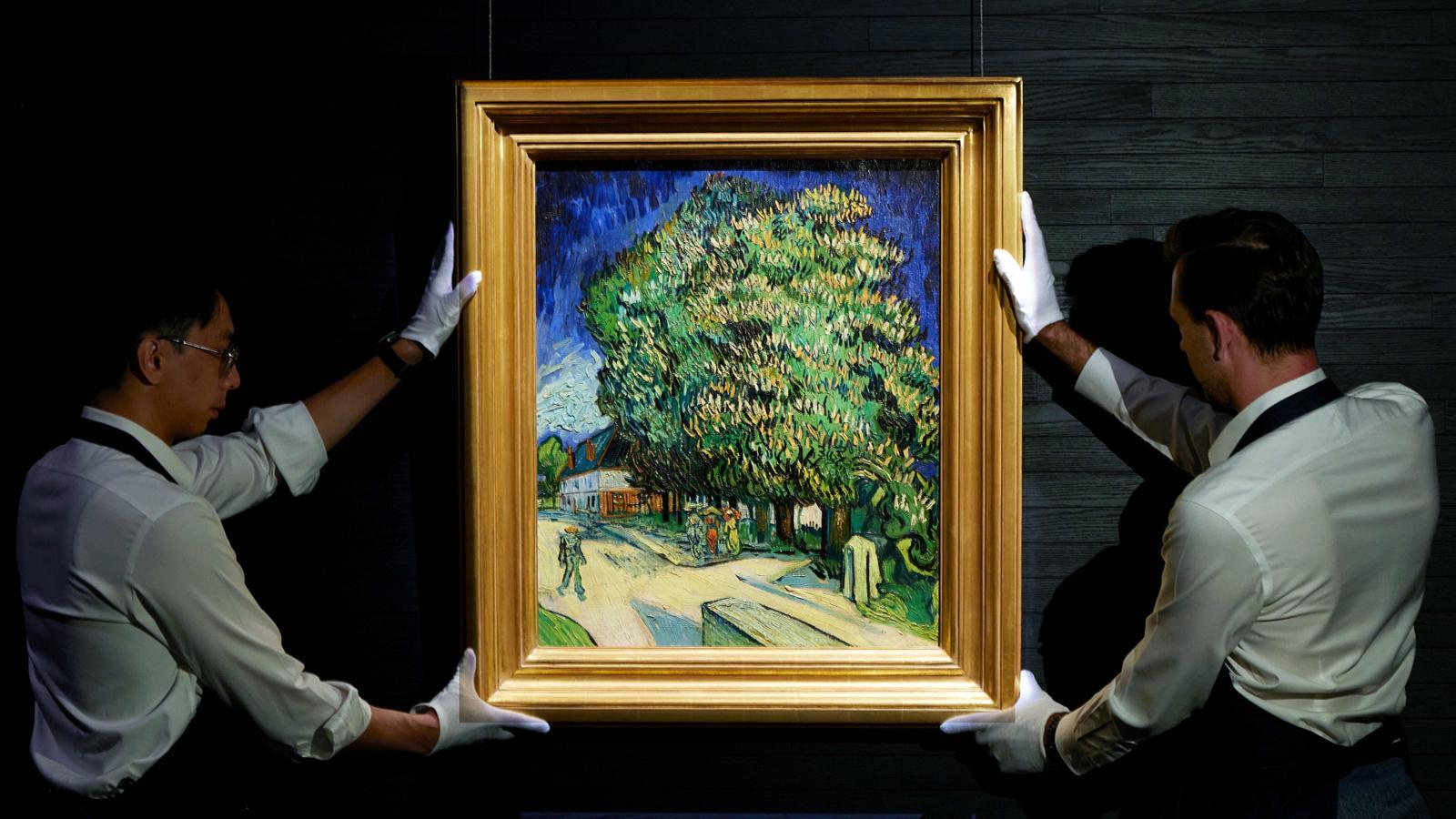
Van Gogh’s ‘Chestnut trees in blossom’ reappears after half a century with a price of 164 million euros
The agreement between the Blaquier-Arrieta and Fischer families puts an end to the dispute over the Nazi past of the work, which Sotheby’s will auction today

-
CAT -
CAST
BarcelonaOne of the great private collections of Impressionist and Post-Impressionist art, kept out of the public eye for more than half a century, is returning to the light. The Sotheby's auction house in New York is auctioning twelve masterpieces from the Blaquier-Arrieta collection this Wednesday, with a joint estimate of around 410 million euros. The collection, assembled during the 1970s and 1980s by the Argentine couple Carlos Pedro Blaquier and Nelly Arrieta de Blaquier, includes pieces by Vincent van Gogh, Paul Cézanne, Pierre-Auguste Renoir, Camille Pissarro, Edgar Degas, and Claude Monet, among other fundamental figures in the history of modern art.
The two main protagonists of the sale are the paintings Chestnut Trees in Blossom, by Van Gogh, valued at around 164 million euros, and Harlequin, by Cézanne, with an estimate of 109 million. Both works could set new price records for their authors. Their reappearance is especially exceptional: neither of the two has been seen publicly for more than fifty years.
Painted around May 24, 1890, Chestnut Trees in Blossombelongs to the final months of Van Gogh's life, when the artist had settled in Auvers-sur-Oise, in France, after leaving the psychiatric facility in Saint-Rémy-de-Provence. Near Paris, and his brother Theo, the painter lived a period of intense creative activity, marked by a renewed energy that translated into some of the most expressive works of his career.
The canvas presents a large flowering chestnut tree that dominates the composition, resolved with energetic brushstrokes and dense pictorial matter. At the foot of the tree, a solitary figure—who could remind one of the artist himself—passes in front of three women in dresses that seem of Japanese inspiration and who are carrying parasols. The scene combines the observation of the landscape with an almost dreamlike atmosphere. Its importance also lies in its rarity: only eight landscapes from the Auvers period remain in private hands, and this is one of the largest and highest quality canvases.
For sale ‘in extremis’
The history of the work is also notable. After the death of Van Gogh, it passed to his brother Theo, to the latter's widow, Johanna van Gogh-Bonger, and to their son. Later on, it became part of the collections of the bookseller Samuel Fischer and the American film producer George Buddy Gard DeSylva. The Blaquier couple acquired it at the Wildenstein gallery in 1975. Since then, it has not been exhibited publicly again.
But Chestnut Blossoms is going on sale in extremis. As Sotheby’s announced yesterday, the Blaquier-Arrieta family and the legal heirs of Hedwig and Samuel Fischer have reached an agreement on the sale of the painting. The former owner of the work was the Jewish publisher Samuel Fischer, founder of the publishing house S. Fischer Verlag, who bought the painting in 1909. Years later, with the arrival of Nazism in Germany, the Fischer descendants fled from Berlin to Vienna with the painting. And they sold it in 1936 through an Amsterdam gallery, three months after having left Germany. Many restitution claims are based on the fact that the sales of the works occurred in a context of persecution and coercion that cast doubt on the freedom of the owners to decide on the sale.
The agreement reached now puts an end to the dispute linked to the complex history of the work during Nazism and to the suffering of the Fischer family during the Holocaust. The heirs have expressed their gratitude for the negotiations and the collaboration of both families and Sotheby’s, which have allowed for the recognition of the Fischer family's suffering and the vindication of the path taken by Gisela Bermann Fischer in the search for justice for her family. For their part, the Blaquier-Arrieta family has described the resolution as friendly and has highlighted the constructive dialogue that made the agreement possible.

The other major attraction of the auction is Harlequin, painted by Paul Cézanne between 1888 and 1890. The work is part of a series of only four paintings dedicated to the figure of the harlequin, inspired by the Carnival celebrations that the artist knew since his childhood in Aix-en-Provence. In these compositions, Cézanne progressively moves away from the comic and theatrical character of the Commedia dell’Arte figure to focus on the stillness and introspection of the figure.
The model for this series was his son Paul, who was an adolescent at the time. Dressed in the characteristic red and black diamond-patterned suit, with a white hat and a wooden sword, Cézanne’s harlequin presents an enigmatic, almost abstract expression. The painting anticipates some of the transformations that would mark modern art and reflects the artist’s interest in the representation of the human figure. The work, which belonged to prominent collectors and passed through galleries such as those of Ambroise Vollard, Durand-Ruel and Paul Rosenberg, has not been seen in public since 1975.

Beyond these two pieces, the collection offers a journey through different moments of Impressionism and its offshoots. Among the most outstanding lots is Young Girl in a Boat, by Pierre-Auguste Renoir, estimated between 23 and 32 million euros. Painted in 1877, the year of the Third Impressionist Exhibition, it is one of the artist's boating scenes that still remains in private hands. The model could be Marguerite Margot Legrand, one of the figures Renoir portrayed in several of his best-known compositions.
Also standing out is The Place du Théâtre Français and the Avenue de l'Opéra, Winter Sun in the Afternoon, by Camille Pissarro, with an estimate of 27 to 36 million euros. Created in 1898, the painting shows modern Paris from the window of the Grand Hôtel du Louvre and captures the movement of the grand boulevards transformed by Baron Haussmann's urban reforms. It is one of the most important compositions in the series of urban views that Pissarro painted during the last decade of his career. The set also includes the pastel Before the Race, by Edgar Degas, valued between 18 and 27 million euros, which represents the atmosphere of contained tension of the moments prior to a horse race. The piece, one of the artist's most significant works dedicated to this theme, has not been publicly exhibited since 1968.
Paris through Monet's eyes
By Claude Monet, The Tuileries Garden is presented, painted in 1876 and with an estimated value of between 14 and 18 million euros. The canvas is part of a series of four views of the Parisian gardens made from an apartment on Rue de Rivoli. Exhibited in 1877 at the Third Impressionist Exhibition, it is a testament to Monet's interest in the transformation of Paris and the new forms of urban life. Completing the selection are Flowers in a Vase, by Paul Gauguin, a still life from his later years in Tahiti, with an estimate of 9 to 14 million euros; Boats in the Port of Collioure, by André Derain, one of the representative works of Fauvism, valued between 7 and 11 million; a painting by Maurice de Vlaminck, a landscape by Alfred Sisley, another work by Pissarro and a portrait by Henri de Toulouse-Lautrec.
The history of the collection is inseparable from the passion for collecting of Nelly Arrieta de Blaquier, a prominent figure in Argentine cultural and philanthropic life. Particularly interested in art and education, she participated in the boards of various international institutions, including the Museum of Modern Art in New York and the circle of friends of the Musée d'Orsay in Paris. She also presided over the association of friends of the National Museum of Fine Arts in Buenos Aires and promoted initiatives to support education and medical research.
The couple built much of their collection in London during the 70s, when it was still possible to acquire Impressionist masterpieces on the gallery market. At the Lefevre Gallery, located on Bruton Street, they bought at least seven of the twelve paintings that are now going up for auction. Most of the pieces have never been offered on the public market, which reinforces the anticipation surrounding the sale.
