Intergalactic Minibus: "We like LSD and making overdriven rock"
The band from Girona presents the album 'Polynomial oscillating movement y=1/x', which reaffirms them as one of the most unique and daring groups on the Catalan scene

-
CAT -
CAST
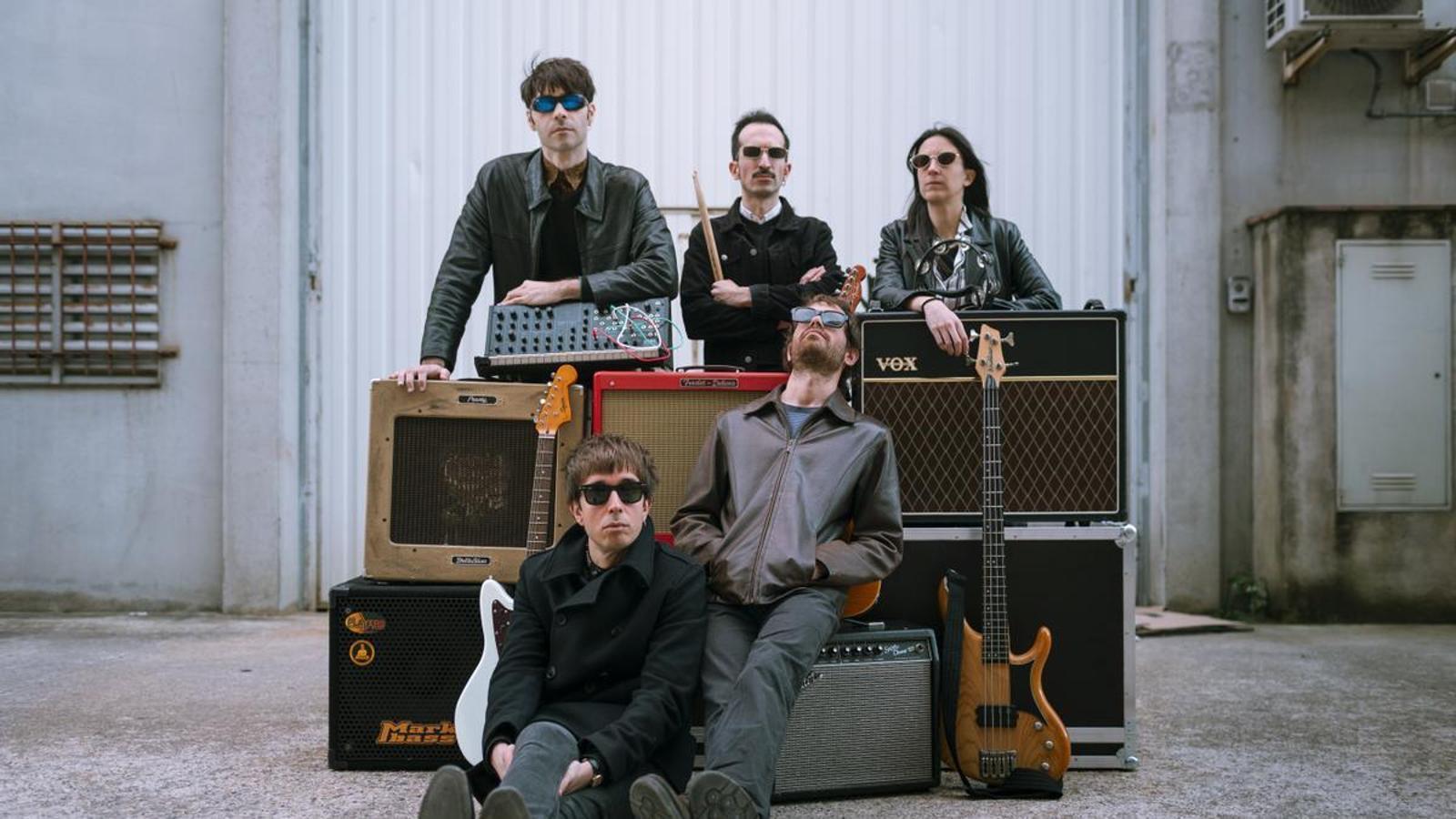
GironaThe Girona-based group Minibús Intergalàctic is already making a name for itself in the Catalan music scene. After a very solid debut album, they now present their second record, "Moviment oscil·lant polinòmic y=1/x" (Neu!, 2026), which forms the basis of the project and is set to become one of the musical discoveries of the year. The presentation tour will begin on April 24th in Girona and will continue in Barcelona (May 9th), Reus (May 22nd), and Lleida (May 30th).
The band was formed spontaneously and without pretension in 2021, in the hallways of the University of Girona, where five young people born in the late nineties with common interests hit it off. They are Edu Lazo (drums), Santi Fonfría (guitar and vocals), Ivette Roig (bass), and Aram Figueras (guitar), all from Girona or its surroundings, and Ícar Iranzo (organ, synthesizers, and vocals), from Terres de l'Ebre, who came to the city to do his medical residency.
Since then, they have consolidated their own powerful style, with psychedelic roots and a sixties feel. On this second work, their sound delves into darker territories, with incursions into space rock, shoegaze, post-punk, and the noisy indie pop of the late eighties. The result is a tense balance between the power of electric guitars and a melodic pop sensibility that makes everything more digestible. And, live, all this energy multiplies into an overwhelming, almost chaotic performance, with a touch of madness. "I think
psychedelic
is a label that suits us well, because we like LSD and it's a very broad umbrella that covers many things. In the end, it's nothing more than rock gone wild: making everything strange and weird", explains Santi Fonfría.
Certainly, everything surrounding Minibús Intergalàctic is strange and eccentric, but also honest and sincere. Without pretension, imposture, or concessions. Just as it comes out. "There is a sincerity in what we do. It's what comes out of us because there's no other way, it's very direct. If the album turned out this way, it's because it's what we like and what we listen to. At no point was there any idea of changing something because it might sound better on the radio," acknowledges Aram Figueras.
From The Smiths to Antònia Font
In their musical proposal, a clearly Anglo-Saxon imaginary resonates, with references such as The Smiths, Spacemen 3, Spectrum, Oasis, and Spiritualized. A background that in the Catalan sphere really has little prevalence, but which has also survived through bands like Banyoles' Kitsch or Antònia Font, kings of psychedelia, with whom Minibús feel a special connection. The album, moreover, features the invaluable collaboration of producer Martin Youth Glover, a key figure in rock history linked to projects such as The Jesus and Mary Chain, Paul McCartney, or Pink Floyd, who has just rounded off the entire unleashed sound of the album.
Life, a polynomial where the extremes are included
The ten songs do not follow an evident narrative thread or thematic axis, but the lyrics, quite metaphorical and profound, share a substratum about life understood as a scale of grays, full of contradictions and paradoxes. Like a Frankenstein made of apparently disconnected pieces. From here comes the title of Polynomial oscillating movement, which refers to a pendulum fluctuating from one extreme to another. And the formula that completes it (y = 1/x) corroborates it.
This is how Ivette Roig develops it: "Although it's a bit cryptic, polynomial oscillating movement is something that moves from one extreme to another. The formula expresses that which is inversely proportional, one thing with respect to the other, but at the same time, when X is 1 and Y is also 1, then they meet".
And if the first album, Meditacions des dels miratges mercúrics, everything was more unrestrained, with humor and parody, with echoes almost plagiarized from Pau Riba and Jaume Sisa, the second work, with this more existentialist theme, opts for a darker and more everyday register. Disillusionment and lucidity coexist, existential emptiness, paralysis, direction and the paradox of wanting to live and not knowing how to do it. Some of the most accomplished songs on the album express this very well, such as the naked rock of Mòbil continu, Cap de trons, more uninhibited, L’agredolça lliçó de la Vall del Mas Daurat, or Camí vell, with folk airs and a very complete development.
