Moroccan spies in the corridors of the European Union
Fifty days later, the crisis of the European Ceuta marks the start of the political year in Europe

-
CAT -
CAST
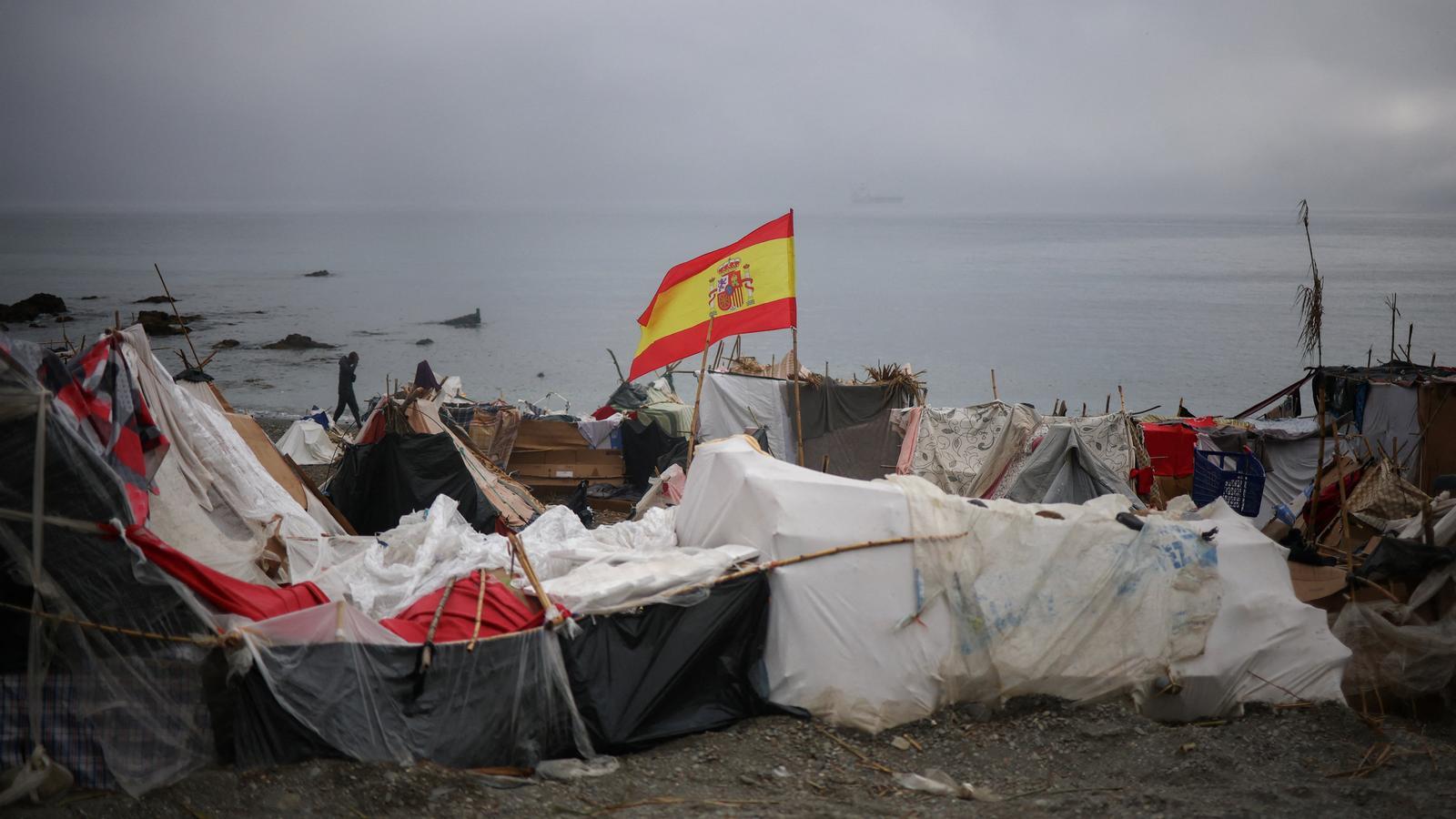
StrasbourgJoking or not, a European source said: on July 30, the day of the assault on Ceuta, the first thing many community advisors had to do was explain to their politicians where Ceuta was. Then, the chills came.
The images of tens of thousands of people entering Spain by force anticipated a crisis –political, not migratory– of European proportions. The Achilles' heel of the community chancelleries had been touched: immigration, Europe's great taboo. The instrumentalization that the far-right, omnipresent in the continent's discursive compass, would make of it would mark the cold responses of the capitals from the beginning, and also of Brussels, while from Madrid “solidarity and empathy” were requested.
There was surprise and unease in the Spanish government over the harshness with which most European partners responded to the situation of the European city of Ceuta. Voices close to Moncloa point out that they were especially hurt by the letter, led by Giorgia Meloni and the Danish social democrat —yes, social democrat— Mette Frederiksen, from 22 countries in which the assault on the Spanish border was linked to the policies of regularization of foreigners promoted by the socialist executive. Pedro Sánchez labeled the response as “selfish, polarizing and illegal” and from the Spanish government a diplomatic effort was initiated to “explain and contextualize” the Ceuta crisis to the other European executives, who accused it of not having calculated the magnitude of the crisis well.
The Moncloa's strategy had two main objectives: on the one hand, to refute that the situation on the ground put the Schengen area at risk and many other alarmist claims that had been launched, above all, from Rome; on the other, to point out the link between the position of many partners with Donald Trump's migration thesis and, therefore, that of the far-right. The latter, Madrid maintained, went head-on against the European values that sustain the common project and showed the EU's unity at a decisive strategic moment.
Over the weeks, the European response has softened and Spain has received meager rhetorical embraces, points out Pol Morillas, director of Cidob. “The border of Ceuta is a European border because Ceuta is Spain. Ceuta is Europe. And Europe will be there for you”, said the President of the European Commission, Ursula von der Leyen, on Wednesday in her State of the Union address. But in politics, the first reaction, the most visceral one, is usually the one that counts. And Ceuta continues to be a very thorny issue in European institutions.
On Thursday, the European Parliament passed a resolution holding Spain responsible for the mass entry of immigrants into Ceuta. The text was presented by the European People's Party, with a very prominent role played by the Spanish PP, which is campaigning in Europe, and was widely supported by the right and the far-right. The movement highlights five points that summarize these 50 days of crisis.First: that the assault on Ceuta has reaffirmed Spain's loneliness in matters of migration policy. Second: that the EU's rhetoric on immigration is hardening at an allegroMeloni pace. Third: that the regularization of immigrants promoted by the Sánchez government rankled several European capitals. Fourth: that European policy responds, above all, to the internal logic of each country and party. Fifth: that point four is the worst news the EU can receive on the threshold of a difficult autumn, marked by Moscow's hybrid war and by Trumpian unpredictability.Rabat is not Moscow
“Of course Europe’s initial reaction is open to criticism,” said Juan Fernando López Aguilar during a meeting with Spanish journalists. The socialist MEP demanded the same emphasis for Ceuta as is placed on condemning the hybrid attacks suffered by the Baltic states at the hands of Russia. Similar statements have been insistently repeated by the Spanish government, especially the Minister of Foreign Affairs, José Manuel Albares: “The EU’s southern land borders are as important as those in the east, west, and north, and we expect the same solidarity, the same support”.
But this is where the paradox comes in, widely discussed these days in the corridors and rooms of Strasbourg.
From minute one, the Spanish government has pointed to mafias and human traffickers regarding the mass jump on July 30. Silence on Morocco. Later, and in a clumsy turn of discourse, it also hinted at Russia's involvement. Silence on Morocco. The official version from La Moncloa says that there is no conclusive evidence to point to Rabat, but the famous National Police report and geopolitical logic make it almost evident that the Moroccan government played at least some role in the Ceuta crisis. In the aforementioned European Parliament resolution, it pointed towards the Moroccan authorities and suggested rethinking the association agreement with Morocco. And Morocco, that same day, responded by puffing out its geopolitical chest: it expanded its ties with Israel and the United States, announcing an agreement to "strengthen their trilateral cooperation on the territorial scene".

In Europe, there is a feeling that Sánchez, an expert at surviving crises, has now lost the narrative. Regarding this, a source from the European Commission asks an interesting question: “How is Europe to accuse Morocco if Spain does not do so first?”.
We already know the context of the answer: Morocco is Spain's kryptonite, the foreign actor that has the most power to generate a crisis for the Spanish government. For this reason, Madrid opts, as it has always done, for responsible diplomacy in the face of its dependence on Morocco to contain and control immigration. La Moncloa does not plan any change in the kid-glove relationship with Rabat. There is another question, a classic and a condemnation of the EU's situation of strategic vulnerability: Can Spain and Europe afford to anger Morocco?
“In Europe, Morocco also exerts pressure, aware of the privileged position it holds in a key aspect such as immigration…, which is why Brussels is fine with not pointing the finger at the Moroccan hand,” says another parliamentary voice. Rabat is not Moscow, a zero-risk political target, as Morillas reminds us. But even when Sánchez pointed at Russia, the response from Brussels was not forceful. Some voices interpret this as a symptom that the Spanish president's latest international moves –his criticisms of Trump, the migration issue, defense spending– have caused him to lose harmony with his European counterparts. In the face of the discourse from the Spanish right and far-right, which sells Sánchez as the new Orbán of the EU, a prominent PSOE voice was blunt this week in Strasbourg: “There is a great deal of respect here for Sánchez and for how he has managed the crisis in Ceuta”.
The migration debate over Ceuta has marked the start of the political year in the EU and will mark the crucial Spanish elections next year, which are already being felt in Europe. In another room in Strasbourg, PP MEP Javier Zarzalejos cursed the socialist management and said that it is “difficult to aspire to a political and commercial relationship with Morocco”. Next to him, the head of the Vox delegation in the European Parliament, Jorge Buxadé, spat out his anti-immigration speech, said that Sánchez is "an agent of Morocco" and called for building a much, much higher fence at the Ceuta border. "Ceuta is now a war zone".
And joking, or not, Buxadé said that the tentacles of Rabat are so present in Spain and the European Union that he was sure that "here", in that room, there was “some spy from Morocco”. The twenty or so journalists who were sharing the space looked at each other feeling violated, incredulous, intrigued and with a certain secondhand embarrassment at the excess of populism.
