The new life of Rais Esteve and Arnau París: television cooks and fathers of twins
They share the 'Cuines' space making recipes in a jiffy on TV3 and he will take on the challenge of inheriting 'Joc de cartes'
-
CAT -
CAST
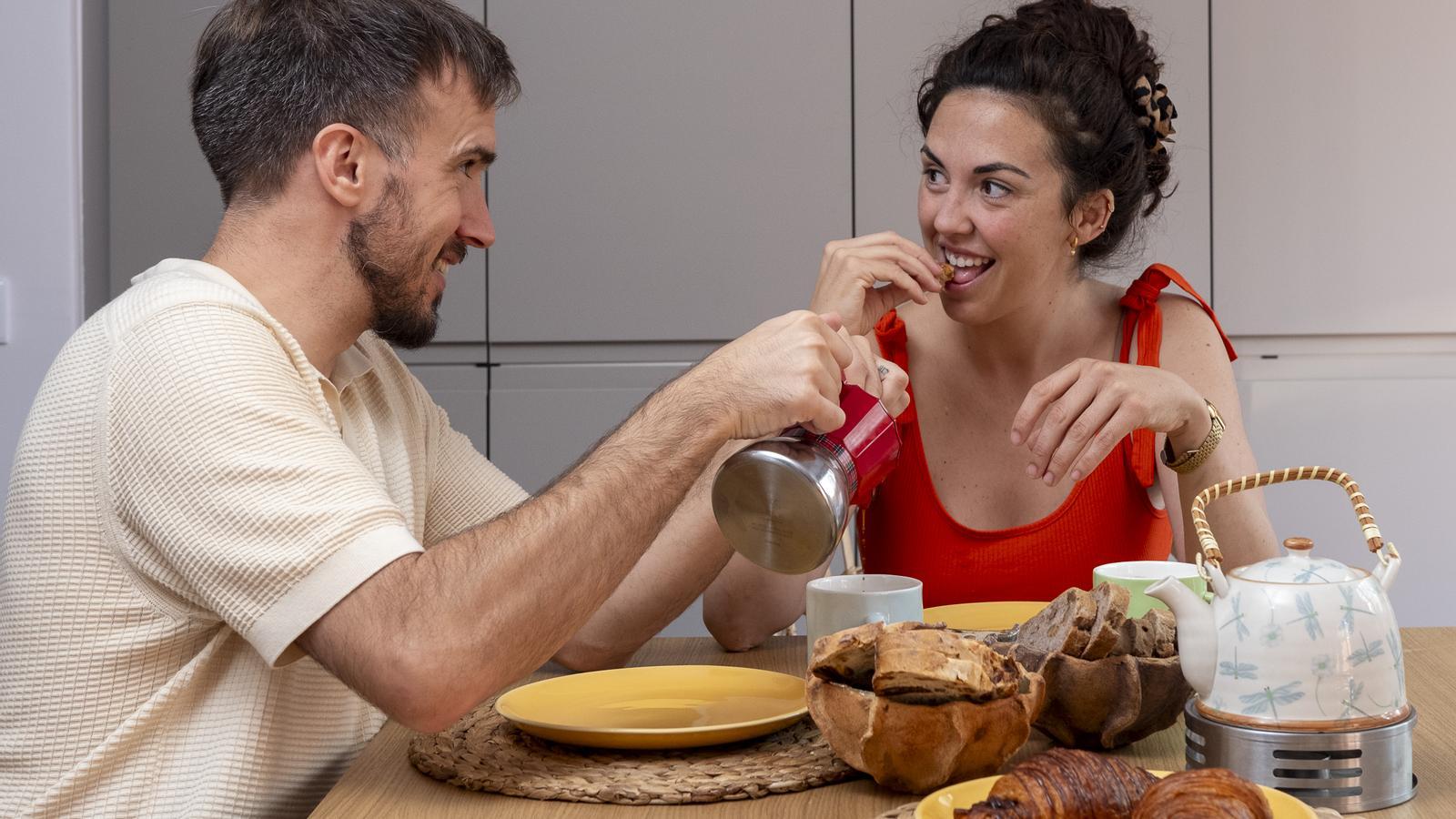
Cornellà de LlobregatWe arrive in Cornellà just as Arnau París (Barcelona, 1988) and Rais Esteve (Sant Boi de Llobregat, 1989) have left their twins, Artur and Robert, at the nursery school. It has been a year of many changes for this couple, who met at MasterChef, in which Paris won the 2021 edition and Rais Esteve worked in gastronomic consulting. Since they knew they were receiving a visit from ARA, they waited for us with the table set for breakfast. Paris insists that we taste the sobrassada that they make themselves.
While Paris is well known in Catalan households because it appears in the Cuines, making her recipes simple in a jiffy, Esteve, who had a long career as a chef, was not known to the general public until now. She was known, however, in the field of gastronomy. She has worked with Paco Pérez, was part of the team that achieved the three stars at Dani Garcia, and has been the head of R&D at Disfrutar. Furthermore, she was one of the people who used to warn Jordi Cruz through his earpiece that a contestant's sauce was breaking or that they were making a decision that would be fatal. The commitments in Paris, which this year will see her take over from Marc Ribas on Joc de cartes, has left room for someone to join in and introduce the viewer to more simple preparations. Esteve, who was already collaborating on the program by writing many of these recipes, has had to leave his position behind the camera and get in front of it. So the conversation begins by asking Paris who Rais Esteve is, for whom his mother chose his first name by looking in a name book.
"Rais is the best in the world," she says with confidence. "She is the most professional person. The person who knows more about cooking than anyone I have ever met. I swear. She is a person I admire a lot for the work she has done and for the talent she has, for how hard-working she is, for how she explains things. I have always said that she is a person the world cannot afford to lose," Paris asserts while Esteve blushes. "And on a personal level, she is a very affectionate person." At this point, Esteve doubts whether this is of interest to the public. But Paris does not care and continues. "She loves very, very strongly, very clearly, very intensely," she says, and adds: "I don't mind, but she is too demanding of herself. She is a very good mother, she is very hard-working, she is tireless."
When they met, at the MasterChef, casting, nothing suggested that this would end with twins. “We weren't a couple until two years later,” they say. París explains that he had to work very hard. “I was a mining expert,” he admits. Esteve remembers that she had a very different image of him, at that moment. “I won't say I hated him because I didn't hate him, and because I was fond of him because he was Catalan. And because in the end, he always knew how to land on his feet in any situation. But he was a histrionic guy. Who flirted with everyone.” “And here we are,” says Esteve, amused. “A long time later I discovered that behind that mega-character there was a person I want in my life forever.”

And starting this season they also share a program, Cuines. “I want to claim that on the program Cuines there are also some people who seem not to exist but they do exist. The culinary experts. At MasterChef without us they wouldn't know anything about what was happening. I also had to prepare the tests. If they wanted a super difficult chocolate test that lasted 90 minutes, I had to be able to do it in 45 minutes,” explains Esteve. She, seasoned in high-level kitchens, finds that the current challenge makes more of an impression. “When I arrived at Disfrutar I had spent 8 years in an haute cuisine environment. A lot of demand, a lot of perseverance and almost an obsession for your work. And I like that. It’s like my personality, deep down. And, on the other hand, putting myself in front of a camera is the opposite, knowing that everything can happen a bit live and perhaps you don't have all the resources to fix it. It won't be a worldwide disaster, but I can think 'oops, I don't like how this thing I'm cutting is turning out'. This flexibility of 'it is what it is, smile and it's fine, because at home it will pass', is what has cost me the most”.
For París, appearing on TV involves a learning process. A time to let go until you gain enough confidence. But for Esteve, comparing herself to her colleague is a handicap. “My comparison is Arnau, and it's impossible to reach the level of this beast. You see him and you say, how handsome, how well... And I look at myself and almost cry”. París responds that no way: “In four years you will be the same and you will say, damn, how well I do it. It's like a dish when you make it many times. She does it very well!”, he says with conviction.
Approachable, friendly and ironic
The challenges in this house never end. The next season of Joc de cartes has already been filmed in its entirety: they finished in July. In chapter five, there will be a change of presenters. “I hope that people have as much fun watching it as I do making it,” he states. There won't be many more changes; it is one of the hit programs on TV3. “We start from a format that is already made, which is what it is, and in the end, what I do is give it my own tone when it comes to hosting the format. And how am I? I’m a close, friendly, ironic guy; I play a lot with my facial expressions. Everything shows on my face, and that will be shown on screen.” Esteve highlights his colleague's ability to connect with people as one of his superpowers. “I have managed to create environments of trust and good vibes with the contestants, and that also allows them to let go a lot when it comes to explaining things to you, to playing,” he assures.
In recent seasons, there have been controversial contestants and tense situations. Regarding this, París is clear. “I start from the premise that those of us sitting here are responsible adults and have a criteria. Therefore, what you say is what will then appear on screen. And how you have your kitchen, what you show, is what we will then show the audience with the program. There is no distortion. Therefore, if your kitchen is a mess, you already knew we were coming. It actually amuses me. In some kitchens, we have entered and I have thought: ‘Damn, but you knew we were coming today!’”. And this carries over to the way of being. “Just like when playing: if in your real life you are a jerk and you come to the program being a jerk, then it will turn out that you are a jerk. You are of age, you know yourself. You already know what TV is. It doesn't come as a surprise to you”.
What was new was the twins. Esteve got pregnant and at the ultrasound, surprise, there were two. They had to change homes. A penthouse without an elevator cannot be reconciled with two babies. Motherhood has not prevented Esteve from taking on the new challenge on television. “It has been the luck of my life, this Cuines thing, because it is very easy to reconcile. We record more than one program in a day. Not only have I been lucky enough to have the opportunity, but also the timing in which it came, because all the work I was doing as a culinary advisor...” Here París interrupts her. For him, the facet of advisor should not be conjugated in the past tense. But Rais Esteve insists: “That is to say, I am a mother now. It's like that, because life is like that. You can't say 'I am still...'. No, right now I am a mother and I appear on TV. Period. All the work I did before has been sidelined”.
When she was pregnant, one day she made an appeal. She couldn't find any chef's jacket for pregnant women. She gave birth in March, and until February she was teaching classes. The problem is that the sector did not foresee her case. And even less so with a twin belly. She had to buy a very large jacket with a zipper. “In the end, I was walking around in a potato sack and that's it. I wrote to many people. And it is a drama. I believe that the fact that there is no jacket for pregnant women immediately means the denial of a reality and of a large part of society”.
"We are not the Civil Guard"
Rais Esteve and Arnau París have been preparing meals for several summers in Boada (La Noguera), at Molí de la Vansa. The estate is where Arnau París's paternal family has lived and where they produce oil. It is also a rural tourism house and where six years ago they began a gastronomic project. They served tasting menus there in the summers, except for this last one, which they did not do because they had just become parents. París acknowledges that they are thinking about how to transform this project: "Until now we used our vacations to cook up there, but now we have other priorities.” Esteve adds that “it's cool that there are always common ideas and separate projects”. “Exactly, we don't work 24 hours together”, says París. And Esteve concludes: “we are not the Civil Guard”. And suddenly the salesperson appears that París was before being famous: “We cannot be the Civil Guard because we will invoice half; if each one goes on their own, we invoice double. I am a results-account person”. “We are the opposite. I love my work, I live for my work, I am always a romantic”, finishes Esteve. The yin and the yang getting along well. Or to put it in culinary terms, a pairing by contrast that works.
