Will the giant of the Mediterranean swim again along the Catalan coasts?
Catalonia and the Balearics study reintroducing the monk seal, a marine mammal of almost three meters and 400 kilos that disappeared from our coasts after centuries of persecution.

-
CAT -
CAST
“I have a request: do not call it a monk seal. That is an invention, a literal translation from Spanish without any tradition in our language.” With this very clear warning, the Majorcan biologist and conservationist Joan Mayol touches a raw nerve in maritime memory: “In our sea, it has always been called a sea old man, sea calf, or sea lion. And recovering its name is not a whim, but the first step to restoring the dignity of an animal that lived with us for millennia.” This claim is the starting point for rediscovering a discreet giant that, for decades, we condemned to oblivion.
The public reappearance of the sea old man has gained renewed momentum thanks to the release of the feature documentary The Odyssey of the Sea Old Man, directed by Núria Abad and Marta Hierro. The film, which is available on the CaixaForum+ platform, has reawakened the fascination for a creature nearly three meters long and four hundred kilograms in weight, with dark fur and characteristic white patches on its belly, which for centuries was the great lord of our coastal caves and cliffs; an audiovisual chronicle that accompanies the real debate already taking place among biologists and governments, with the intention of reactivating experimental reintroduction projects in places like Cap de Creus or the Balearic Islands.
Far from the image of cold-water seals, the sea old man is a fully Mediterranean creature, with strictly coastal habits, which spends its life near the coastline hunting octopuses and fish in the shadows of the coves. Having become one of the most threatened marine mammal species on the planet, its name rings out again today not as a longing for the past, but as a challenge for the future of our sea.

Story of a fierce persecution
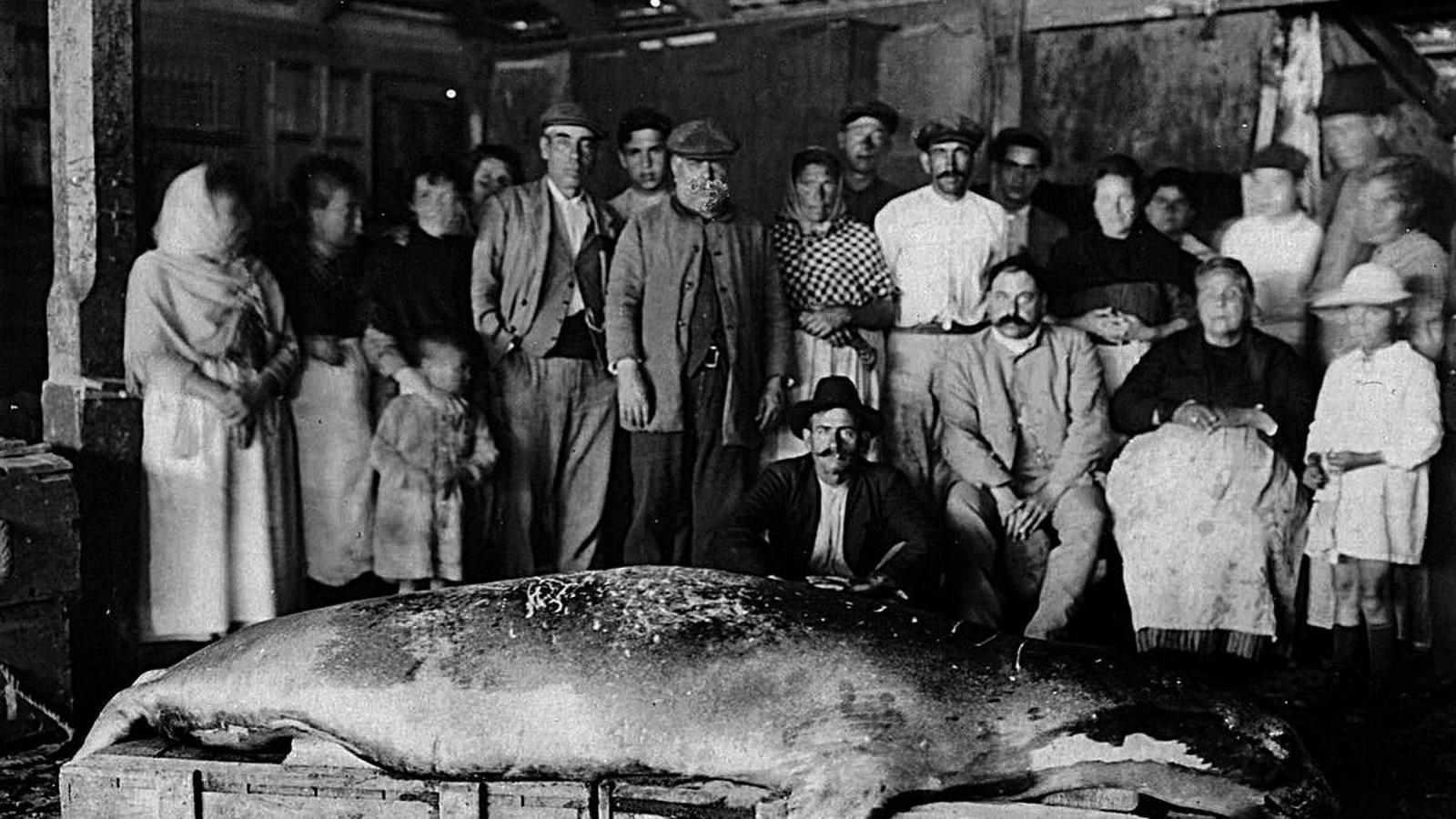
To understand the void left by its absence, it is necessary to reconstruct the long history of coexistence and persecution that the monk seal suffered on the Catalan coast. Its presence was not merely testimonial: in medieval Barcelona, the trade of its skin was fully integrated into the urban economy. As Joan Mayol details, “not long ago a medieval document was found in Barcelona in which the price of monk seal skin was regulated; if its sale was regulated, it is because it must have been a frequent product in the markets”.
For centuries, the animal was hunted intensively to extract its fat, skin and oil, or simply to eliminate what fishermen considered a direct competitor that damaged their nets. Figures such as Archduke Ludwig Salvator of Austria left evidence of this ruthless hunting using firearms or traps placed at the entrances to the caves, among others.
This extractive pressure gradually cornered the species into increasingly isolated strongholds. If in 1900 it was still present in the Cabrera archipelago and in 1922 one of the last specimens was captured near the port of Andratx, during the forties and fifties its presence became almost residual. The final tragedy in Balearic waters was consummated at the end of the fifties: in 1958 the Civil Guard killed a specimen at Cala Tuent (Mallorca) and, that same year, a pregnant female was captured at Mondragó, and its local extinction was certified during the sixties.

“At that time, killing the last specimens was socially seen as a positive thing for fishing, there was no kind of social rejection,” recalls Mayol. “On the other hand, nowadays the attitude is completely opposite: the great cultural change has already taken place. We have gone from seeing a species as undesirable to recognizing it as an emblematic and protected symbol that it would be a huge privilege to have back in our waters.”
A global rescue in the Mediterranean
Beyond the restitution of a lost symbol, the reintroduction of the Mediterranean monk seal responds to an international biological urgency. Nowadays, the species is divided into two main, dramatically isolated nuclei: the Atlantic colony of Cabo Blanco (Mauritania) and scattered groups in the Aegean and Ionian seas (Greece and Turkey). This concentration means that the global survival of Monachus monachus hangs by an extremely thin thread. In Mauritania, natural episodes of toxic algae blooms have managed to exterminate 75% of the colony in a few days, while erosion accelerates the risk that the collapse of a single cave could bury dozens of individuals. "We have most of our eggs in one basket," warns Mayol.
Creating a new population in the western Mediterranean is not a local whim, but the only way to reduce the risk of catastrophic extinction by re-establishing the genetic bridge between the Atlantic and Greece. And our coasts have the best conditions to accommodate them. Compared to the Eastern Mediterranean —a highly oligotrophic region, poor in nutrients and with less biomass—, the waters of the Balearic Islands and the northeast of Catalonia present a much higher density of fish and octopus.
As highlighted by Jordi Sargatal, Secretary of Ecological Transition of the Government of Catalonia, the return of the animal goes far beyond the protection of a single species: “Returning the monk seal to its historical habitats is a global rescue operation for a critically endangered species”. Furthermore, Sargatal emphasizes the transformative value of this initiative: “Its success will serve as an indisputable measure of environmental excellence and social maturity, and will demonstrate that the human community and wildlife can share the coast in perfect harmony”.

The science of rewilding
The path towards reintroduction is a rigorous scientific strategy that has the year 2027 as a key date in the institutional calendar. As Sargatal explains, from the Department of Territory the intention is to resume and update the technical feasibility studies carried out years ago, adapting them to the current ecological and coastal reality. This process of rewilding or renaturalization is based on a very precise sequence of methodological steps. First, a meticulous diagnosis of the coastal strip is carried out to identify coastal caves that have interior resting beaches not prone to flooding by storms. On the Costa Brava, the consolidation of protection figures such as the Management and Use Master Plan Pla Rector d'Ús i Gestió (PRUG) of the Cap de Creus Natural Park guarantees strict reserve spaces, a requirement that aligns with the conditions offered by the Cabrera Archipelago Maritime-Terrestrial National Park in the Balearic Islands.
Once the specimens have been selected from the source colony, the protocol establishes a period of quarantine and soft release (progressive release) in facilities conditioned on the same coast. This step allows for checking the health status of the seals, preventing the introduction of pathogens, and encouraging them to recognize the new environment as their own before their departure to the open sea. Once free, each animal will carry a radio satellite tracking transmitter and GPS that will allow the teams of biologists to know their displacement, diving, and resting routes in real time.
But, how can the presence of a large marine mammal be made compatible with human frequentation and the recreational use of the Costa Brava or the Balearic Islands? The scientific answer lies in the reproductive phenology of the species itself.
"The great advantage is that the seal begins to breed at the end of September and during the month of October," highlights Jordi Sargatal. During these autumn dates, recreational navigation, the presence of bathers, and tourist pressure have decreased drastically compared to the summer months. “This ensures that mothers can nurse their pups in the caves in conditions of absolute peace, and proves that Cap de Creus is a sanctuary as viable as Cabrera can be".
Environmental maturity sign
No environmental restoration project can prosper without the consensus of the communities that inhabit the territory. The announcement of the initiative's reactivation has generated debates in the north of the Costa Brava, where the reservations expressed by the Cadaqués City Council regarding the impact on recreational navigation and artisanal fishing have placed the negotiation at the center of the table. Faced with these misgivings, Jordi Sargatal bets on diplomacy and pedagogy: “Since the news came out, we have received a pile of calls from people in Cadaqués who are in favor of the project and from other town councils delighted to receive the seals. All this must be redirected, talking with great calm and diplomacy; evidently, it must be something desired by the territory”.

Sargatal recalls that the coexistence between human activity and wildlife is a daily reality in the eastern basin: “It is absurd to think that the seal can coexist with the people of Greece or Turkey, where there are photographs of seals sleeping on boats in ports and fishermen there handling them, and that Catalans, the people of Cap de Creus, cannot make this possible. It will be a very clear indicator of environmental quality and civilization”.
This approach has firm institutional precedents. As Joan Mayol recalls, in the Balearic Islands a technical draft project was already evaluated before the flora and fauna committee, where the administrations and fishermen's guilds are represented: “This committee examined the draft project and it was reported favorably without a single vote against it”.
Furthermore, the current environmental legislative framework obliges public administrations to recover extinct native species when technical viability and favorable habitat exist. The conclusions of WWF's 2026 Living Planet Report reinforce this horizon: ecological restoration based on scientific data, community cooperation, and sustained plans proves that threatened fauna can reverse its tendency toward collapse and flourish once again. As Jordi Sargatal concludes with profound conviction: “The presence of the monk seal will be an imposing attraction and a crucial factor of environmental seduction. I can guarantee that anyone who locks eyes with a monk seal will fall in love with it forever”.
