The mystery of Agatha Christie that goes beyond her crimes
The writer's great-grandson regrets the lack of recognition from critics, while London commemorates the half-century of her death with an exhibition

-
CAT -
CAST
LondonA mystery wrapped in an enigma, perhaps? In the last interview she gave, in 1974, for the Imperial War Museum sound archive regarding her memories as a volunteer nurse during the First World War, Agatha Christie replied that she would like to be remembered "as a good writer of detective and suspense novels". Most likely, that is how she is remembered. And it has already been half a century since her death (January 12, 1976).
Who has not read her? Who has never been hooked on one of her stories? Or, at least, who has not seen an adaptation of one of her books in cinema or television or one of her plays? In the worst case, everyone has heard of her, right? But who was the Lady of Crime really? What explains her success? When did she start writing? How did she write? Where did she get her ideas from? Which authors have followed in her footsteps?
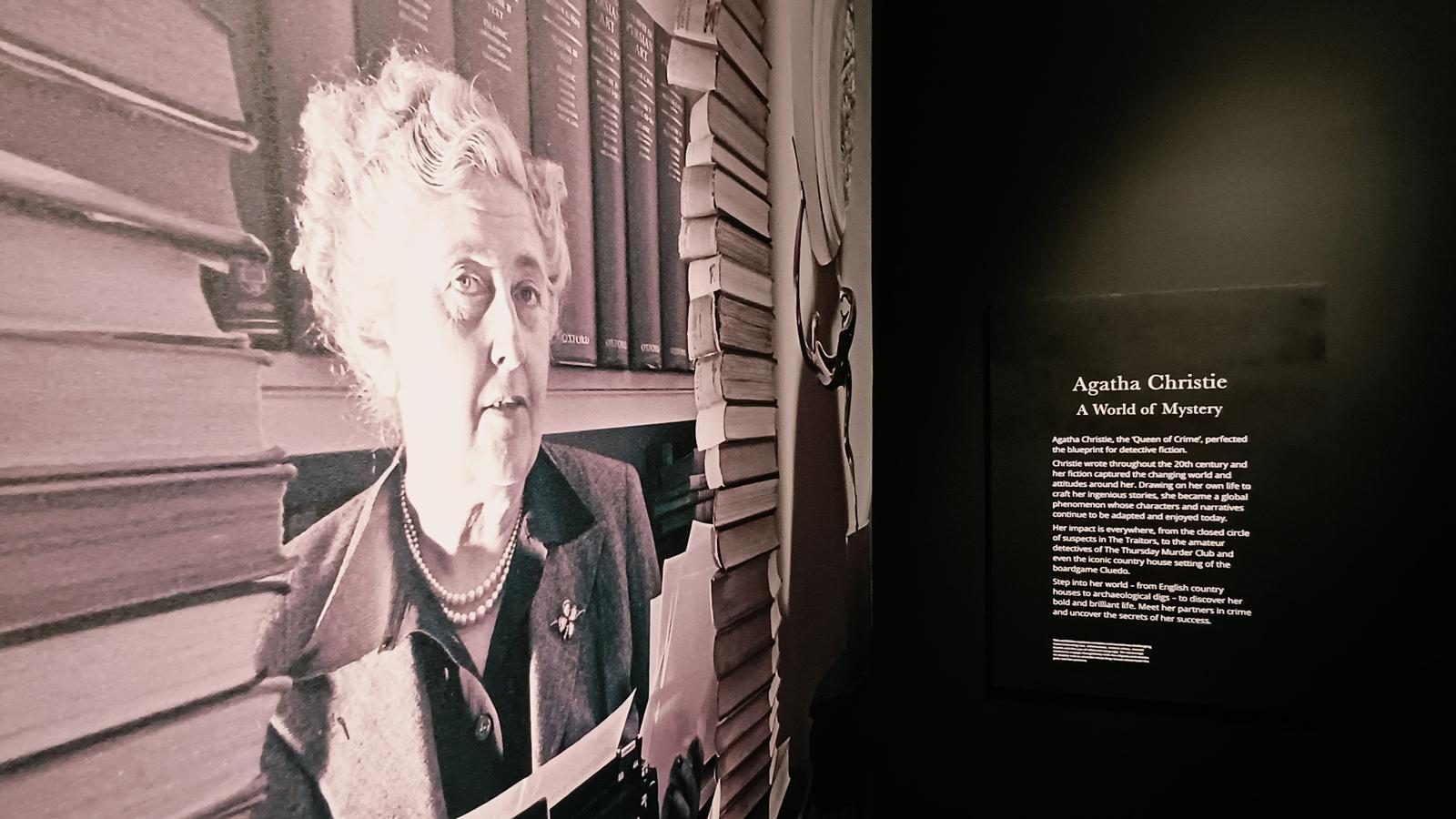
These are questions that the exhibition opening this Friday at the British Library, in London, attempts to answer, and it can be seen until June 20 of next year without interruption.
Fans of the adventures of Hercule Poirot and Jane Marple, Miss Marple, have an unmissable appointment there. What will they see? A delicate and friendly display, which delves into the great topics surrounding the author, and which is divided into five large spaces: the manor house from the end of the Victorian era, inspired by the house where she was born and raised, in Torquay (Devon); the hospital-dispensary, where she worked as a nurse, and where she learned a lot about drugs and toxic substances, something that would later prove very useful for her poisonings; the train: of course, the Orient Express, an ideal setting for the locked-room mystery; the archaeological site, and the West End, with theatre as a very relevant activity starting in the fifties, which, apart from film adaptations, would increase her popularity even more.
Among the long hundred of objects and documents on display, some for the first time, are personal photos, the portable Remington with which she traveled to Iraq and Syria, and which allowed her to write while she was at an archaeological site with her second husband, or the Leica with which she photographed the work being carried out there.
One can also read a brief letter from 1921, from the publisher William Heinemann, in which he informed her that he would not publish her first novel, The Mysterious Affair at Styles: "We have carefully examined your manuscript, but we regret to inform you that we do not feel in a position to offer you its publication…" Did he ever regret it?
There are letters from her aforementioned second husband, the archaeologist Max Mallowan; the last portrait that was made of her, painted by Oskar Kokoschka, and also first editions of her books, as well as notebooks –of the 73 of hers that are preserved– in which she sketched out the main lines of her stories. Without forgetting either the passports she used throughout her life, essential while she traveled from Iraq to Oceania, passing through the United States, Egypt, and a multitude of European cities.
A glance at her passports allows one to notice a detail that, at the very least, draws attention. Until 1946, in the profession section, she noted "writer". Subsequently, she changed it to "married woman". And in the autobiography, published posthumously in 1977, she left the following: "Married woman was my status and my occupation". "As a complementary hobby, I write books", she added. For being a supposedly marginal activity, the success was overwhelming, it must be remembered. She has sold more than 2,000 million copies in one hundred different languages.

And yet, her great-grandson, James Pritchard, stated in a brief conversation with ARA during the presentation of the exhibition that he believes she still lacks recognition: "Almost all my life I have had the impression that Agatha Christie has been undervalued and that she has not been given enough credit for the merit she has." What are the causes of this judgment of his? Pritchard says: "We can discuss the reasons. Perhaps it is that she is too popular. Perhaps it is a matter of literary genre: people do not like genre writers, or do not value them enough. Or perhaps, and I do not believe this factor is irrelevant, it is simply because she is a woman. I cannot believe that if a man had done what she did, he would not have been showered with praise from every corner of the world." Did he have Simenon in mind? He won't say.

The great-grandson's opinion is, to say the least, debatable. There is a film document collected in the last space, that of the theater, which emphasizes the relevance Agatha Christie had in her lifetime. These are the images of the gala dinner to celebrate ten years of uninterrupted performances, in the West End, of The Mousetrap, which had premiered in 1952. Now, in 2026, the play is still running. And it was only suspended during the pandemic. In 2027 it will be 75 years.
Not to mention that there is the inevitable reference to her disappearance, for eleven days, in December 1926, soon to be a century ago, and which caused a media stir that would now be called viral. The front page of the Daily Sketch –a tabloid that would give rise to the Daily Mail, still alive– is quite explicit: "Mrs. Agatha Christie found alive"… Found alive after the press treated it as just another one of her mysteries. A biographical enigma that the exhibition does not detail enough, not even keeping in mind that in the romantic novels she wrote under the pseudonym Mary Westmacott, she explored the suffering of a woman rejected by her husband and who stands one step away from suicide. The same thing that happened to her? That same 1926, her first husband had abandoned her.
As noted, this 2026 has marked the fiftieth anniversary of the writer's death and the centenary of the publication of The Murder of Roger Ackroyd, the novel that shook the conventions of the genre because the murderer is… No, no spoilers. It's better that you read it. And, if you can, the British Library awaits you.
