Von der Leyen announces a security alliance of the EU with Canada, the United Kingdom and Ukraine
The president of the European Commission proposes to Ottawa to be the first associate member and launches a message to Ceuta

-
CAT -
CAST
Brussels"It was the best of times, it was the worst of times". Echoing the words of Charles Dickens in A Tale of Two Cities –in reference to Europe just before the outbreak of the French Revolution–, the President of the European Commission, Ursula von der Leyen, has portrayed the moment the continent is living through today. "The state of our Union is stronger than ever. The state of our Union can also seem more precarious than ever", the German leader began in the speech on the state of the Union, with which the European political year is inaugurated every year.
The paradox, according to Von der Leyen, is that Europe has gained capacity for response while the environment surrounding it has become more dangerous. After a summer marked by the migration crisis in Ceuta, the rise of the far-right and the episodes of Putin's hybrid warfare at the borders of the EU, Von der Leyen has claimed the increase in defense spending by almost 80% in just five years and that it has responded to threats like that of Greenland. But, at the same time, she has admitted that it is a difficult moment because one is navigating in an "openly hostile" world.
The threat is twofold: on the one hand, external pressure –Russia, China, the fracture of the international system, disinformation– and, on the other, internal erosion from ultranationalists and "puppets of authoritarians", she explained. Faced with this, she has demanded more unity and more sovereignty: "In this world, the destiny of Europe must remain in the hands of the Europeans". And she posed it as a dilemma: "Do we want a strong and independent Europe that defends its values in this world? Or do we let divisions and dependencies hold us back?".
From the seat of the European Parliament in Strasbourg, the President of the European Commission has highlighted the trade agreements that the EU has signed under her mandate with partners such as India, Mexico or the Mercosur countries. "In this new world, we must urgently rethink our alliances and build global coalitions to strengthen our resilience and our democracies", she said.
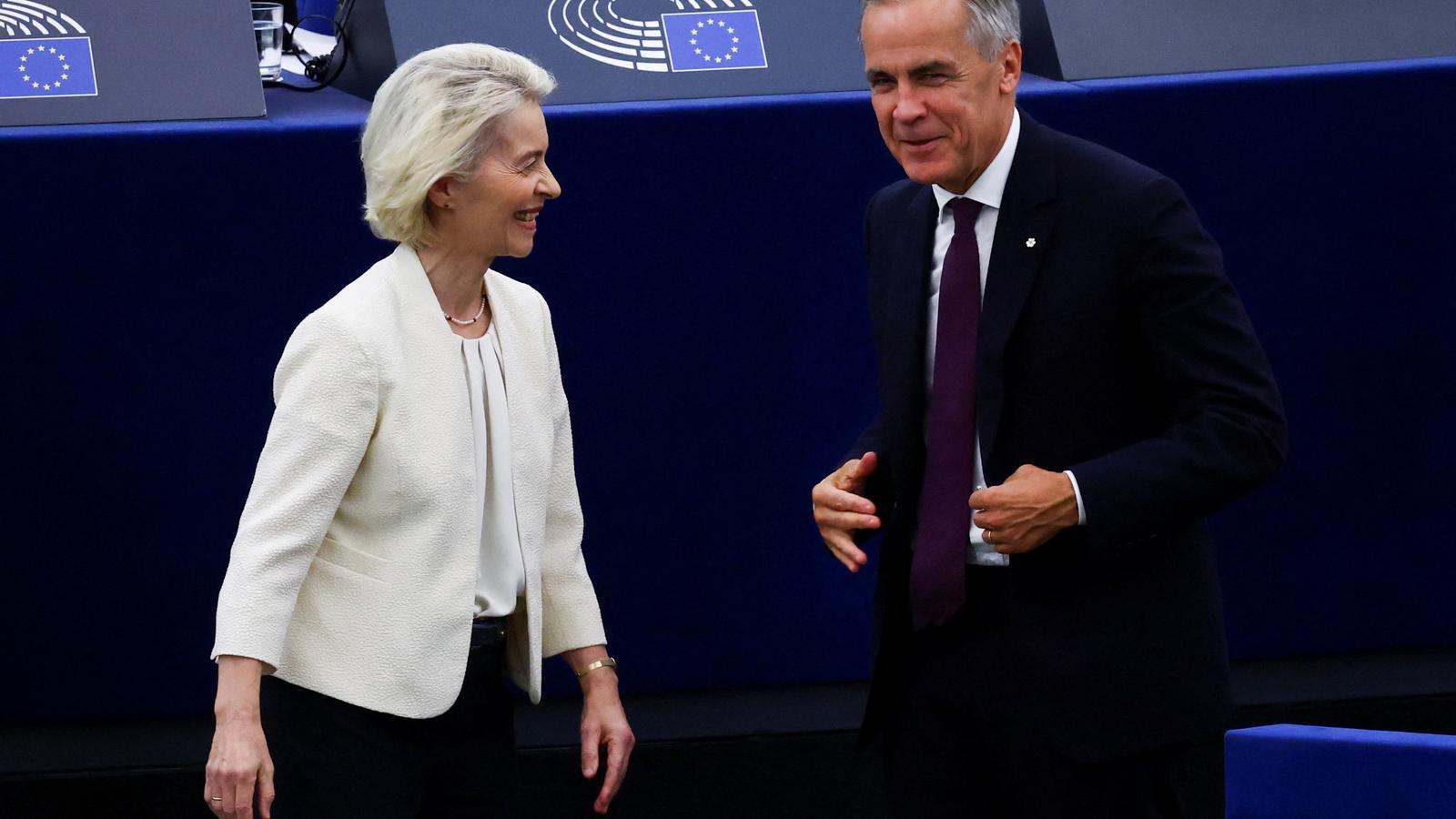
To respond to this need for partners, it has offered Canada to be the first associate member of the EU. The Canadian Prime Minister, Mark Carney, who has been involved in a confrontation with Donald Trump in defense of freedoms and global governance, has been the guest of honor in the hemicycle, and will speak on Thursday at the European Parliament. Von der Leyen defended that "democracies can choose who they work with" and remarked that the bond with Canada "is not against anyone, but in favor of our strength".
The alliance would also expand in the field of defense. Von der Leyen spoke of the Leipzig episode, which she attributed directly to "Russian operatives". The attack was not "only against a member state, but against our entire Union", she said, and stressed that the hybrid threats facing Europe are "less and less hybrid and more and more threats". To deal with this, she proposed a European Security Council that will include partners external to the Twenty-seven: Canada, Norway, Ukraine, and the United Kingdom. "The time has come for Europe's Article 4, or a Security Emergency Protocol", she stated. This mechanism, similar to NATO's, would activate an automatic collective response when a member state invokes it, in order to respond collectively to incidents such as sabotage or cyberattacks.
Warning to Beijing
Regarding the economy, Von der Leyen highlighted that the EU "has resisted better than expected" the impact of the Middle East war, but acknowledged that energy prices continue to impact families and businesses. For this reason, she insisted that reactivating the European economy must be "the number one priority": it is necessary to complete the historic review of the single market before the end of next year and advance in energy matters, with the goal of doubling the electricity share by 2040.
However, she warned that none of these initiatives will be of any use without addressing the trade deficit with China, which "is now one billion euros a day". "We have reached a turning point", she asserted. Von der Leyen recalled that she maintains a dialogue with Beijing; now it must "yield results". And she issued a warning: "Let it be clear: we will use all tools at our disposal to rebalance our relationship". To reduce dependence on China (80% in general and 90% in some rare earths), she announced a European Critical Raw Materials Corporation to obtain and store these materials.
"This has been the summer of truth for the continent", said the president in reference to the fires that have devoured Europe. The toll is "devastating": 660,000 hectares burned, 12 million tons of crops lost and more than 35,000 deaths during the heat waves. In this sense, Brussels is committed to maintaining climate goals, not only to prevent, but to adapt to the new reality. Von der Leyen has presented a new climate alliance with several axes: climate insurance (which will cover damages caused by natural disasters), a water initiative and a future European Firefighter Fleet.
The other great challenge for the future, she said, is artificial intelligence. After recent requests from some CEOs to slow down the development of this technology, Von der Leyen used a more cautious tone than in other years and highlighted the dangers of "self-recursive models". However, she maintains: "We must continue in the development race, because it is fundamental for our independence". And she remarked that we must work "in the European way": "AI can benefit humanity, if we do it right".
Minors and social networks
The area in which she has indeed dared to speak of regulation is social media. Thus, she has announced that the Commission will ban social media for those under 13 and will limit its use for those under 15. "We must not accept addictive features. We must not accept that children are dragged towards increasingly extreme content," she stated.
She also addressed the Ceuta crisis and wanted to send a message to Spain, specifically to the inhabitants of this city located on the African continent: "Ceuta is Spain. Ceuta is Europe. And Europe will be there for you." Regarding the crisis, the German leader assured that vulnerable people are being exploited, both by "unscrupulous traffickers and smugglers" and by their "adversaries," whom she did not detail. In this context, she presented the new European Emergency Response Framework, to face emergency situations at the borders. "We will comply with our principles," she said, but warned that the EU will not give up on protecting its borders: "We Europeans decide who enters." The initiative proposes strengthening Frontex to accelerate returns, and improving early warning systems and collaboration with third countries.
In the international arena, Von der Leyen condemned the funeral received by the criminal Ratko Mladic in Belgrade and mentioned Gaza. If last year's speech was marked by lukewarmness towards Israel, this time the former minister of Merkel's government has condemned Israeli settlements in the West Bank: "They are unacceptable," she stated.
