Blocus: Catalonia, on alert for an unclassifiable phenomenon
The Mossos will deploy a maximum device in Barcelona in the face of a risk that had not been foreseen since the protests for Pablo Hasél of 2021

-
CAT -
CAST
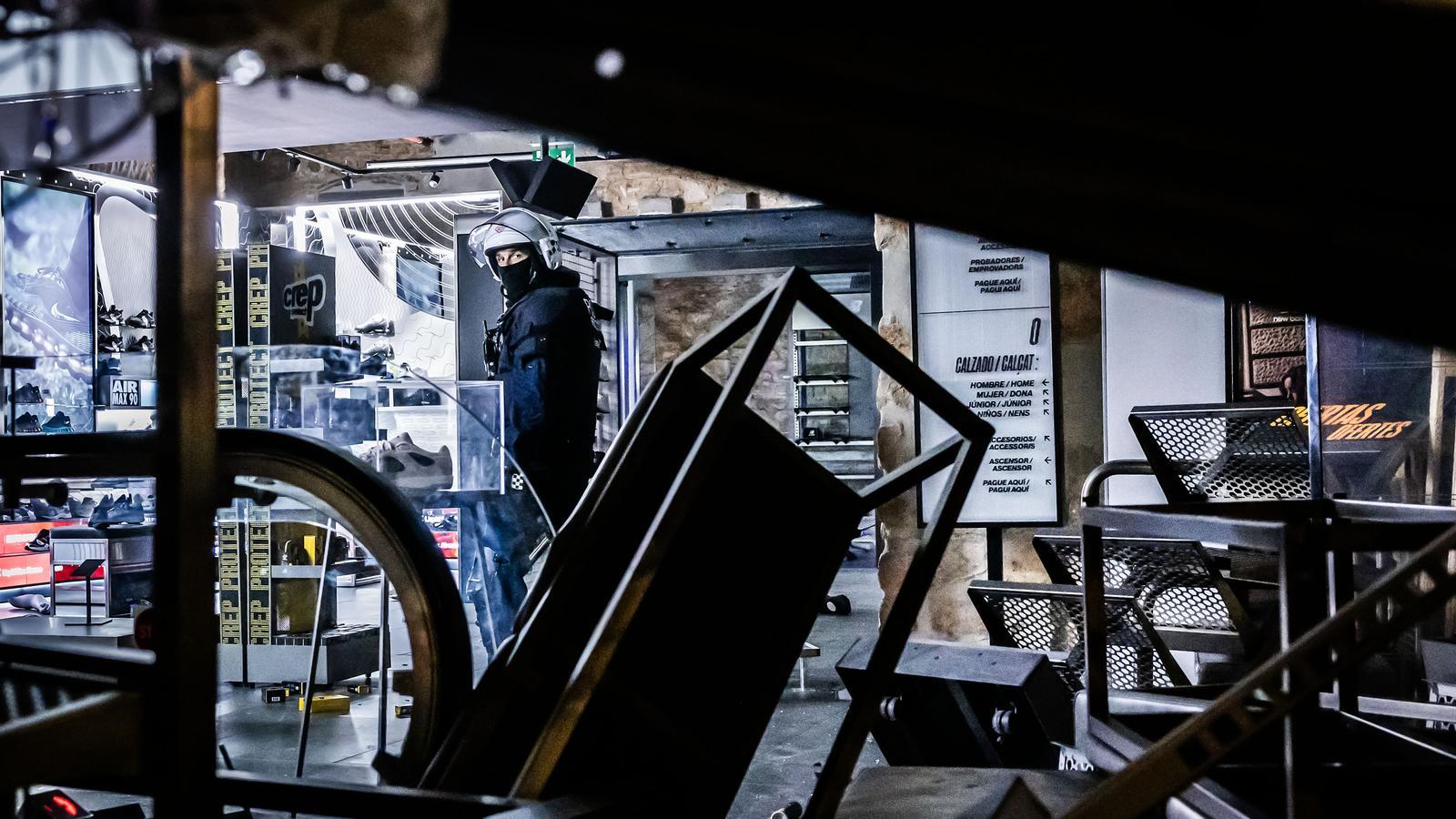
BarcelonaIt says a lot about how new a social movement is that it currently cannot be classified. Not even that it can be called a movement, nor that it is social. The Mossos d'Esquadra speak of Blocus as a phenomenon. They discovered it at the beginning of last week, shortly before riots that exceeded their expectations of violence. Since Saturday, they have been analyzing them in depth: the profile of those arrested, the users inciting these groups, the accounts calling for new protests... And in the last few hours they have carried out arrests in record time. For the moment, the police have not identified any clear pattern.
The Mossos are still not entirely clear about what Blocus is. They speak of a phenomenon because it is neither a mobilization nor a protest. Nothing concrete is being demanded there. It is not violent extremism either. The police have spoken with the intelligence services of several countries such as Germany, Italy, or Spain itself and, as of now, they all agree on the same diagnosis. All except France, where it is indeed detected that there is an ideological basis of educational demands. Precisely because of its novelty, with Blocus, the Mossos are considering changing the items they normally use to predict whether a demonstration will be violent.
The Mossos' specialists do not believe that there is an organization behind Blocus. According to police sources, there is a certain organization regarding how, where, and when the lootings should take place, but they do not detect a hierarchy or structure behind it. In fact, the agitators arrested so far have no relation to each other, nor are they IT experts. They do not have records for radicalism either. They are young people, police sources state, like many others. Some are founders of groups, others are amplifiers of the message, and many are moved by a concept as well-known nowadays as FOMO (fear of missing out, that is, the fear of missing out on something). "It is not an organization, we are not arresting affiliates. Ten days ago [the Catalan Blocus] did not exist," state police sources. In fact, posters have been seen in Spanish, but with pro-independence flags, anarchist symbols, and more symbology that, when grouped together, has no logic whatsoever.
The new calls
For the moment, however, the demonstration called by various profiles this Saturday afternoon in the center of Barcelona, coinciding with the Castanyada, is considered to be at a level of 4 out of 4. There has not been a demonstration with such high risk since the protests over the imprisonment of Pablo Hasél in 2021. There are three called: one around Plaça Catalunya, another on Passeig de Gràcia (near Casa Milà), and one on Passeig Lluís Companys. The police operation will be at maximum capacity, with mass identifications starting at 3:00 p.m. – on Saturday, 300 identifications were already made before the disturbances – and the removal of dangerous objects or balaclavas. And what if a boy comes with a Halloween mask? The 'Blocus' groups encourage those summoned to wear one to infiltrate among the population. The police will assess it in each case, but they may be confiscated if the officers consider it appropriate. In general, the Mossos ask for calm and for no one to stop doing their activities, from walking through the city center to opening their shops.

Although Barcelona will be the focus of attention this weekend, there are more than ten Blocus demonstrations called in various parts of Catalonia. However, it is not possible to speak of exact figures, since the calls appear and disappear easily on social networks. On Friday afternoon, there were calls to gather in Blanes, Terrassa, Reus, and El Vendrell, and the Mossos set up devices and carried out prior identifications, although there were no incidents. There are also some planned for Saturday in Lleida, Badalona, Igualada, Mataró, Girona, Figueres, Platja d'Aro, Martorell, and Gavà.
These are posters created with AI that are circulating on social networks –more than a hundred have been detected since Saturday–, but the authorities do not believe they pose as high a risk as in Barcelona and they are assessed with a risk level of 2 out of 4; the level that the protest last Saturday initially had and which they believe, before the riots spread, was the appropriate forecast. The Mossos reached this conclusion after seeing that many of the calls these days have been ghost ones, like the one on Thursday in Vic. Furthermore, most of these posters have very few interactions on social networks. One on TikTok received three likes.
In addition, the police have already closed four Telegram groups after turning, as ARA explained, to the Intelligence Center against Terrorism and Organized Crime and using anti-terrorist methods. The Mossos are now monitoring ten messaging groups (they want to keep some active to know what is being said there), but they are all practically inactive. "They only send emojis," notes one of the monitoring reports. The Mossos consider that the groups are the true indicator of whether a protest will have a following, more than the interactions a publication might have on TikTok.
The algorithm and virality
The big question is how these contents reached the mobile phones of young people who, predominantly, live in the first metropolitan ring. The Mossos have detected that the massive dissemination of these contents mostly occurred hours before Saturday's demonstration. Videos from Paris, of young people looting businesses and standing up to the police, went viral, and among this TikTok content, the calls to action began to appear.
Did someone amplify it? Was it the algorithm by itself? Did AI play any role? These are questions the Mossos are asking themselves and do not yet have an answer to. The police are also looking into whether the recruitment may have been developed through online gaming chats. This is a common dynamic in jihadist radicalization, to give an example. For now, this is not being detected.
Among the open police hypotheses is that of foreign interference or hybrid action, since the Mossos have been detecting them for some time. "We don't know. It is a hypothesis that will have to be refuted or confirmed," police sources point out, adding that it will be very difficult to know if it was the action of a foreign actor. In fact, the Mossos make it clear that it is not their jurisdiction and that there are already state bodies that are taking care of it.
