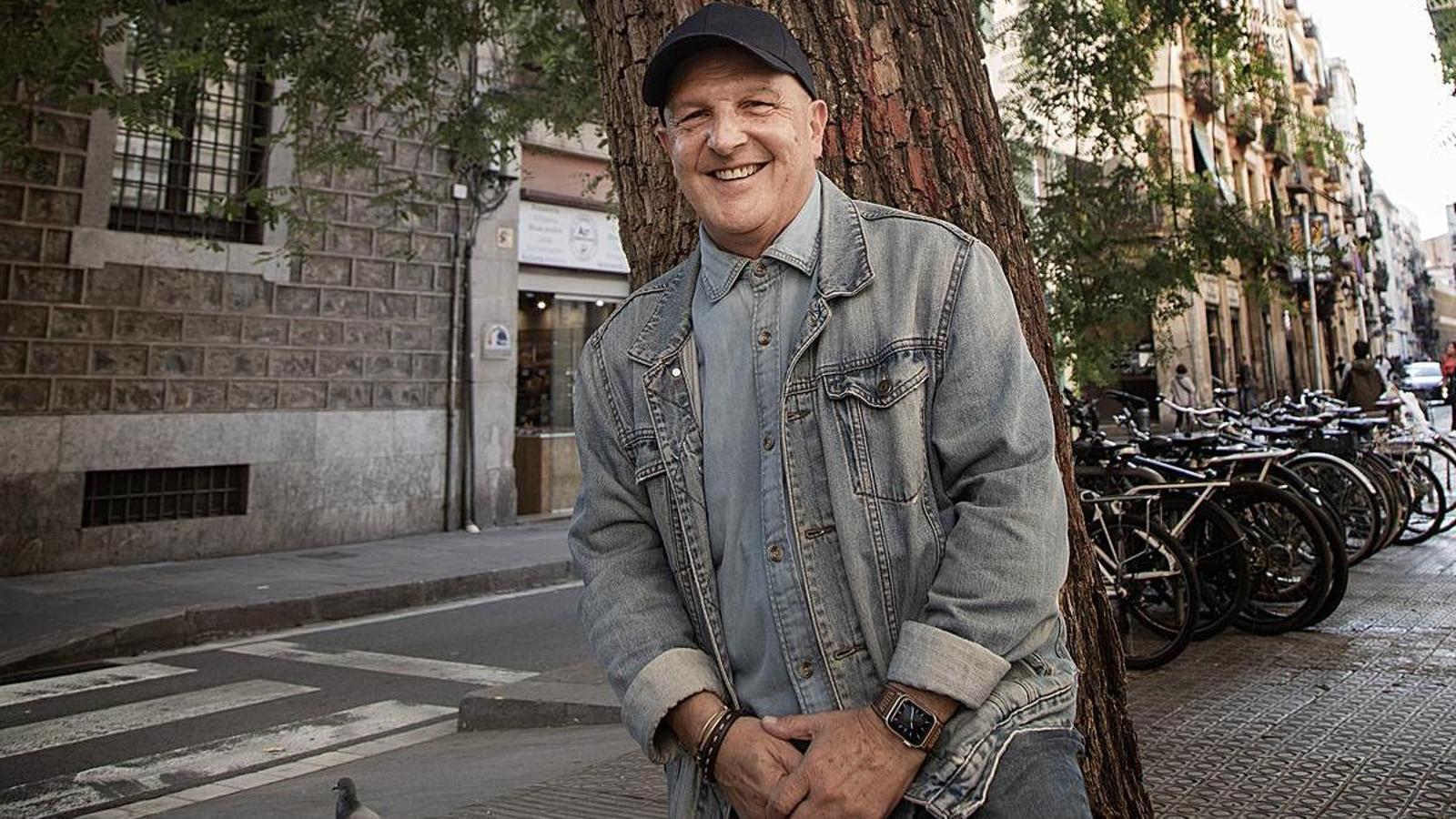
Claudio Lauria: "What has cost the most is breaking the stereotype that environment is only nature or ecology"
Filmmaker, founder and president of Suncine
-
CAT -
CAST
When he was a boy, he was gifted a Super-8 camera and made his first short film at just 13 years old. Born in Rosario (Argentina), Claudio Lauria was a “precocious” filmmaker, who learned very early on the mobilizing power of a good documentary, at a time when the Argentine dictatorship banned any form of cultural expression. Years later, once settled in Catalonia, he became a pioneer again when he founded the Environmental Film Festival, today called Suncine and considered the oldest of its kind in the world. Lauria defines himself as a “militant of culture, cinema, and life,” and it is largely thanks to his activism that Suncine—which will celebrate its 33rd edition from November 4th to 22nd—has just been declared by the Catalan Parliament as a "strategic cultural event for Catalonia".
You also define yourself as a self-taught filmmaker.
— I have had many teachers. They are not in my memory, they are in my body. Like Luis Bras, one of the great animation filmmakers not only of my city, Rosario, but of the country, and of the world. He taught me many tricks and many things with a 28-second wind-up [camera] Bolex. I was sixteen or seventeen years old when I met him. They were very dark times. I had an active militancy. We were screening a documentary film by Pino Solanas that was called La hora de los hornos, which was prohibited. With a 16mm projector and a bedsheet, we went through the neighborhoods screening it, always being chased, obviously. Sometimes, halfway through the film, we had to unplug everything and run away.
Are you an activist?
— Videla made me a militant by force. My brother went into exile before the military coup. Many friends disappeared, others died, others went into exile. One day I woke up with paramilitaries inside the house, at 13 years old, looking for my brother. We could all have died that day, but it did not befall us. I remember that man, a fascist, an ignorant person, telling my father: "So you are not a Marxist!", and my father trying to explain to him that the book he had found was not by the Marx he thought, but by Groucho Marx. We had burned all the books a year earlier in the backyard of the house: a history book could be the cause of your death or disappearance.
How did that mark you?
— It marked me in every aspect, because for me at that time cinema was only documentary. My gaze was only documentary, because I believed that through cinema we could transform or at least provide a record of what was happening. It does not mean that fiction does not do it, but generally it does so much later. The documentary is a record, it is the document, it is here and now. For me, documentary cinema has been my alma mater. And I began to discover it through the eyes of Pino Solanas, Jorge Pregorán, Fernando Birri, Octavio Getino, Costa-Gavras, among others.
Documentary of denunciation, then.
— Or of strong social content, that explains human stories. For me, human stories and their relationship with the environment, whether social or natural, always mobilize me more.
How did you end up in the environmental documentary?
— It was much later. The seed of the [Suncine] festival was a three-day event in Buenos Aires where I convinced Luis Bras to exhibit his work. I realized the value of seeking out and showcasing what great talents are doing. Luis was introverted and shy, and that was a gift because he didn't usually show his things. Luis has been a role model for me; he brought magic into my life, and I was motivated by his talent and his way of understanding life. Pino Solanas instilled in me a sense of activism. And I was also lucky enough to meet him personally; I did a workshop in Buenos Aires with him. He took me to a window and said to me: "Do you see that tree over there? That is cinema. Now, if you take that tree, shrink it into a bonsai, and put it in the bathroom window, that is television." Years later, I met him again when I helped set up the San Cristóbal de las Casas Festival in Chiapas, and I asked him if he remembered the story of the tree, and he told me that he did.
Do you also prefer cinema to television?
— It is neither better nor worse, just different. Before, producing a documentary was very expensive and required many resources; now, it is easier. With this [points to the mobile phone], you have enough quality to record and communicate massively. But what matters are not the formats or the media, but the stories you tell. If you manage to move people, it does not matter if it is on a big or small screen. Good films first enter through the heart and from there they make the journey to the head, not the other way around. That is why it is beautiful to watch the film a second time to make the reverse journey: from the head to the heart. Then you find a lot of details that you had not seen before.
You have also done television, in fact.
— During the dictatorship the film school was closed. It reopened the year after the fall of the dictatorship, in 1984, but it was empty. We started working in television because there you had the resources that were not available at the school. We believed that we could do things there, but we realized that we could not do it, because television is the bonsai that is on the bathroom window.
What do you mean?
— We had to do things that didn't interest us. And the weekends were when we did what we liked, like a little documentary I made that reached the hands of Arafat, which was called En Palestina nacerá la paz. I still have a scarf he sent me as a gift.
How did you end up in Catalonia?
— I needed a change of scenery, and my brother had been here since the year 75. I came to Barcelona for four months and 38 years have passed. I started working as a waiter, and with my savings I bought a camera and started filming everything, accidents, whatever it was, and I sold it to television. For a while I sold curious images that were seen at the end of the show to Arús. I worked for a production company covering sporting events for Televisión Española. And with all that I gathered money, I bought a station and I set up Channel 29 with two friends, which was the local television of Castelldefels. And in those years I made a short film that was called No nos hundamos, which was an analogy of a ship that had sunk with what was happening to us on the planet. And I decided to set up the festival.
Let's talk about 1993, how was a film festival set up back then?
— It is almost like producing a movie, a script is made, resources are sought... At that time there was no Google or email; everything was by fax and letter. The first years were very hard, I went to many festivals around the world and I built a database of producers from America and Europe. I remember we took about 3,000 envelopes to the post office with the regulations and the registration form to send. Each participant would send us a VHS that we would watch; if we liked it, we would ask them for the Betacam or the U-matic. Sometimes I don't understand how I managed to do it.
Who were you?
— I started with Thomas Münzer, a German guy I used to work with making videos and at the local television station. That is how FICMA was born, the International Environmental Film Festival, and it started in Castelldefels, but later the mayor of Gavà, Dídac Pestaña, may he rest in peace, came to me and proposed moving it there. It was the second edition and there was a massive growth.
How were you funded? Grants?
— Yes, Gavà provided a lot of support, but over the years we gradually gained publicity. When we left Gavà, we were left without a "home" and that reached the ears of the then-president Jordi Pujol; he called me and invited me to see him. He offered me help to look for another city to hold the festival, and we ended up choosing Sant Feliu de Guíxols. This festival owes part of its life to Pujol, whatever may be said about him now.
Why did you specialize in the environment? Did you think it was a niche that remained to be covered?
— Of course, as a documentary festival, there was only the one in Bilbao. I created a space at the festival called Doc TV where the main television networks were: National Geographic, the Discovery Channel from the United States, Odisea, Documania... They came every year. And that transformed us into a benchmark festival; it put us on the map of documentary film festivals in the world. People+Arts, for example, the Discovery channel, was launched here many years ago with the film Alive!. I brought Fernando Parrado, a survivor. It was the only time in 33 years of the festival that we had to repeat a film the next day.
Alive! is it environmentally friendly?
— Don't you think? Humans surviving in the middle of nature: it explains what we do in extreme moments, how far we are capable of going. Once, we showed a film about antipersonnel mines, and upon leaving, I heard a woman complain: "And what does that have to do with the environment?". I approached her and said: "We haven't deceived you, because when we talk about the environment, we are talking about life, including human life". Why should a lion's life be more important than a human life? We are nature! Everything is the environment and everything moves with an engine called life. And from there, we build values in defense of life or otherwise.
The environmental documentary is not just the reports on La 2 that help you sleep.
— The thing that has taken us the most work has been breaking those clichés. The cliché that environment is nature, is ecology... No, the environment is a table with many legs, not just nature or ecology: it is also human rights, the cultural part, the economy, it is also a war. We have brought to the festival various productions by Leonardo DiCaprio, one of them was Checkpoint Zoo, which recounts the evacuation of a zoo in Kyiv during the Russian bombings. A production that cost three and a half million dollars. At the festival, we have awarded films that have ended up at the Oscars like Virunga or recently Yanumi, people have passed through there like Jane Goodall, the Cousteau family, Daryl Hannah, Fernando Trueba, Martin Sheen, Icíar Bollaín, Beatriz Rico...

In this time have you made your own documentaries?
— Yes, I made one about Pepe Figueres, who was president of Costa Rica and built there the democracy that exists today, the country of natural parks and the pure life, and that he was the son of Catalans, his father was from Os de Balaguer. From him I learned this life maxim: “He who does not live as he thinks, ends up thinking as he lives”. But now it has been 20 years since I last filmed and I have a lot of itch, I think next year I will do one.
