The dismissal of the Constitutional Court judges triggers the crisis in Poland
The conservative opposition accuses the government of a coup d'état and the president returns urgently from a trip to Senegal
-
CAT -
CAST
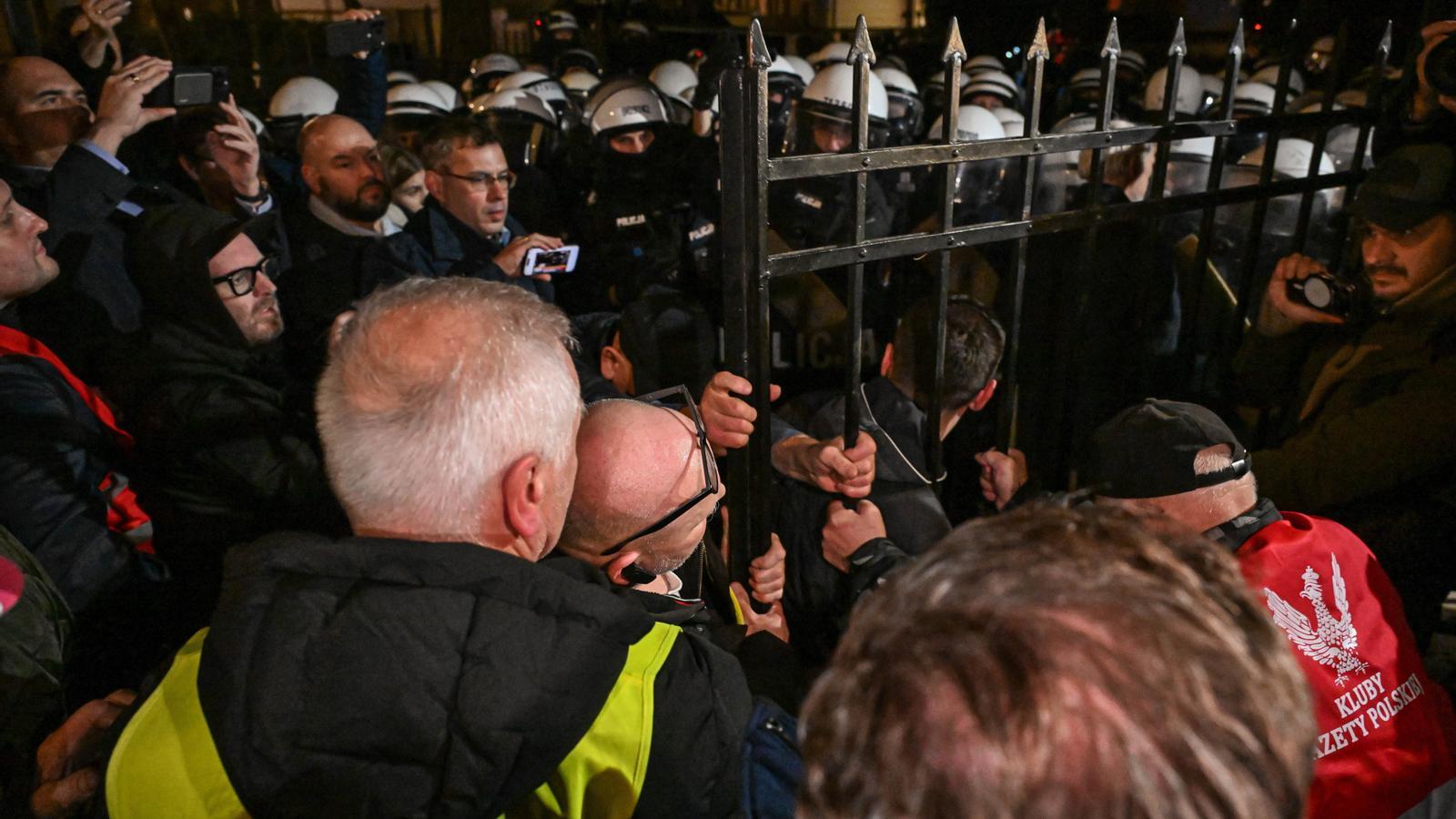
BarcelonaRiot police were deployed this Friday night at the Constitutional Tribunal headquarters in Warsaw following a protest over the dismissal of its president, which ended in clashes and triggered a new institutional crisis in Poland. This is the latest episode in the battle between the liberal, pro-European government of Donald Tusk and the ultra-conservative opposition of the former Law and Justice (PiS) party government. For ten years, both sides have been clashing over the independence of the court, and the suspension of its president, Bogdan Swieczkowski, and vice-president Bartlomiej Sochanski has reignited the conflict. Officers arrived at the court to protect the judges who were inside the building protesting against the suspension of their colleagues.
On Thursday, the new interim president of the high court, Anna Korwin-Piotrowska, removed the two magistrates from office, triggering clashes between factions. Korwin-Piotrowska, who was appointed by Tusk, accused her predecessors, who were in turn appointed by the government of Mateusz Morawiecki (PiS), of having obstructed the work of the judges elected by the current parliamentary majority. Afterwards, the Ministry of Justice announced that it intends to lift the immunity of the two magistrates and file criminal charges. In the background lies the problem of the country's democratization after 8 years of the ultra-conservative government (2015-2023), which created a tailor-made justice system and placed the Constitutional judges under its control with a judicial reform that European justice authorities considered contrary to the rule of law.
In December 2017, Brussels activated the Article 7 procedure of the Treaty on European Union for the first time in the history of the EU, considering that there was a "clear risk of a serious breach of the rule of law" due to political control over the Polish judiciary. Furthermore, the Court of Justice of the EU imposed a daily fine of one million euros on Poland for maintaining the Disciplinary Chamber of the Supreme Court, which it considered an instrument of the government to control and dismiss judges at its convenience.
However, the institutional legacy of the PiS—including the composition of the Constitutional Tribunal—has filled Tusk's plans with legal obstacles. Thus, for years, the Constitutional Tribunal has been at a deadlock and in a situation where its members mutually deny each other's legitimacy, which has led to an institutional crisis with uncertain consequences.
Tusk's unexpected victory in the 2025 elections halted the judicial reform, but the judges appointed by the PiS remained in office and blocked the new liberal government's parliamentary initiatives. The current government is trying to renew the Court and restore its legitimacy, but it has encountered resistance from the president and the outgoing leadership. Tusk presented a plan on the rule of law in February 2024, the European Commission unblocked the withheld European funds and announced the closure of the Article 7 procedure in May 2024, considering that there was no longer a clear risk of a serious breach.
In recent months, Parliament had elected three new judges to replace those whose mandates had expired, in some cases for more than a decade, but the country's president, Karol Nawrocki, close to the PiS, a declared rival of Tusk and an ally of Donald Trump, had refused to appoint them. The plane carrying the president to Senegal, where he was scheduled to make an official trip, turned around tonight to return to Warsaw.
Hundreds of protesters, including some deputies, gathered in front of the court headquarters to support the suspended judges, and the police made three arrests. This morning, Nawrocki appeared at the scene, crossed the police cordon, and declared that the magistrates appointed by Parliament "are not Constitutional Court judges." He criticized "the violation of Poland's constitutional order" and said that the court "has been taken by force," before urging the police to leave the building.
Everything points to the clash polarizing the country even further, in an act that is already part of the pre-campaign for next year's legislative elections, in which, according to polls, the extreme right could return to power.
