Declarations of love, the “quietly” and the rock star Rufián: the 10 moments of the 29-N campaign
The irruption of candidates in podcasts and entertainment programs marks an electoral race with a lot of presence on social networks

-
CAT -
CAST
BarcelonaThe housing crisis, which precipitated the elections, the tragic accident in Urda, and the background of the massive entry into Ceuta. These are the major themes that have marked the November 29th campaign, but the last two weeks have also seen many moments that could be decisive in mobilizing voters. The use of AI, the fever for interviews on podcasts and entertainment shows, and the candidates' own statements have defined a highly polarized campaign that has been played out as much at rallies and debates as on social media, with the left armed with digital armies. At ARA we have selected 10 hits that explain the path to November 29th.
1. Begoña Gómez and the interview in Lecturas
Pedro Sánchez's strategy in this campaign has focused on trying to humanize his figure and distance it from the cold and calculating image attributed to him by the right. That is why his dancing at rallies and his multiple informal interviews, in which he has spoken about his origins, his daughters and, above all, his wife, Begoña Gómez. Under investigation for alleged corruption in a case that the Spanish president describes as “fictitious”, Sánchez has made her the protagonist of the campaign.

The photograph of the kiss between them both at a pre-campaign event, which filled front pages, was only the beginning. The campaign started with Gómez's participation in the PSOE rally, and the socialist candidate has dedicated multiple declarations of love to her in fifteen days. The most talked-about one was in an exclusive interview with Lecturas: “I cannot imagine my life without Begoña”, headlined the gossip magazine.
2. AI impersonates identities and 'resurrects' Xirinacs
The use of artificial intelligence by the parties has been significant in this campaign. The PP has gone all out with various videos and images made with AI that have gone viral on networks and which, in several cases, have generated controversy. One of the most controversial creations was a video in which the faces of Begoña Gómez, José Luis Rodríguez Zapatero and Santos Cerdán appear, among other socialists, acknowledging the facts for which they are being investigated in the courts.
The Popular Party, whom the Socialists reported to the justice system for this video, have not been the only ones to use AI in the campaign. In Catalonia, for example, Alhora posted a video in which it revived the historic politician and activist Lluís Maria Xirinacs and made him dance next to the candidate, Jordi Graupera. The criticism led the party to delete the video from social media.
3. Abascal’s goal on ‘La revuelta’ and the snub to Jordi Wild
The candidates' appearance on La Revuelta, David Broncano's comedy show on TVE, was one of the most media-awaited moments. Sánchez broke the ice with ease, followed by the tandem of Gabriel Rufián and Irene Montero and, from the left flank, Ada Colau also appeared. On the right, the popular Alberto Núñez Feijóo did not dare to face the format or the progressive tone of the interview, but the leader of Vox, Santiago Abascal, did so, which turned his interview into one of the campaign's highlight moments.

The far-right leader managed to impose his audience on the set, who applauded him during any intervention, and quickly disarmed Broncano, who lacked the tools to counter the ultra discourse and ended up apologizing. The program was the most-watched in the history of La revuelta, with 4.8 million viewers. Just after his success on TVE, however, Abascal made a bad decision, at least in the eyes of his audience: cancelling his interview with the influential youtuber from Manresa, Jordi Wild.
The official argument of the Vox leader was the fear that some fragment of the conversation would be cut, even though Wild had guaranteed that this would not happen, and the communicator's anger multiplied on the networks among the bulk of influencers from the far-right orbit. “You cannot vote for Vox,” El Xokas went so far as to say, who approaches 15 million accumulated followers.
4. Feijóo's English and his alter ego, Anotop At
Alberto Núñez Feijóo did agree, like Pedro Sánchez and Ada Colau, to step up to the microphone of The Wild Project. The head of the PP list did so to try to connect with young voters, but his discomfort was evident and he ended up giving a headline that did not leave him in a good place. “I don’t know English, but I know how to govern,” Feijóo replied, when Wild asked him about the knowledge of the language a president should have. Sánchez and Colau, on the other hand, passed Wild's interrogation without a scratch.
Also in an attempt to rejuvenate the popular candidate, the conservatives have exploited in the campaign the character of Anotop At. It is a kind of alter ego of Feijóo, made with AI, that appeared on social media and that has adopted multiple forms: from trap singer to pirate, Shaolin monk or secret agent. But the name of the character, which the party's leaders have claimed en masse, is born from a slip of the tongue that Feijóo had a year ago in Congress, in an attack on Sánchez that did not go well for him.
5. The fan phenomenon of Rufián

Despite not having achieved the unity of the left that he was pursuing, the ERC candidate, Gabriel Rufián, has caused a sensation in the campaign, especially among the youngest. Screams at his rallies, hugs, and queues to take selfies with him or get t-shirts with his face on them have been a constant. And videos have even spread on social media of young people taking campaign posters of the republican from the street to take them home. Esquerra has taken advantage of the appeal of its head of list, aware—mind you—that some of his fans are still not old enough to vote.
6. The “Yo sí te voy a votar...” of the PSOE
The soundtrack for the PSOE, and one of those of the campaign, has been “Yo sí te voy a votar”. The song was born following a sentence in a rally by the PP spokesperson in Congress, Ester Muñoz, who told Pedro Sánchez that “nobody” would vote for him. On social media, videos have multiplied of these statements followed by people dancing to a response song that says “Yo sí, yo si te voy a votar, Pedro Sánchez, lo vamos a demostrar...”
The song, which has gone viral, has been used by socialist leaders and militants to record themselves dancing and post the video on social media. Minister Isabel Rodríguez and the Minister of the Presidency, Albert Dalmau, joined the trend, and it was also done by celebrities like Jorge Javier Vázquez and Laura Escanes to express their support for the PSOE candidate.
7. Puigdemont's interview in El Mundo
One of the most unexpected moments that most shook the campaign was the interview that Carles Puigdemont granted to El Mundo hours before the Sánchez-Feijóo face-to-face debate. The former president accused the socialist of having a “boundless ambition” for power and asserted that Junts had taken advantage of it to “defeat Spain” with the amnesty. He did so, moreover, in conversation with the media outlet and the very same journalist who published the false accounts abroad belonging to Xavier Trias. A total earthquake inside and outside of Junts. A few days later, the Supreme Court confirmed Puigdemont's definitive amnesty and, after nine years of exile, the former president announced that he will return to Catalonia on December 12th.
8. Feijóo prevails over Sánchez in the head-to-head

In the midst of the hangover from Puigdemont's interview, Feijóo and Sánchez faced off in the only head-to-head of the campaign. A duel in which, according to most of the published opinion, the PP candidate prevailed. The popular candidate cornered the PSOE leader with data and attacks, who chose to avoid the confrontation and ended up apologizing for the corruption and the train accidents in Adamuz and Urda. The republican Gabriel Rufián claimed that Feijóo had “eaten” Sánchez.
9. Feijóo's “you, be quiet” to Colau
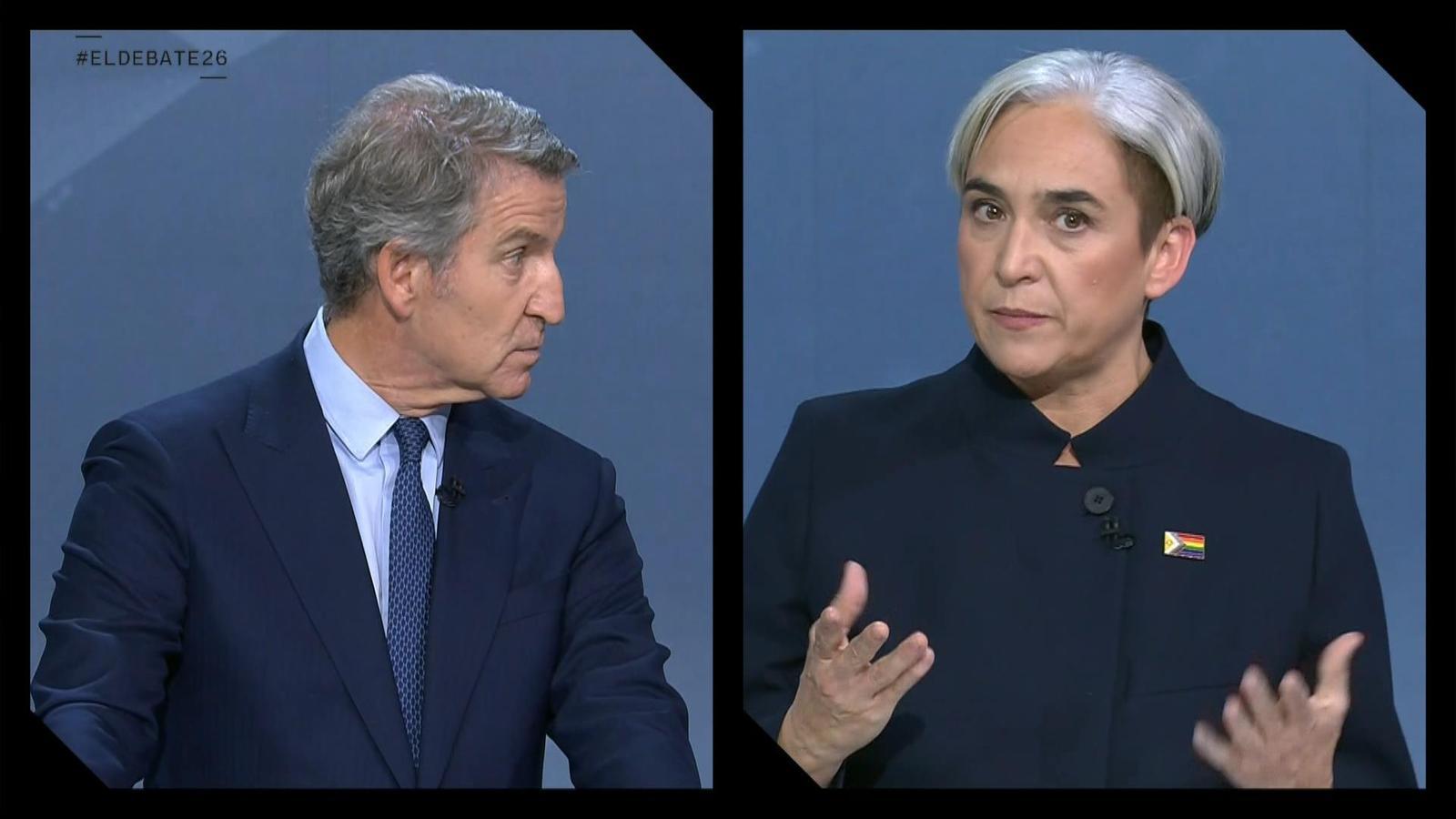
Almost a week after the head-to-head, Feijóo's euphoria collided with the four-way debate with Sánchez, Ada Colau, and Santiago Abascal. The Spanish president, who regained his incisive tone, and the Broad Front candidate joined forces against the PP-Vox bloc to skillfully attack the right-wing's theses on housing, immigration, and feminism.
The debate, however, will be remembered for the accusations of sexism against Feijóo after he told Colau that she was "quiet" regarding Sánchez's management after the DANA in the Valencian Community. After the debate, Feijóo said that he would withdraw it if it had "bothered" anyone, but later he reaffirmed it. Be that as it may, it had already become a hit for the left to mobilize the electorate.
10. The Council of Ministers and the CIS, the PSOE's weapons
The PSOE has used the fact of being in the Spanish government as an electoral resource. The council of ministers has multiplied its activity during the campaign with the approval of a whole battery of social measures, such as the increase in the minimum wage and the salary of civil servants. Measures that, like the anti-eviction decree that the right-wing parties had rejected, have received the endorsement of the permanent deputation of Congress, where the executive does not depend on the vote of Junts. The objective of the PSOE has been to make a simulation of what four more years of a progressive government would be like in Spain. A possibility that is precisely drawn by the CIS, practically the only one of the polls that gives an absolute majority to the PSOE and its left-wing partners.
