Pol Makuri: “My disability has allowed me to live things that almost nobody will live”
Athlete
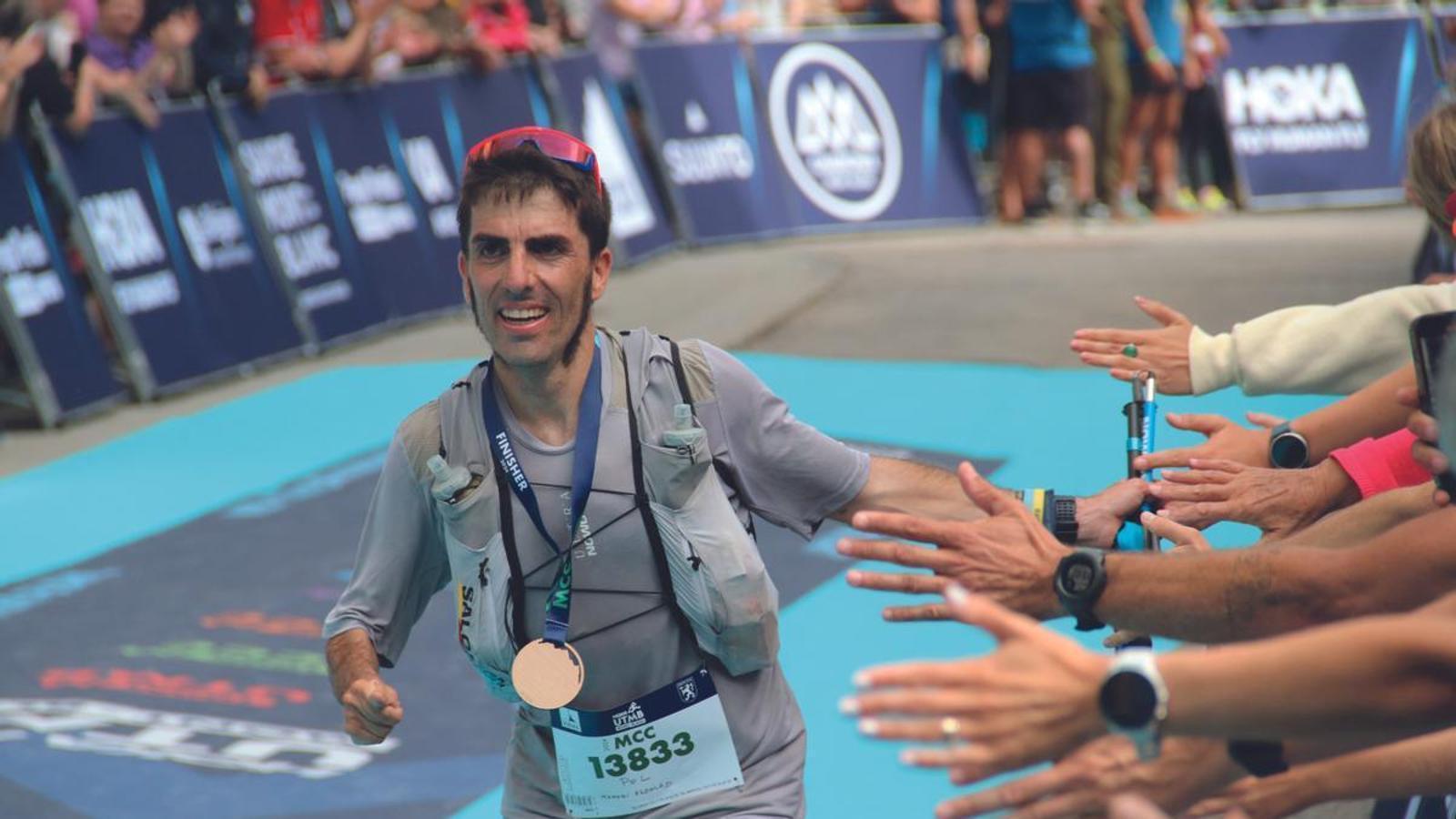
BarcelonaPol Makuri Redolad Garcia was born in 1991 in La Paz (Bolivia), where his parents were working before returning to Igualada. That is why he has a compound name, half Catalan (Pol) and half Andean (Makuri). Pol was born with cerebral palsy that affects half of his body as a result of hemiparesis he suffered during pregnancy. His parents discovered it when they saw that he only grabbed things with one hand when he was a baby. Over time, he has become a benchmark in adapted sports. He was the first athlete with cerebral palsy from Spain to compete in a Paralympic Games, in 2008 in Beijing. He was also the first skier in a Nordic skiing World Championship. He is now a well-known face in mountain races, is a Salomon athlete and is publishing his first book, Tell me I can't (Cossetània).
He has always faced challenges. This one was different: explaining his life in a book.
— Yes. And the first thing they told me was that I had to hold on tight, that there would be curves ahead.
You often say that doing sports has allowed you to know more about what you are like on the inside. Have you also discovered things about yourself through writing that you were unaware of?
— It is true that sport has helped me a lot to know more about myself. Cross-country skiing was a time of great self-demand, in which mentally I faced situations of high stress. And I suffered blockages where I didn't quite know what was happening to me. Writing the book has helped me a lot. After being able to debut at the Paralympic Games, I left cross-country skiing and began to understand many things about my trajectory and situations in which the brain would block. It was clear to me that I wanted to explain my disability, but not from the physical side; because my case is a birth injury, cerebral. So all of this has gone very well for me to organize concepts. For many years I said that I had suffered a stroke, and it is not so. I have been learning about what happened to me, reflecting on how the brain works. The people at the Guttmann Foundation have helped me a lot to put a name and words to my own disability.
He has lived many lives already, while still being young. And he has found many people who have helped him.
— Yes. But in the book I also wanted to talk about another part, that of the obstacles. Situations that I have found very difficult, which I had practically not explained to anyone before. And here I have wanted to explain it, but being careful not to cross a red line, so as not to shoot myself in the foot.

Does it refer to the problems a pioneer encounters when there are no established structures that allow them to participate?
— A person who held an important position in local sports told me that my sports career in cross-country skiing was made by going against the system. Because nothing was designed for someone like me to be able to compete. And when I fought, others looked the other way.
An athlete with cerebral palsy had never been to a Winter Paralympic Games. How did he do it?
— The problem is that we have people with disabilities who will not be able to participate in some sports at the Paralympic Games because the category or discipline does not exist. When I was doing cross-country skiing, the Spanish Federation and the Catalan Federation asked me for minimums to reach the World Championships and the Paralympic Games that, due to my disability, were impossible. The times were not designed for someone like me. The criteria are the same for someone without an arm as they are for someone with cerebral palsy. For me, it is a system that is not fair. I fought hard for 12 years.
When I was young, my dream was to be able to play roller hockey. Afterwards, skiing. Always finding people who said I couldn't do it, and others who did add to it.
— I was able to enjoy my time in hockey. I found a team that opened its doors wide for me. And from then on, it was a completely ordinary life, without obstacles. Even the opponents or the referee congratulated me more than once. But with skiing, I have indeed encountered many obstacles. It was a labyrinth from which I could not find the exit. It wasn't until I debuted at the Games that I realized I had opened a door. And I understood many things about my own path.

Where does your character come from, we could say a bit rebellious, of not accepting many unjust situations and continuing to fight?
— This is how I am. My problem was at birth. So... I have not had any trauma, I have not had any accident. That helps. And I have entered a world, that of adapted sport, where everyone experiences it in a spectacular way. I would say that I have not met anyone who experiences it in a negative way. And that is why it is important for a person with a disability to watch Paralympic sport or adapted sport on television or in the media, because they see a very interesting way of living life. That is why I always say that everything that has happened to me is a stroke of luck. My disability has allowed me to experience things that almost no one else will experience. I have been able to compete for 12 years in cross-country skiing, sharing experiences with people with Chernobyl deformities, with war wounded, with people who have survived accidents... In the races the same thing happens to me: I experience the same as the other athletes, but with the added value that I am a person with a disability and competing at an international level. And all this, when you put it on a scale, weighs more in favor. Of course I have asked myself a thousand questions. I have cried a lot. I have asked myself why it happened to me. That is part of the journey and will be part of my life. And that means that if today I experience it one way, tomorrow I will experience it another.
And how do the parents experience all of this?
— Well, very well. I mean, they are freaking out. But I suppose they are already used to seeing how I am always up to my old tricks and preparing new things... They wonder how I will surprise them now.
And how will it be?
— I am considering a 100-kilometre race. I am at a point in my sports career where I want to observe what my body is capable of. My body has shown me that it is capable of many things, because I have swum in the sea, I have covered 60 kilometres after climbing Mont Blanc... I want to see where we can get. For years, thinking about doing a marathon was taboo. And I was able to do it. I did it at the Salomon Ultra Pirineu. Later I did the Oman marathon, where it was 42 km on the first day, 55 on the second, 47 on the third and 21 on the fourth, through the desert.

