Sánchez looks for the miracle: where could he win the elections?
The polls favor Feijóo and Abascal, who have tried to minimize risks during the campaign

-
CAT -
CAST
BarcelonaThe resilience of Pedro Sánchez, adapting his priorities and principles to what each moment required, is beyond doubt. Electorally, he already bounced back in 2016, when it seemed that Podemos would end up eating up the PSOE, and he did it again in 2023, when a week before the elections, Alberto Núñez Feijóo already saw himself in the Moncloa. A fan of office politics, which, as El Mundo Carles Puigdemont has stated –in a pejorative tone–, he is capable of anything to retain power. Each time, however, he has found more difficulties along the way to the point that we arrive at the most difficult of all: the miracle of Sánchez.
The X-ray of the Spanish executive's exhaustion is complex in a legislature without a budget –the Spanish government has not even fulfilled the constitutional obligation to present them–; with numerous cases of alleged corruption –former minister José Luis Ábalos has been sentenced to 24 years in prison–; with the exhaustion throughout the State for having approved the amnesty for the leaders of the 'Procés'; with skyrocketing inflation that directly affects the purchasing power of citizens; with the perennial crisis of Rodalies added to the two fatal high-speed rail accidents; with the massive entry of immigrants into Ceuta, and with a housing crisis that has triggered the first general strike in fifteen years –which the government has redirected against the opposition–, as the thorniest issues. The executive shields itself from criticism by pointing to the State's economic growth –at the forefront of the EU–, the high employment rate, and the measures to protect the most vulnerable –some of which were approved by the council of ministers already in the election period.
That there can still be a game with this track record is to the credit of a campaign in which Sánchez has returned to the strategy he knows best: stopping the extreme right. An epic narrative full of historical solemnity to which his main partners have joined, from the Broad Front to ERC. The thesis is that we are back in 1982, a year after Tejero's coup attempt, or even in 1936, when the left-wing front defeated the right-wing parties at the polls months before the outbreak of the Civil War. In Sánchez's plan, Vox plays the role of the 23-F coup plotters and those of the national faction commanded by Franco, and the PP acts as the necessary facilitator for the extreme right to regain power in Spain. Thus, it is not only the government that is at stake, but also an involution of rights and freedoms.

Aware that this strategy worked three years ago, the PP and Vox have tried to adopt a more moderate role in this campaign, hiding some of their more controversial proposals. The chronicles of many of Santiago Abascal's rallies have even highlighted the widespread listlessness of a leader who on other occasions had even chosen to associate his image with that of a kind of cowboy modern of the reconquest. The free rein they have to blame immigrants—and Sánchez—for everything is moderated for many other issues. Ending the autonomous communities, they say, is now not a priority, nor is fighting Catalan identity—in fact, they have started to claim James I or to speak to their children in Catalan—, not even linguistic immersion in school, even though their program points in this direction. Three years ago, Catalonia was decisive in stopping the PP and Vox government: 40 deputies—PSC, ERC, Comuns and Junts—allied with Sánchez to prevent Feijóo from becoming president. Although Junts has distanced itself from the socialists, none of them seem willing to change sides now, but the election results could make none of them necessary.
Javier Milei's chainsaw has been buried until the economic spokesperson for Vox, Alberto Figaredo, brought it out at the last moment of the campaign in response to questions from Bloomberg: 112 billion euros in cuts to “superfluous and ideological spending,” one in every four euros of public spending by the State. They have not even raised an outcry against the European Union, when Brussels reminded them that the national priority does not conform to community law.
Feijóo has also tried to campaign without taking unnecessary risks, although this time he could be seen vying for the youth vote in formats he had previously preferred to avoid. To avoid slip-ups, he even snubbed Silvia Intxaurrondo, the TVE journalist who, three years ago, put him through the worst ordeal during an election period, when she showed that the PP leader was lying about pensions. The “quiet now” to Ada Colau in the four-way debate must have been one of the few evident errors he has made in the last fifteen days, in which he even allowed himself the luxury of defeating Sánchez in the face-to-face debate—as he already did in 2023.
The weight of the polls
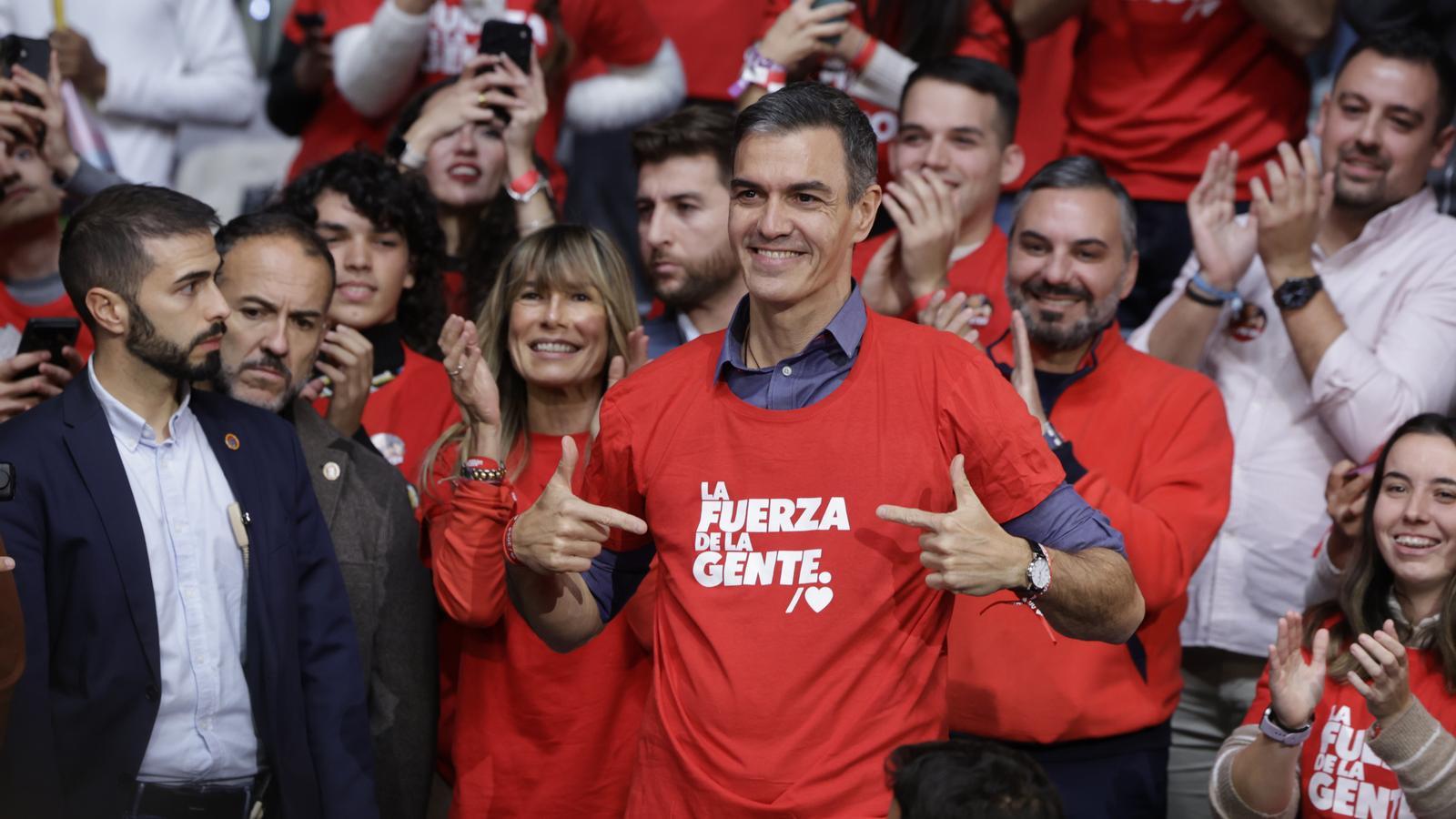
Without his usual squires –neither Óscar Puente nor José Luis Rodríguez Zapatero have been seen these days for obvious reasons–, Sánchez has exploited his most personal side. He only stopped dancing for a few days after the Urda accident, but between the kisses and declarations of love to Begoña Gómez, his appearance on podcasts and comedy shows of maximum diffusion and the hit musical Yo sí te voy a votar–present at all the socialist rallies–, the Spanish president has breathed optimism into his followers and made them believe that on Sunday not everything is decided, whatever the polls may say.
And what do the polls say? That the PP and Vox will reach an absolute majority in practically all the scenarios foreseen. The average of the two right-wing parties is around 190 seats –three years ago the forecasts were around 175–, but as many politicians usually remind us –usually those who come out worst in the polls–, on Sunday everyone will start from zero.
What would have to change for Sánchez to be able to opt for a new term at La Moncloa? First, that the polls had miscalculated. In the application that you can consult in the ARA, prepared by the UB professor and former director of the Center for Opinion Studies, Jordi Muñoz, the PP and Vox add up to an absolute majority in more than 90% of the simulations. But, if one percentage point were to move from the Feijóo bloc to the Sánchez bloc, the cases of an absolute majority would be reduced to 76%. If, instead of the 49% that the polls grant to the PP and Vox, the percentage were to fall below 46%, they could end up below 176 deputies.
Second, that the left-wing voter mobilizes much more than what the polling has detected so far. In 2023, in fact, it already happened that the voters who decided their vote at the last minute opted mainly for left-wing options. The post-election survey by the CIS, which was conducted a month after those elections, concluded that 52% of the people who decided their vote on the day of reflection or on the day of the election itself voted for the PSOE or Sumar and, on the other hand, only 28% for the PP and Vox. Among the people who had decided their vote before the campaign, there was a majority for the PP.
And, third, that the last decisive seats benefit the parties of the left-wing bloc. The PSOE, which has been growing over the last few weeks, getting closer to the Popular Party, is the one that has the best chance for these last seats, which is why it makes the appeal to the useful vote on a recurring basis. In fact, the option that it becomes the first force ahead of the PP is a scenario that the polls leave open, even if there is a right-wing majority. There are nine constituencies (Cáceres, Las Palmas, Murcia, Barcelona, Cadiz, Lugo, Ourense, León and Granada), where the left is less than five points away from a seat that is currently held by the right. In Barcelona, in fact, there could be two in play and Madrid could also enter the dispute. It is clear that there are others that are in the opposite situation. The miracle, then, depends on the dice favoring Sánchez.
