The Supreme Court applies the total amnesty to Puigdemont and definitively archives the 1-O case
The high court also closes the case of the former ministers Toni Comín and Lluís Puig, who have already returned to Catalonia
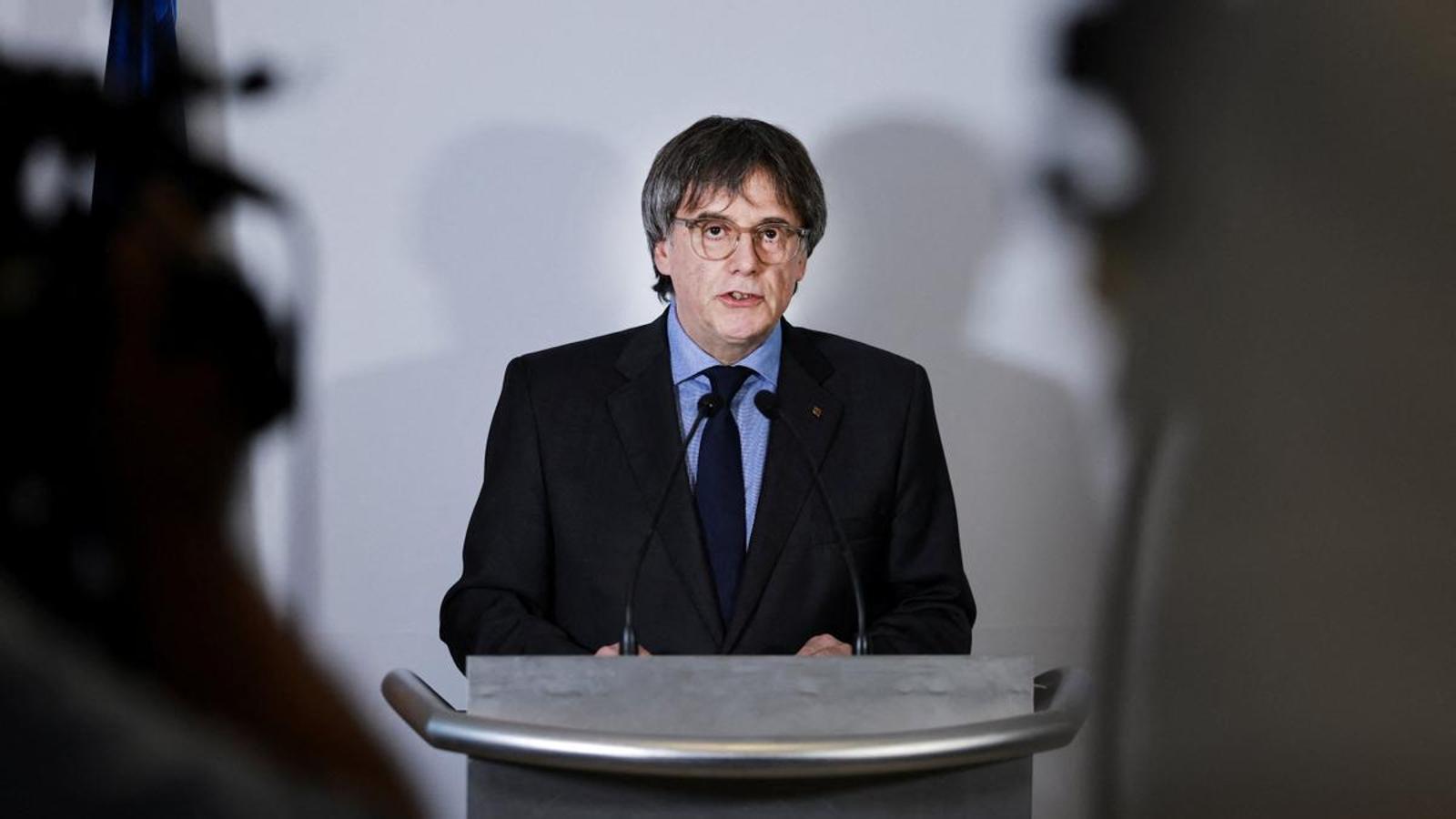

MadridIrreversible white smoke. After a long odyssey, Carles Puigdemont has finally been amnestied by the Supreme Court and is exonerated from the case regarding the organization of the October 1st referendum. Manuel Marchena has been forced to apply the law to the leader of Junts, as well as to the former ministers Toni Comín and Lluís Puig, once Pablo Llarena reversed the 2018 prosecution and concluded the summary proceedings following the Constitutional Court's ruling that required the Supreme Court to grant amnesty for embezzlement. Previously, the investigating judge had lifted the arrest warrants, which allowed Toni Comín to collect his MEP credential in Madrid and Lluís Puig to return to Terrassa.
With a brief six-page interlocutory ruling, the three exiles have now had the same outcome as the four convicted in the 'procés' trial: Oriol Junqueras, Jordi Turull, Dolors Bassa and Raül Romeva. Thus, all members of the 2017 Government have been freed from criminal liabilities and the 1-O case at the Supreme Court has been definitively buried. A few weeks ago, the accounting prosecution was also buried by the Court of Auditors. However, Puigdemont's return will not be immediate, because the leader of Junts has opted to return to Catalonia once the elections of November 29th have passed.
The decision ended up imposing itself by its own weight and after twenty days of waiting and uncertainty. On November 6th, the high court asked the parties once again – the three defense teams, the Public Prosecutor's Office, the State Attorney's Office, and Vox as a popular prosecutor – what the outcome should be. And, as they have been reiterating for two years, all of them except the far-right were in favor of applying the amnesty. In fact, the Supreme Court has stopped the party of Santiago Abascal, which wanted to freeze the amnesty even further. Vox wanted to wait for the Court of Justice of the European Union (CJEU) to resolve the preliminary ruling question raised by the High Court of Justice of Catalonia regarding the embezzlement or to propose a new one. “It limits itself to proposing the convenience without any argumentation,” Manuel Marchena reproaches it, referring to the Luxembourg ruling from last July, which “does not show the doubts” that Vox was raising.
The five magistrates in charge of making the decision were Manuel Marchena –the rapporteur of the trial sentence– and Andrés Martínez-Arrieta –the president of the criminal chamber–, along with Antonio del Moral, Julián Sánchez Melgar, and Javier Hernández. The first three participated in the Procés trial and the latter two have recently joined the chamber. Unlike the interlocutory ruling that granted amnesty to Junqueras, Turull, Bassa, and Romeva, which was very harsh toward the Constitutional Court, the Supreme Court is now making its final move with a technical resolution without a single word out of place. A month ago, Manuel Marchena reproached Cándido Conde-Pumpido, the president of the TC, for including “superfluous epithets” and “manifestly dispensable considerations” in the ruling on embezzlement. “The unnecessary grandiloquence of the terms reveals the desire to adorn a line of reasoning that invades the jurisdictional sphere belonging to the Supreme Court with expressions meant to camouflage the intensity of the interference,” protested the Supreme Court magistrate.
Six days before the elections
The amnesty for Carles Puigdemont arrives on the eve of the November 29 elections –in which the amnesty is playing a secondary role– and four days after the leader of Junts shook up the electoral campaign with an interview in El Mundo in which he branded Pedro Sánchez as an "amoral" person with an "excessive ambition" for power. The former president of the Generalitat claimed that the members of Junts "took advantage" of this ambition to "defeat Spain" through, among other things, the amnesty law, and explained that the pro-independence supporters wanted to test "how far they could pressure" the Socialists to "profit from it".
Just yesterday, in an interview on Salvados, Pedro Sánchez claimed that the amnesty has served to "normalize coexistence" in Catalonia and boasted that the pro-independence parties now talk more about regional financing or Rodalies than about independence. Likewise, he ruled out accepting a referendum in Catalonia in exchange for the votes of ERC and Junts for a new investiture after November 29: "It would be doing the exact opposite of what we have done, which is to normalize coexistence, unite Catalan society, and therefore, not divide it," he justified.
