Lluís Gavaldà: “I would like to make a last album by Els Pets, but before I must find myself well”
Musician

-
CAT -
CAST
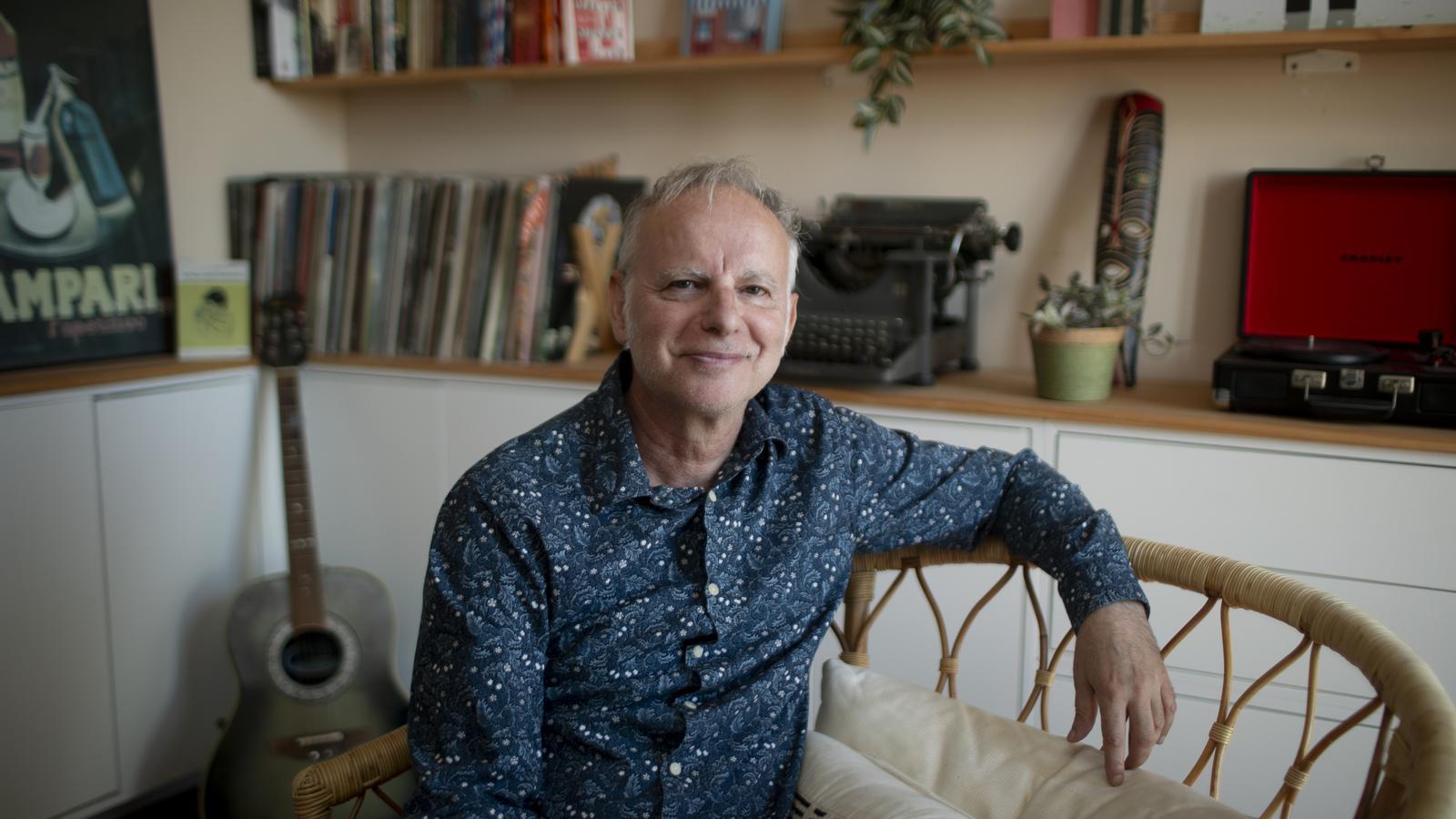
AltafullaOn Saturday, December 5th, in Girona, Els Pets will close a two-year tour with which they have celebrated the group's four decades. On stage, they are a band in top form. Outside of it, Lluís Gavaldà (Constantí, 1963) admits he is going through a low-spirited moment. Since he works during the summers, he travels with his partner and son every Christmas, because he has the theory that holidays are only worth it if there are children under ten years old and, if not, nostalgia wins over joy. The most prosaic reason is that long after-dinner conversations are his “absolute nightmare”. He is preparing for a trip to northern Colombia. One morning at his apartment in Altafulla, he gifts us a conversation about the future of the group, music in Catalan, age, family, and the country.
Forty years writing and singing with Els Pets. 13 albums, more than 150 songs. How can you have insecurity?
— Because I have no innate talent. To be a good musician you must have skill and patience. I have neither one thing nor the other, and it is not false modesty. I play the guitar just as badly now as I did forty years ago; it is almost a miracle because, through osmosis and practice, one should improve. I am incapable of repeating, repeating, repeating.
Don't you think that perhaps your pathological melomania overwhelms you?
— No. I believe that melomania has served as a crutch to compensate for my lack of skill as an instrumentalist. Everything I don't know because I haven't studied music, I have compensated for by listening to music compulsively. I have always needed music to be happy; it is the only thing that has broken my introspective nature. It is the most powerful medicine I have.
Man, Lluís, you have released generational anthems and verses that accompany us through life.
— Because I have worked more on the creative side. To make one of my songs, I don't need great technical skill, I need imagination, ideas and a certain knack for explaining them. In this aspect I am delighted, especially with the evolution: Els Pets is one of the groups that least resemble their beginnings.
You have evolved in parallel with your audience.
— The key to a song having heart is that you speak about what you know, not what you have heard about, which does not mean that you cannot invent. We have never tried to hide the age we are when writing the lyrics for our songs. When you have such a long career, you have the privilege of accompanying people in what they are going through. The greatest compliment I have ever been given is: “There is always a song by Els Pets that explains what is happening to you”.
A fact: Agost is in the top 3 of the 400 best albums of the 21st century, according to Enderrock.
— I didn't expect it. I am very proud of Agost, but I imagined that more recent albums would come out. And when I saw that I was accompanied by the two groups that I admire the most from the Catalan scene of all time...
Of all time? Antònia Font and Manel?
— Yes, for me they are the pinnacle of pop in Catalan. It is very good company.
You have toured to celebrate the band's 40th anniversary for two years. Does it worry you to get stuck in a songbook from the past?
— Not at all, because we have never been a nostalgic band. Whenever we release a new album, when we do the next tour we play it in its entirety. But this has been like paying tribute to ourselves. We will not do it again and, if we make more music, we will most certainly forget these songs and look at the new ones.

You go to concerts in a blazer and tie. Is it British influence?
— It is like going to Sunday mass. I have always liked seeing the musician dressed as a musician. I find that it adds value to what we are about to do and puts you in the mood: now you will be someone else. Which in my case, moreover, happens a lot, because my character on stage is the opposite of how I am off stage.
What is a concert day like for you, today?
— I am restless and anxious, that is crystal clear, but I handle stage fright much better. I do gymnastics and stretching, and I wait for my private taxi driver to come. The concert begins when I get into Rafel's [Falin Cáceres, bass player] car. I look forward to his arrival because I know he will brighten my day; it's medicinal. We are lucky because we have had a team for fifteen or twenty years with whom we get along very well, and with them, half of my worries go away. We try to get through the soundcheck with as little tension as possible, and then comes the most fun moment: it is absolutely forbidden, but we have dinner before the concert. And then, from the moment I step onto the stage, I have a memory lapse. The concert is the moment in life when I am happiest, but when it ends, I don't remember anything of what happened. I don't know how to explain it.
Does your consciousness disconnect?
— Exactly. Since I am such a hyper-conscious person about everything, that is where I free myself. I have a repertoire, but I never know what I will say, nor how I will say it, nor what will happen, nor if I will go down from the stage, everything is about letting yourself be carried away. When I finish, that is when they explain the concert to me. And afterwards I really want to go home, because you have nothing left to do, you don't have to go out and show yourself, that whole liturgy no longer exists.
Do you miss the nights that used to stretch out?
— No, not at all. One of the things you learn with age is that everything you do after two in the morning, the next day you will regret when you remember it. The next day I am a flat encephalogram. Physically I am very exhausted.
Past 60 years old, are you still too young to grow old?
— No: now I am old. The 60s have been like a hammer blow. They have been a slap in the face, physically.
When did your youth end?
— [Reflection] I think I have prolonged it a lot, thanks to the work I have. I realized it with my group of friends, who came less and less to the concerts until you didn't see them there anymore. The luck of playing with a pop band is that you prolong this almost eternal adolescence and you have to be careful, because the body gives you signs. It's not that I have been a prodigy of expressiveness and sex, drugs and rock'n'roll, quite the opposite, but you realize that you are in another vital epoch and the self-obligation to put on a decent show makes you demand more of yourself and take care of yourself.
How did becoming a father influence the musician?
— I was a late-in-life father and very aware that I was living a unique experience. I have been very present in my son's life and it is one of the things I am most grateful for in my profession. I have been able to experience this emotional tsunami that is raising a child. Now, with one I have had enough.
How do you think young people see you?
— I am stunned. Young people should shit on us a lot more. The first thing we did when we came out was to criticize the posh pop of Barcelona and some horrific atrocities. And yet, the new generations have a sympathy for us that flatters me a great deal.

You talk about fellow musicians. But what about the young audience, how do they see you?
— Like old fogies, I suppose. But many come. It's a cliché, but we are the band with the most intergenerational audience. I think Els Pets is the main bond left for parents and teenage children to do something that both enjoy.
I would say that it has also happened at the Oques Grasses concerts. Filling four Olympic Stadiums has been a milestone for music in Catalan, perhaps on the level of your Catalan rock night at the Sant Jordi. That there are 220,000 people...
— Damn, spectacular. It is something never seen before and it is absolutely admirable. I take my hat off to this group's pulling power and I think they deserve it. Music is one of the most normalized parts of the country. The offer and quality we have is extraordinary, much better than when we started. To spoil the mood...
Tell me, tell me.
— What makes me feel a certain distrust is the need for a concert to be a multimedia event. I do not have a good time at a macro-concert and I do not think it is the best habitat for a band to show what they do. What is the need to concentrate an entire career into one day, when you can spread it out over 60 days of celebration with people so close that you can smell them? I find that historical events are now being prefabricated ahead of time. I am not talking about Oques Grasses at all, I am talking about festivals where music is not the purpose and where there is also an oversupply of music that you cannot digest. Now, there are people who go there to party, and good for them.
Who do you write songs for?
— I write to understand myself. Most of the time I have the will not to talk about myself, because what I feel and think is neither that important nor that original, but when I finish I realize that I have spoken about myself more than I thought.
Are there any of your songs that you hate?
— There are those who... Mosquitoes in the tap, I am not a hole... There are lyrics that haven't aged well. And there are humorous songs that I don't like because, like jokes, they are only funny the first time. And the other type of lyric I can't stand is the moralizing one, that messianic point of telling others what they should do; the first person plural gives me the creeps.
The Pets of youth were more political and those of maturity are more focused on customs, right?
— I believe there is a dysfunction between our work and our political activism as public figures. There is a feeling that we are more political than we have been because we are unapologetically pro-independence and we have explained that a lot. But we have never been a monothematic group. When a group speaks only about one topic, I don't believe it. Because songs are like life and life is both the genocide in Gaza and the fact that you have very beautiful dimples, and you have to speak about both transcendent and banal topics. It is true that our first protest songs were very obvious and I have been trying to make them less evident. I can put the Iraq war in the middle of a love song, in "a balcony that wants to stop the war".
Gerard Quintana, Joan Miquel Oliver, Guillem Gisbert or Santi Balmes have needed to step out of the band's discipline. You have performed solo concerts, but have you ever considered doing a project of your own?
— Working alone makes you feel very lonely and I need to feel very accompanied when I make music. Because I am an obsessive overthinker, which is the worst possible mix for creating. I need people to tell me if what I am doing is good or not, if I am on the right track or not. I have never had the feeling of making a song and saying: “It will be a hit”. On the contrary, if the first person who hears it tells me they don’t like it, I don’t like it anymore either. Imagine what insecurity. With Els Pets I have at my side not two musicians, but two brothers, and also I have the great luck that they have always let me be in charge.
It's just that the Sopa de Cabra documentary has traumatized us.
— Catalonia discovered they are not friends, but in the profession we already knew it, and it was part of their charm. Els Pets are, we are very good friends, we are brothers. It's just that we were friends twenty years before forming Els Pets. We have been together for 60 years. We made our first communion together!

You went to live in England to stop being Lluís Gavaldà. Did that work? Because is being famous in Catalonia so serious?
— The problem with talking about the downsides of being famous in Catalonia is that you come across as very pedantic, especially to people who don't experience it. In my case, being a public figure has brought me 99% joy. The problem is if you are not very sociable; that's where the drama is. It's not that people overwhelm me, it's that I get overwhelmed very easily. You would like to have a switch to be able to do things you used to do and now don't. Living in England allows me that. It's a relief. Besides, I don't live in England all year round. I need my land, I am deeply Catalan and I carry it in my blood. At most, I come here every month and a half.
Does it mean here in Altafulla?
— Yes. Barcelona makes me very sad, honestly. I come from a country where no one understands me when I speak in Catalan and when I come home I like to be understood. The last few times I have been to Barcelona no one understands me. I get indignant, I get into fights... It's just that I don't have it normalized, now I have the vision of the tourist. I think: how is it possible that we have these suburban trains and that people don't burn trains? I'm not as indignant about the incompetence as I am about the apathy with which the mistreatment is received, the lack of labor rights, how they are forcing a savage capitalism on us, how racism is rampant...
You have performed sixty concerts in two years. What is ending on Saturday?
— What will happen with Els Pets, that I am not at all clear about. Basically, the problem with making a new Els Pets album is how it affects me emotionally. I suffer through them too much. Of the last three albums, in two of them I ended up breaking down, and getting back on track took quite a long time. I have that fear. I am not afraid that we won't be capable of making a worthy album, I have a ton of ideas, but I panic at the thought of entering the studio because that is when I start to get anxious.
Due to the pressure it entails?
— On one hand, because I cannot help but think that what we are doing will remain there and can never be retouched again, and that blows my mind. On the other hand, on a record there are six or seven different opinions that have the right to be heard, and there are differences of opinion, but a single decision must be made. And I realize that the decision made in the end is not so much for its certainty as for its vehemence. The one who is clearest about it, wins. And in a studio, I am not emphatic. Furthermore, it is really hard for me right now to write songs that do not sound like songs I have already done. And I also do not want to do things just for the sake of not having done them, because now that I have learned what works for me and what I know how to do, I am not going to start making urban or reggaeton. I need to write songs in which I feel comfortable.
There is no rush, I see.
— No rush. I know that both of them are waiting and I don't want to make them suffer, either. If I can, I would like to make at least one last Els Pets album. But first, I have to feel well. In every sense of the word.
I think you seem fine, but you were telling me that you are a bit soft.
— I am a person of emotional highs and lows, I am very fond of joking and I have a certain tendency to fall into a kind of sadness. I made it public in case it helped people, the thing is that afterwards I realized that there is a very fine line between making a condition of yours public and having people always ask you about the same thing. And a point came when I decided to stop it because I do not want it to define me, nor do I want people to have an erroneous image of me. Simply put, I have streaks, there are moments when the world overwhelms me and I need to be tucked away, calm, with my own people. And that is when my mother scolds me because I do not call her enough.
Don't make her suffer. Will we have Gavaldà in 2027?
— I have a project with Joan-Pau Chaves that is like the antithesis of Els Pets. A very small format, I provide the lyrics and he provides the music. And what we will do is play with the bond between two different songs: we take a song by Els Pets and relate it to melodies by other musicians, in such a way that we reclaim the references and desacralize the idea of the creator. Copying is not only not bad, but it is essential. The artist who does not copy ends up being a parody of themselves, ends up always making the same song. Dylan started by copying Woody Guthrie; the Beatles started by copying the Everly Brothers; the Rolling Stones, Muddy Waters, and no one ever found it strange. This stigmatization of showing your influences is for the ignorant and also for that type of person who causes me a lot of disgust: the plagiarism hunter.
