A judoka, a driver and a Spanish lawyer: who are the candidates in France?
The far-right leader Marine Le Pen leads all the polls while the entire right negotiates a common candidate

ParisOne of the particularities of French politics is that any person – as long as they are of legal age and have French nationality – can run in the presidential elections. It is not necessary to have a large party behind you or political experience. You only need to obtain 500 endorsements from among the 42,000 elected officials in the country. For the presidential elections that will take place between April and May, the still provisional list of candidates is long, there are 38 of them. Aside from the political leaders of the large parties, there are also three former prime ministers – Gabriel Attal, Édouard Philippe and Dominique de Villepin – and a good handful of outsider candidates.
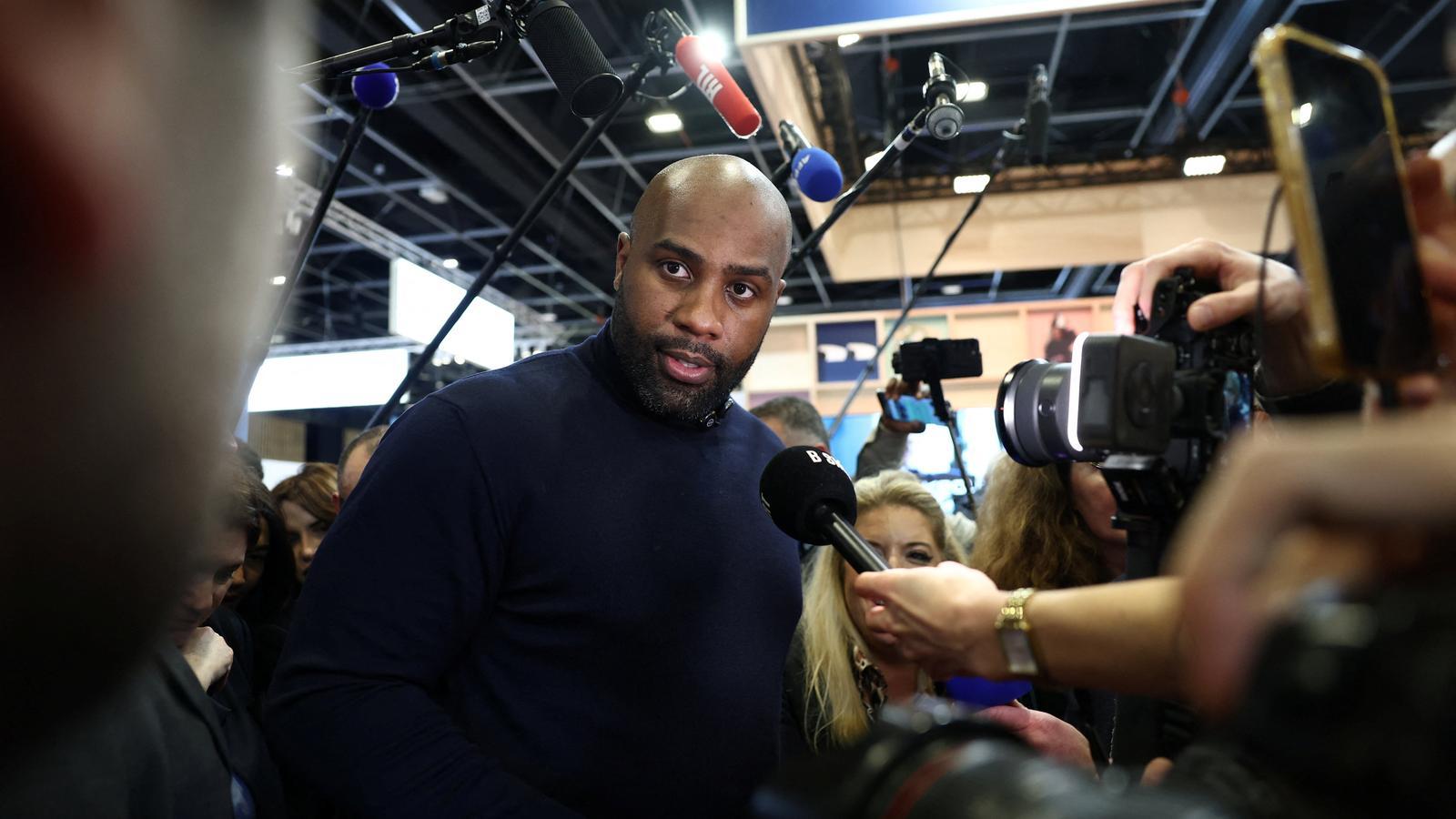
Among the outsiders, one of the most unexpected names is that of judoka Teddy Riner, one of the most popular and beloved athletes by the French. In a country where judo is one of the most deep-rooted sports, the new presidential candidate is seen almost as a national hero. With his more than two meters in height and 139 kg, Riner has participated in five Olympic Games and has won five gold medals and eleven world titles. With his sports career coming to an end – he is 38 years old – Riner wants to make the leap into politics.
Thanks to his popularity, he is the only independent candidate who enjoys media coverage and this may have turned against him with some statements that have provoked a rain of criticism, such as his reproaches regarding aid to Ukraine and the intention to send troops to the ground once there is peace. The president, Emmanuel Macron, has labeled Riner's words as "naive" and "irresponsible" and reminded him that if Europe abandons Ukraine, "France's security would be put at risk".
Assange's advisor and accused of rape
The list of independents also highlights the French-Spanish lawyer and activist Juan Branco –he was born in Estepona, Malaga, and his mother is Spanish–, historically linked to La France Insoumise, the party considered in France to be far-left and led by Jean-Luc Mélenchon. After breaking with the 'insoumis' a few years ago, Branco is running as an independent, with the citizens' movement Les Ruches behind him. The 37-year-old lawyer was an advisor to WikiLeaks and Julian Assange and could end up sitting in the dock due to a rape complaint.
Among the candidates there is also a thirty-year-old bus driver, Selma Labib, who is running as leader of the anti-capitalist and Trotskyist party NPA-Révolutionnaires, and the controversial 68-year-old singer-songwriter Francis Lalanne, who is campaigning with Dieudonné, a comedian convicted of antisemitism and racist insults. Lalanne and Dieudonné advocate for France's withdrawal from the European Union and the euro and promote a rapprochement with Russia. Labib, on the other hand, defends a communist society where the dismissal of workers is prohibited. In any case, none of these independent candidates has a chance of reaching the Élysée. According to polls, Teddy Riner, for example, would obtain only between 2% and 4% of the votes in the first round, very far from the percentage of the political party leaders.
Le Pen, on the way to the Élysée
With five months left until the presidential elections, the far-right leader Marine Le Pen is leading all the polls. According to the most recent ones, Le Pen would make it to the second round with 33% of the votes. In second place would be Mélenchon, who would manage to reach the second round with 16%. The third position—outside of the second round—would be obtained by a candidate who has experienced a notable rise in the polls in recent weeks, David Lisnard. The conservative mayor of Cannes would obtain 12% of the votes, ahead of the socialist candidate, Raphaël Glucksmann (10%), always according to the latest poll conducted by OpinionWay for the CNews channel, which is close to the far right. Édouard Philippe, the right-wing candidate, who until now was in third place, falls to fifth place with 8% of the votes.
Polls place Le Pen as the president of France. In a hypothetical second round against Mélenchon, the far-right leader would win comfortably. But whether Mélenchon will make it to the second round is still uncertain: the polls for the first round can change a lot, especially if there is ultimately only one right-wing candidate.
Although they belong to different political parties and movements, the center-right and right-wing bloc has many candidates and they have been negotiating for weeks for a single candidate, so far without success. Right now, the list of candidates includes not only Lisnard and Philippe. It also includes the leader of The Republicans, Bruno Retailleau; Macron's former prime minister Gabriel Attal; and Jacques Chirac's former prime minister Dominique de Villepin. The center-right and right-wing vote is very dispersed, and it is most likely that some names will end up withdrawing, even if the negotiations to hold primaries to choose a single candidate fail.
The figure of 38 candidates will be reduced considerably before March 12, the deadline for submitting the 500 endorsements. Some will not obtain all of them, and others will simply withdraw. Obtaining the 500 endorsements from elected officials—mayors, deputies and senators, MEPs, regional councilors, etc.—is not easy. For now, even Le Pen has not been able to gather them. Since the names of the politicians who have endorsed the candidacies were made public, many mayors refuse to support a candidate. Without endorsements, the candidate cannot be proclaimed.
