The PP will be able to use AI to make Sánchez say what he has never said
The populars have resorted to artificial intelligence in a strategy on social networks marked by a belligerent and ironic tone

-
CAT -
CAST
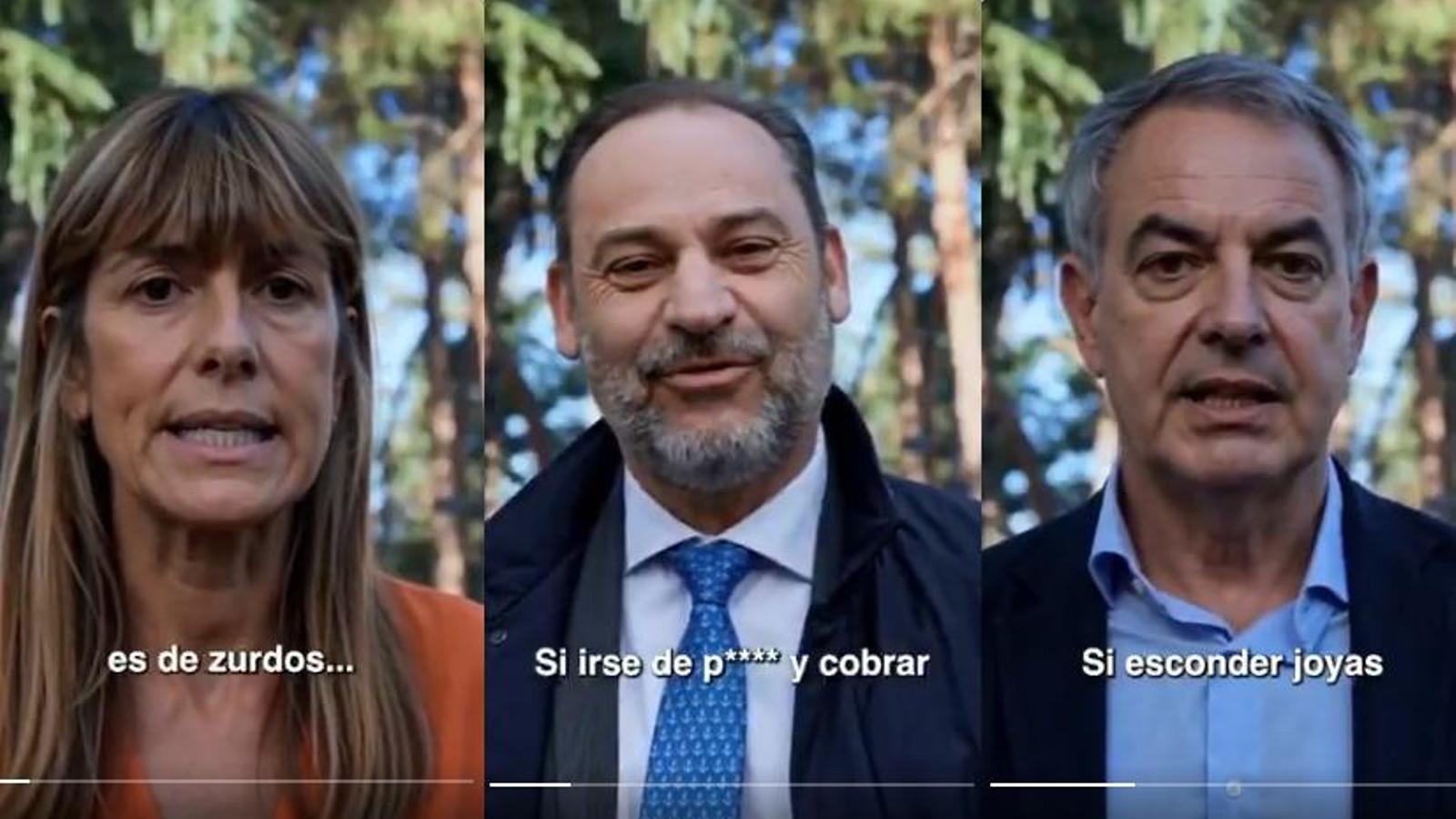
Madrid“They say it’s good, I’ve read it”. This is how Alberto Núñez Feijóo defended on Friday the mysterious community manager of the PP, who has become one of the great protagonists of the November 29th electoral pre-campaign. With a combative, ruthless, ironic, and daring style, the popular party’s posts on Instagram, TikTok, and X have gone viral rapidly and have been able to make an appearance in conventional media. The one that has had the most resonance is a video made with artificial intelligence, seen by more than two million people on X, in which Begoña Gómez, José Luis Rodríguez Zapatero, and Santos Cerdán, among others, appear admitting to the facts for which they are being investigated. It is what is known as a deepfake. “Having a chair thanks to the fact that my husband is the president”, says Pedro Sánchez’s wife. “Hiding jewels in a safe”, expresses the former Spanish president. “Belonging to a criminal gang”, verbalizes the former number 3 of the PSOE. Leire Díez also appears, who has filed a lawsuit against the PP for the crimes of slander with publicity, attack on moral integrity, and digital identity theft.
However, four experts consulted by ARA agree that it is most likely that the PP will come out unscathed. “The use of deepfakes is not a crime and is not illegal. A politician's image can appear in many ways, the only thing is that with generative AI it is more realistic,” summarizes Borja Adsuara, a lawyer expert in digital law. “It is unlikely that this act will have any standing as an infringement, even if it is uncomfortable,” adds Eduard Blasi, a digital lawyer specializing in AI and data protection. Cristina Lorente, director of the master's degree in legal practice and advocacy at Isabel I University, agrees completely: “Although the video may displease them, deepfakes do not constitute an illegitimate intrusion into honor”.
All of them argue that this type of content is equivalent to caricatures. “The law allows for caricatures, so the use of deepfakes with a satirical or critical purpose would pursue that aim and would be protected by freedom of expression,” asserts Antoni Rubí, professor of civil law at Pompeu Fabra University. In the case of the PP video, there are three elements to take into account. The first is that all the people who appear in it are public figures, who have a right to honor on a “smaller scale”, in the words of Eduard Blasi. “There is a brake, the protection is lowered,” emphasizes Cristina Lorente.
Secondly, it is necessary to analyze the words that are put into their mouths. “A slander is when there is a reckless disregard for the truth. If a judge is investigating it, it is because there is sufficient evidence,” argues Borja Adsuara, who believes that the PP “has measured” what they were saying and has used language that is “ambiguous enough”. Finally, the Popular Party complies with the requirement to label that the video has been created with AI, as required by European regulation. Mind you, with satire there is more flexibility and it is allowed to do so in such a way that it “does not hinder the exhibition or enjoyment of the work”. Therefore, with this whole landscape, nothing prevents Génova from being able to manipulate a video of Pedro Sánchez to make him say things that he has never said.
A few months ago, Félix Bolaños promoted a reform of the 1982 Law on the Protection of the Right to Honor with the aim of explicitly prohibiting deepfakes. Despite this, Antoni Rubí believes that "it changed nothing," because the text maintained the exception for satirical purposes and referred to public figures. Likewise, the hasty calling of elections meant the law ended up as a dead letter. By the way, in the last few hours, the Broad Front candidate, Ada Colau, has sent a letter to the PP, the PSOE, and Vox to "expel vexatious AI and identity impersonation from political life."
Mobilize one's own voters
Behind the tactic the PP is exhibiting on social media lies a strategy to mobilize the electorate. That is to say, it is not so much about convincing socialist voters to support Feijóo as it is about ensuring that people who would not go to vote or would vote for Vox choose the PP ballot. "It is not designed for a swing voter or for changing sides, but to mobilize their own. It makes sense, people are increasingly reluctant to be persuaded," summarizes Xavier Tomàs, a political communication consultant, in conversation with ARA.
The expert, who makes it clear that this will be the first election campaign in which there will be "a massive use" of artificial intelligence, maintains that the change in language and content that the PP is exhibiting on social media "is good and makes sense" when there are only a few weeks left to vote, because the mobilization effect is, precisely, "just and only now." A few days ago, in an interview with El Mundo,the community manager of the PP justified the mutation it is undergoing: "To achieve impact, you cannot do the same thing every day. Through humor and enthusiasm, you can also beat the left to a pulp," he defended.
One of the publications that was most successful was a montage of the kiss between Pedro Sánchez and Begoña Gómez that replaced his wife with José Luis Ábalos. But there are more videos made with AI. For example, a banner that says “hypocrites” hanging from the facade of the PSOE headquarters or from a brothel. Or a video of the party's former spokesperson, Montse Mínguez, who resigned due to the real estate dealings of her partner, showing an apartment as if she were a real estate agent.
