The four Catalans in recent history who have opted to preside over Spain
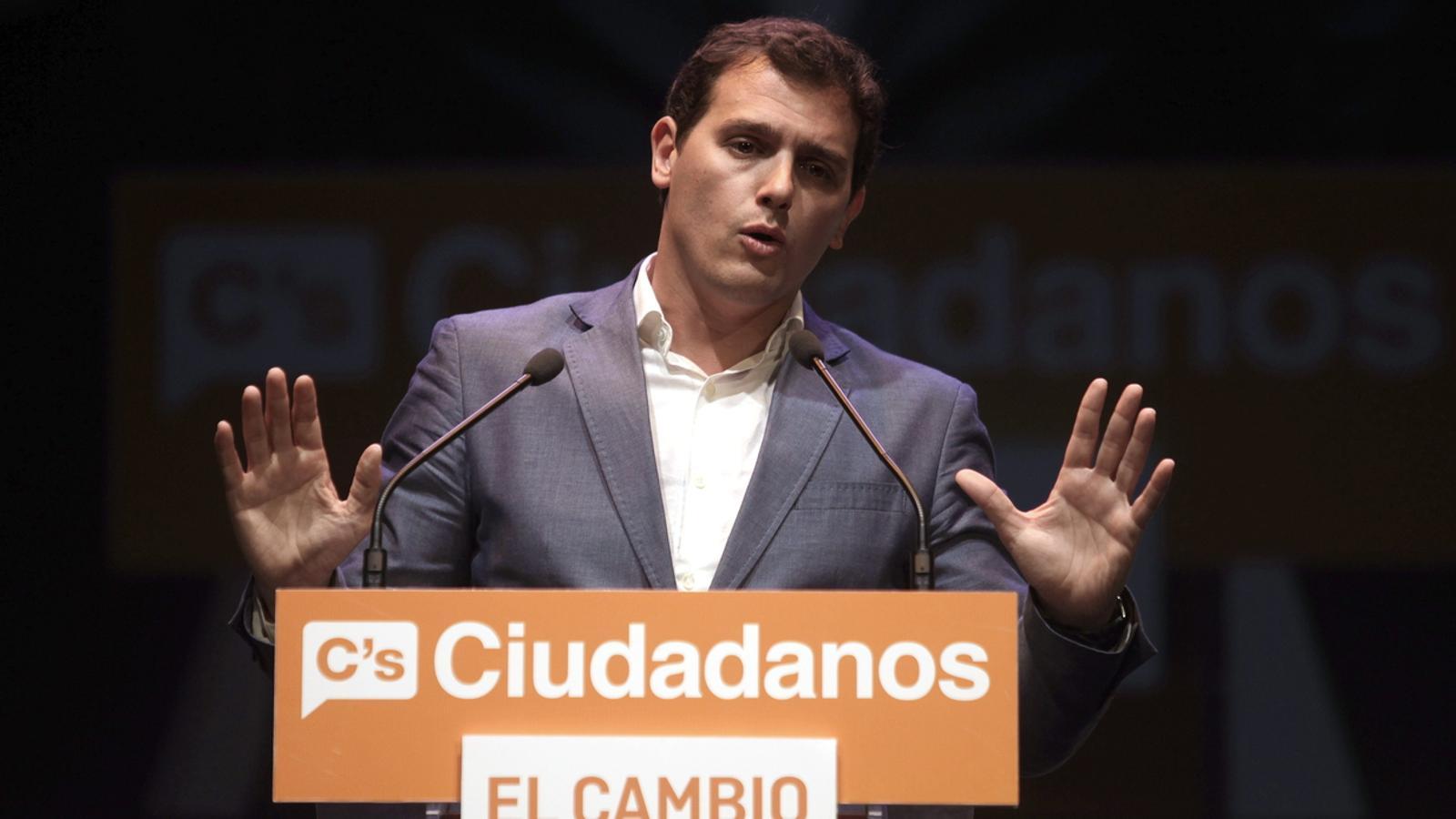
Albert Rivera was the candidate who achieved the best results

-
CAT -
CAST
BarcelonaAda Colau boasts about having been the first female mayor of Barcelona. And now about being the first Catalan woman who aspires to be the president of Spain with the Broad Front. That a Catalan man or woman should preside over Spain now seems like a chimera, but throughout contemporary history, up to three politicians born in Catalonia occupied the highest responsibility of the Spanish government. But if we return to the recent history of the State, with Colau there have been four leaders from our country who have been presidential candidates. And the one who came closest to achieving it was Albert Rivera (Barcelona, 1979).
After Citizens (Ciutadans) won the 2017 Parliament elections with Inés Arrimadas as a candidate, the orange party arrived at the April 2019 Congress elections with high expectations. With Rivera as head of the list, the strongman of the unionist formation, Citizens achieved 57 seats with 4.15 million votes and 15.86% of the ballots. Cs thus became the third political force, only nine seats behind the PP (66), and challenged it, as it sought to do, for the hegemony of the right. Arithmetically, Cs added up with the PSOE, which obtained 123 seats, but Rivera ruled out making a pact with Pedro Sánchez after the elections.
His refusal to invest the socialist candidate led to a repetition of the elections in November. The move did not work out well for Citizens, which fell to ten seats and went from being the third force to the sixth, behind even Esquerra, which reached thirteen by running only in Catalonia. The blow caused Rivera to resign as president of Cs, renounce being a deputy, and abandon politics. From being able to become the vice president of the Spanish executive, Rivera disappeared from the political chessboard.
Before Rivera, the other Catalan who opted for the presidency of the Spanish government was Paco Frutos (Calella, 1939-Madrid, 2020) leading the United Left list in the general elections of March 12, 2000. Frutos, who was general secretary of the Communist Party of Spain (PCE), replaced the historic Julio Anguita, who suffered from health problems. The change did not work because the communist formation was left with eight seats, thirteen less than in 1996, and the Spanish president, José María Aznar, was able to revalidate a second term and, on this occasion, with an absolute majority, without the need to reach a pact with CiU as he had done four years earlier.
Frutos could have had another Catalan rival, and not from just any party. Josep Borrell was chosen as the PSOE's presidential candidate after winning, against all odds, the first primaries held by the party. The former minister prevailed over Joaquín Almunia, the party's general secretary and official candidate, with 55% of the membership's support. One year later, Borrell announced his resignation from the candidacy, following the outbreak of the Huguet-Aguiar case, which involved two of his former collaborators at the Treasury being investigated for tax fraud and bribery, and the PSOE designated Almunia as his replacement.
The pioneer in making the leap to Madrid was one of the heavyweights of the convergent sphere. Miquel Roca (Bordeaux, 1940) was a candidate in 1986 for the Democratic Reformist Party (PRD), which he himself promoted. CiU gave political support to the reformist operation and agreed that Roca would be number 1 for CiU, and at the same time the candidate for the Spanish presidency for the reformist alliance, which did not run in Catalonia. The failure in the State was resounding and Roca obtained only 194,538 votes (0.96%) and no seats. While the PRD's state project was sinking in Spain, in Catalonia CiU went from 12 to 18 seats: it obtained more than a million votes.
Three presidents at the end of the 19th century
Throughout the contemporary history of Spain, however, three politicians born in Catalonia have held the highest responsibility in the Spanish government. The first was the general and progressive politician, Joan Prim (Reus, 1814-Barcelona 1870), who was president of the council of ministers between 1869 and 1870, during the reign of Amadeus I, and who was assassinated in December 1870, before the monarch arrived in Spain.
Three years later, Estanislau Figueras (Barcelona, 1819-Madrid 1882) became the first president of the First Spanish Republic, between February 11 and June 11, 1873. He held the office for only four short months. The economic crisis, the internal division of his own party, and the proclamation of the Catalan state, which he was only able to revoke by accepting the dissolution of the army in Catalonia, motivated his replacement by Francesc Pi i Margall.
At the last council of ministers, he uttered a famous phrase that would go down in history: “Gentlemen, I can take no more. I will be frank with you: I am fed up with all of you!” He left his resignation in his office, went for a walk in the Retiro, and caught a train at Atocha station bound for Paris, without notifying his ministers. His successor lasted even less time. Pi i Margall (Barcelona, 1824-Madrid 1901) was the second president of the First Republic, between June 11 and July 18, 1873. He was only able to govern, therefore, for 38 days due to the divisions between the republican and federalist forces.
