What do the polls for the Spanish elections of November 29 say?
The PP leads the polls, Vox consolidates itself and the PSOE resists in second position
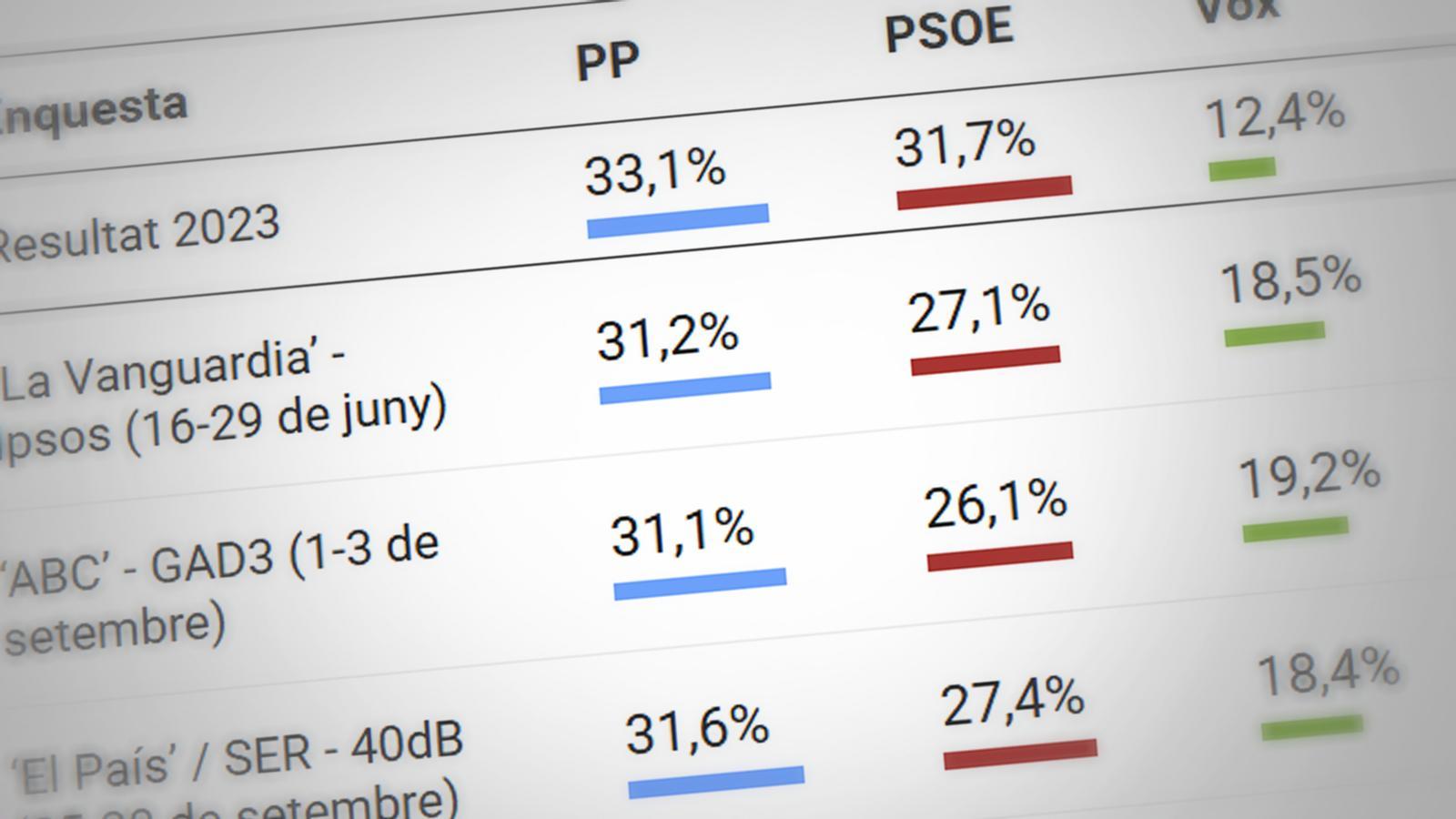
BarcelonaThe Spanish elections of November 29th arrive with a snapshot that, with nuances, is repeated in practically all the polls: the PP is the leading force, the PSOE is second, and Vox is consolidating as the third force. The difference lies in the magnitude of the lead and, above all, in how it translates into seats. However, there is one poll that shows a different picture than the majority of surveys, the CIS: the public body still places the socialists in the lead.
What most polls do agree on is projecting strong growth for Vox compared to the 2023 elections. Santiago Abascal's party obtained 12.4% of the votes and 33 deputies on July 23rd; now the main polls place it between 18% and 19% of the votes. The PP, on the other hand, is moving around 31%-34%, while the PSOE is situated between 25% and 27%.
The PP, first in all the polls
The most recent poll, prepared by SocioMétrica for El Español with 1,000 interviews conducted between October 1st and 3rd, gives 143 seats to the PP, 106 to the PSOE, and 62 to Vox. In terms of vote percentage, the Popular Party obtains 33.4%, the Socialists 26.5%, and Vox 18.1%. The sum of the PP and Vox would reach 205 deputies and, with the UPN seat, 206.
The picture was already appearing during the summer. The Ipsos survey for La Vanguardia, conducted between June 16th and 29th, gave 132 deputies to the PP, 111 to the PSOE, and 64 to Vox. The sum of the two right-wing parties reached 196 seats.
In September, GAD3 for Abc projected 133 deputies for the PP, 105 for the PSOE, and 69 for Vox. In this case, the sum of the two main right-wing parties reached 202 seats. The field work was carried out between September 1st and 3rd.
Vox, the big change compared to 2023
The growth of Vox is the main movement that is repeated in the polls. Ipsos gives it 18.5% of the votes, GAD3 19.2%, 40dB 18.4% and SocioMétrica 18.1%. In all cases, the party remains well above the 12.4% it obtained in 2023.
The latest 40dB barometer for El País and the SER, with 2,000 interviews conducted between September 25 and 28, places the PP at 31.6%, the PSOE at 27.4% and Vox at 18.4%. It is the only one of the main recent polls that does not translate these data into a seat projection. The sum of the PP, Vox and SALF reaches 52% of the estimated vote, compared to 35.7% for the PSOE, Sumar and Podemos.
The right-wing exceeds the absolute majority in the projections
How do these figures translate into seat projections? The polls that make seat projections place the sum of the PP and Vox above the 176 deputies necessary for an absolute majority. Ipsos places them at 196 seats; GAD3, at 202; SocioMétrica, at 205; and NC Report, in a range between 206 and 210. Data10 for Okdiario gives them 203 seats. The magnitudes vary, but the result is the same: all these polls project an absolute majority for the PP and Vox.
The NC Report poll published by La Razón in August is one of the most favorable to this bloc: it gives the PP between 145 and 147 deputies and Vox between 61 and 63 deputies, so together they would reach between 206 and 210 seats.
The PSOE is gaining ground in the latest polls
The photograph, however, is not completely static. The most recent polls detect a certain recovery for the PSOE in seats, although not enough to bring it closer to the PP. SocioMétrica gives it 106 deputies and Data10, 110. In the case of Okdiario, the rise is ten seats with respect to its August poll, but the increase is only seven tenths in voting intention.
This recovery appears after the mobilization for the housing crisis and the political events of the last few weeks. In the case of SocioMétrica, the fieldwork was carried out precisely between October 1st and 3rd, after the rejection of the housing decrees in Congress.
The CIS, the exception
The Center for Sociological Research paints a very different picture. The September barometer, prepared with 4,042 interviews between September 1st and 4th, places the PSOE at 31% of the votes, ahead of the PP's 25.5% and Vox's 16.6%. It is, therefore, the only one of the main polls that keeps the socialists as the leading force.
The difference with respect to private surveys is notable: while these usually place the PP between five and eight points ahead of the PSOE, the CIS gives the socialists a 5.5-point lead over the popular party. The same barometer, however, predates the election call and the rejection of the housing decrees.
The future of the Sumar and Podemos space
To the left of the PSOE, the landscape remains open. The latest 40dB poll for El País and SER, conducted between September 25 and 28, gives 5.6% to Sumar and 2.7% to Podemos: 8.3% between both if they were to run together. The SocioMétrica poll from October 3 places them at 5.3% and 3.1%, respectively, an aggregate of 8.4%.
Sumar and Podemos are negotiating how to run jointly within an eventual Broad Front, while Ada Colau has shown a willingness to head a candidacy if a broad agreement is built that incorporates the different forces of the space. The unknown is whether this understanding will allow these nearly eight points of the vote to be converted into a single candidacy or if the space will once again present itself divided.
What could happen in Catalonia?
Catalonia could be relevant in the final distribution of seats, but the available data are not directly comparable with the state-wide polls. Furthermore, Aliança Catalana is not running in the November 29th general elections, despite its growth in the polls for the Parliament. Therefore, the CEO should be treated in a specific chart or box and not mixed with the state-wide series.
One of the Ipsos polls projected a sharp drop for Junts, which would go from seven deputies to three, while ERC would maintain or slightly improve its representation. The struggle between the two pro-independence parties will also be one of the elements to watch in Catalonia: Junts faces the elections with Miriam Nogueras as its candidate, while ERC maintains Gabriel Rufián as head of the list, even though the until-now Republican spokesperson in Congress has not yet formally presented his candidacy and the party leadership is working on an alternative.
Where would Aliança's votes go?
Aliança Catalana will not appear on the November 29th ballots. The CEO has studied what their voters would do in a general election and clearly concludes who the main beneficiaries of their support would be: 23% of Aliança voters would opt for Junts and 22% for Vox. The analysis points, therefore, to a possible dual vote: voters who would vote for Aliança Catalana in a Parliament election, but who would choose Junts or Vox in a general election.
In the same hypothetical scenario, the CEO barometer estimates that Junts would obtain 4-5 deputies in Congress and ERC, 10-11. The PSC would be the leading Catalan force, with 17-18 seats, while Vox would have 6-7, above the two they obtained in 2023. These are not, however, a specific projection of the November 29th elections, but rather the CEO's estimate of what would happen if a general election were held at that time.
A still provisional snapshot
With less than two months to go before the elections, the polls allow identifying a trend but not anticipating the result. The coincidence among private polls is, however, notable: the PP first, the PSOE second, and Vox clearly above its 2023 result. The translation into seats is even more striking: all the projections we have place the PP and Vox above the absolute majority.
The CIS is the exception and keeps the PSOE in the lead, while the most recent polls detect a certain socialist recovery. The margin until November 29th, however, is still broad enough for the campaign and voter mobilization to be able to alter this snapshot.
