The Catalan school model: how far could it be disfigured?
Linguistic immersion is between the risk and the need to make a new fire to improve the results of Catalan

-
CAT -
CAST
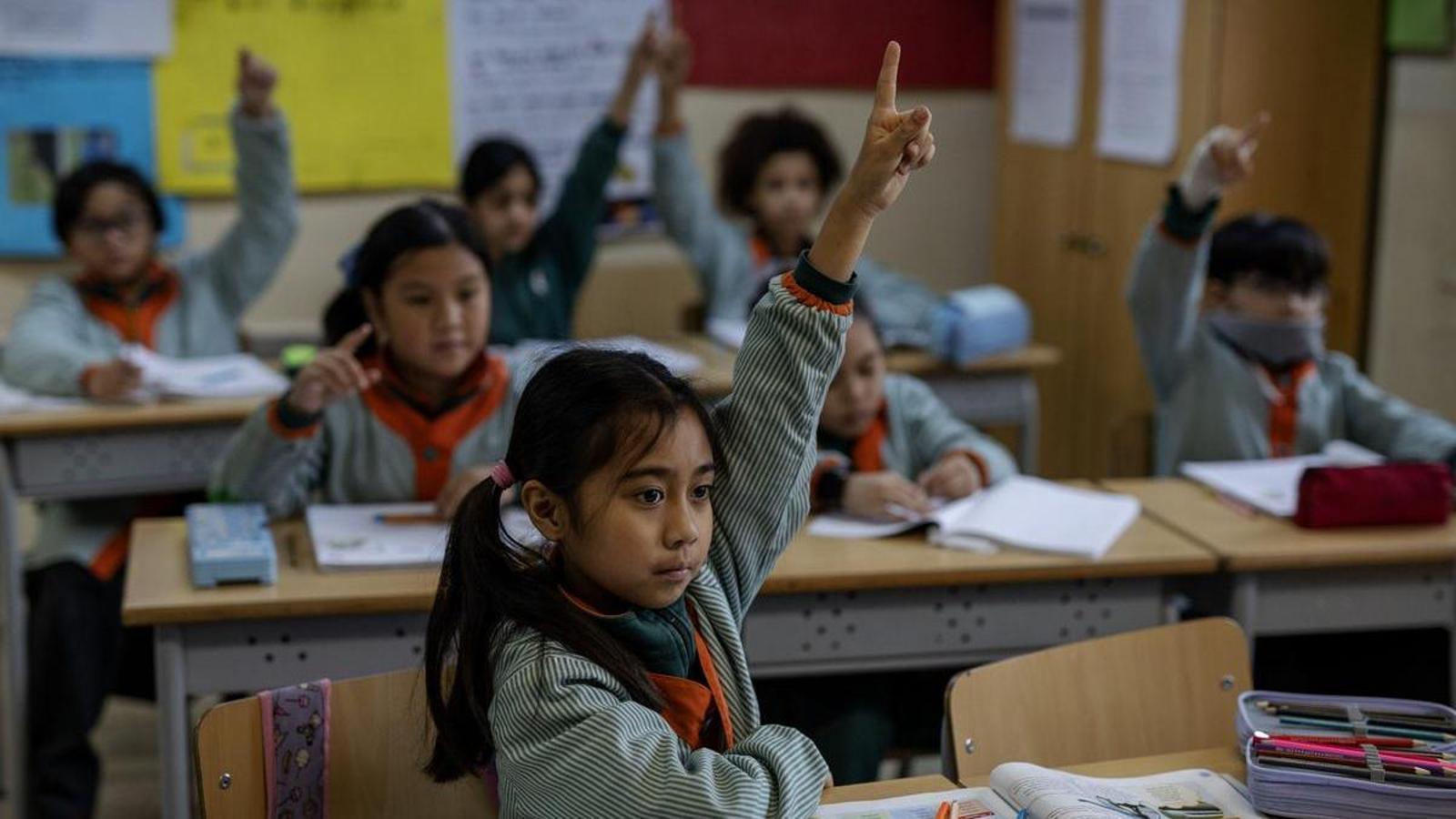
BarcelonaThe consensus around the role of Catalan as the vehicular language in schools remains very solid. 83% of Catalans are in favor of implementing policies so that students know both Catalan and Spanish by the end of their education, according to the 2026 CEO Omnibus survey. However, the idea that school is an infallible tool for learning Catalan and for affiliation with Catalan identity –an axiom during the Convergent governments– has been failing for decades. The figures show, without nuance, that Catalan is retreating in schools: the worst result for Catalan in the last decade in basic competencies, students know less Catalan than Spanish as a second language, and there are three times as many failures in the Catalan language as in Spanish in oral exams; all this within the framework of an abrupt drop in reading comprehension, according to the PISA report.
The full picture shows that Catalan also suffers on the street (it is only the habitual language for 40% of the population), and above all, it is disappearing from many social spaces among young people: half of the 4th-year ESO students never use Catalan outside of class with their high school peers (see graph) and, in the next age bracket, between 15 and 29 years old, only 25% of young people primarily use Catalan with their friends and only 36% identify with Catalan identity.

All the political forces running in the elections believe that the linguistic model of the Catalan school needs to be reformed, but the question is with what objective: to tear it down or to shore it up? From the right, the educational battle has been judicialized for decades to the point that the Catalan school currently depends on the sword of Damocles of the Constitutional Court, which has a pending ruling that could force the application of 25% Spanish in classrooms. A judicial setback would be a moral victory for the right, which in its platform is committed to guaranteeing education in Spanish throughout the State and hopes to apply more Spanish in the most Catalanized environments. Vox even points to the creation of reception classrooms in Spanish.
Transforming immersion
The rest of the political spectrum is against the application of the Galician language percentage model in education. They defend the conjugation model established by Catalan educational law. The goal is for students to master both official languages (and Aranese in Aran). Since surveys show that this balance is not being achieved, experts have been advocating for years that the linguistic immersion applied in the 80s needs to be reformulated to guarantee Catalan in a multilingual environment, as it has, broadly speaking, become Castilianized.
Language Policy, Catalan universities, and the IEC are working to design a new immersion model based on the oral use of the language, with La Bressola as a paradigmatic example. “Education is a cornerstone for the survival and recovery of the language –argued Minister Francesc Xavier Vila just a few days ago, arguing that Catalan is less and less present within the family and on screens–. We must reformulate the linguistic model with which we have reached 2026, because now, spontaneously, children speak in Spanish among themselves and in Catalan with adults: this is the crux of the matter that needs to be changed”.
“Languages should not be treated with equality, but with equity. Therefore, policies must reinforce minoritized languages to level them with the state language. There is no school in Catalonia where reinforcement of Spanish is needed for children to learn it, yet there are children who do not know how to speak Catalan,” states Mireia Plana, vice-president of Plataforma per la Llengua, who advocates for the dejudicialization of education and long-term consensus. “Regarding Spain, touching immersion yields a lot of profit [for the PP and Vox], but I believe there is no real possibility of attacking the whole model. They will not be able to do everything they would like to do,” affirms sociolinguist Miquel Àngel Pradilla, who gives as an example the statements in defense of immersion by Xavier García Albiol (PP).
On one hand, there are legal limits and, on the other, social opposition. In the governments of the Balearic Islands and the Valencian Country, it has already been proven that the PP-Vox pincer has made Catalan in schools a battleground, but it has backfired on them. Their educational freedom law to promote education in Spanish has ended up with 80% of families choosing Catalan as the vehicular language in the Balearic Islands and 50% in the Valencian Country. Their bet on media bilingualism is indeed noticeable, as is the lowering of linguistic requirements to work in the administration, the economic strangulation of the promotion of Catalan and the fracture of the unity of the language. “All this violates the linguistic rights of Catalan speakers. Until now, linguistic policies have been very negligent; I do not know what else has to happen for us to react,” says Mireia Plana, who trusts in the power of civic mobilization.
-
PSC: continuity, with goals in Europe
The Socialists do not propose changes to the educational model nor do they speak of quotas. However, they make clear their intention to implement linguistic plurality in the administrations and are committed to continuing to promote the official status of Catalan in the EU.
-
Front Ampli: explicit defense of the immersion model
The coalition proposes to shield the linguistic immersion model with a state plan for learning co-official languages and a multilingualism law so that citizens can interact with the administration in any official language.
-
ERC: shielding of the Catalan school and mandatory status
The Republicans demand the modification of Spanish laws to prevent the imposition of Spanish language quotas. Catalan, the only “vehicular and social cohesion” language, must be mandatory knowledge for civil servants in Catalonia (multilingualism law).
-
Junts: immersion, “a red line”
The Junts members define the Catalan school with Catalan as the vehicular language as a “red line”. They express categorical opposition to judicial quotas for Spanish, demand the requirement of Catalan in the public sector and justice system, and present specific proposals for universities.
-
PP: right to education in Spanish and single university entrance exam
The Popular Party commits to guaranteeing by law the right to receive education in Spanish throughout the territory, imposing judicial rulings on percentages or linguistic quotas. They also propose a single university entrance exam throughout Spain.
-
Vox: end of immersion and abolition of requirements
The far-right party proposes to completely abolish the linguistic immersion model and guarantee Spanish throughout the territory by unifying curricula. They also propose eliminating linguistic requirements in the public administration.
