The academy for Valencian that the PP opened and now Vox would like to close
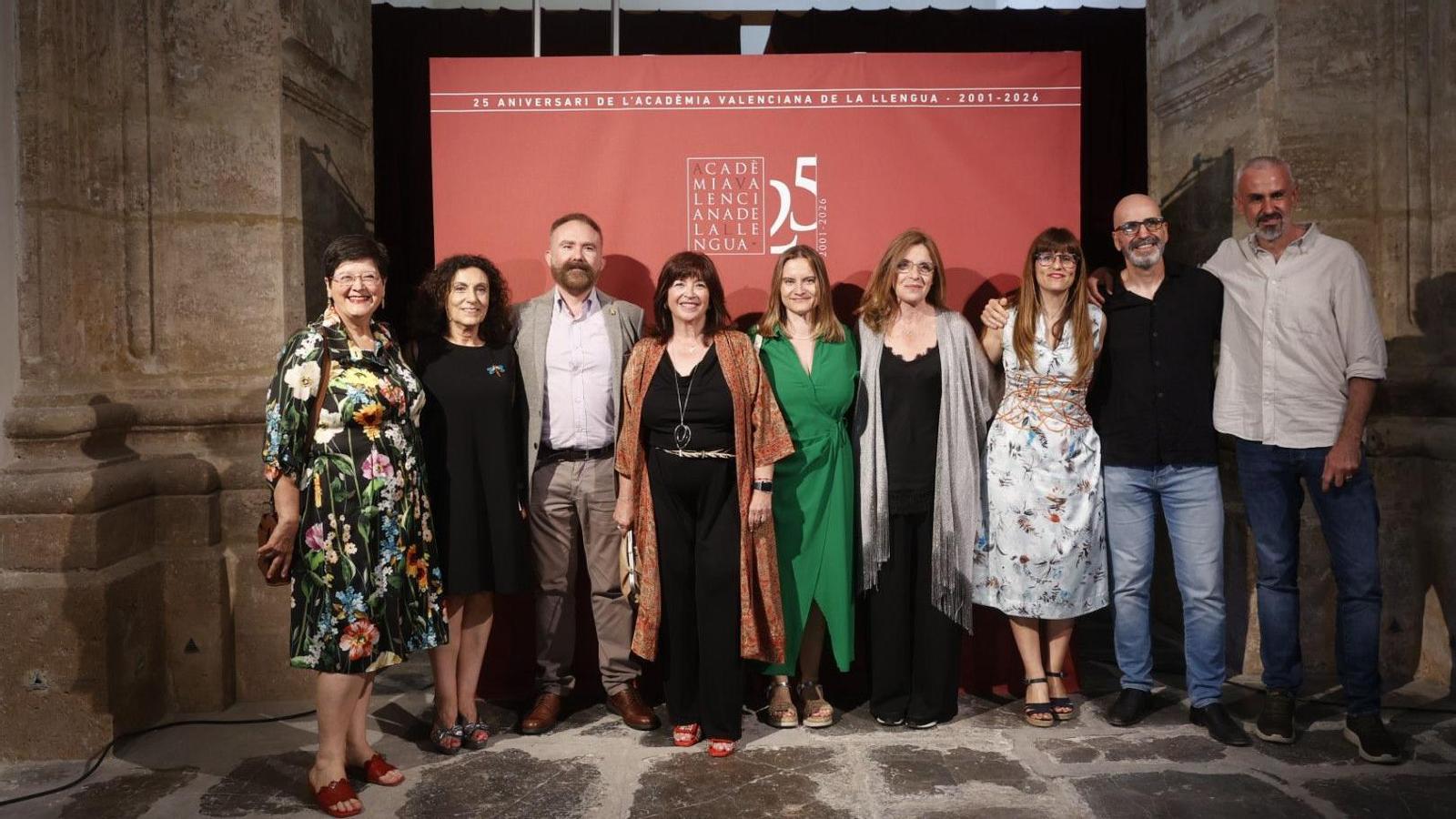
The institution celebrates its 25th anniversary in the face of the danger of asphyxiation by the Generalitat
-
CAT -
CAST
ValenciaIt was born to end the linguistic conflict despite the skepticism of many university and secessionist sectors; it has coexisted with constant criticism from the People's Party, and now survives the virulent attacks of Vox thanks to the shield granted by the Statute of Autonomy, but with the fear of being financially suffocated (both conservative parties have announced that in 2026 they will again cut its budget by 25%). The creation of the Valencian Academy of the Language (AVL), which turns 25 this year, is one of the few cases in which Valencian society has been able to weave consensus in recent years. It is also, however, an example of the many challenges it faces, such as achieving the survival of the institution and, above all, avoiding the disappearance of the language.

A striking element of the AVL is that one of its promoters was the PP itself, which now questions it. The project was inherited by former president Eduardo Zaplana from his predecessor, the socialist Joan Lerma. The also former minister took on the initiative with three objectives. The first, to weaken his partner in government, the uncomfortable secessionists of Unió Valenciana, who generated numerous linguistic controversies that overshadowed the executive's action. The second, to win over the voters of the regionalists and, thus, achieve an absolute majority. And the last, to appease his boss, former Spanish president José María Aznar, who aspired to gain the trust of Convergència i Unió by deactivating – now we know only momentarily – anti-Catalanism.
AVL Operation: the Valencians' linguistic pact Operació AVL: el pacte lingüístic dels valencians (Vincle Editorial, 2021), which is the only study on the entity's trajectory. The also lecturer grants the body a key role to the point of stating that until 2006, when the institution was incorporated into the Statute of Autonomy, "the Transition" in the Valencian Country was not "completed."

But reaching statutory protection –which now prevents PP and Vox from closing the AVL without the favorable vote of progressive parties– was not easy. Before that, the body had to overcome the coercion of the executive of former president Francisco Camps, who in 2004 sent the then Minister of Culture, Alejandro Font de Mora, to a plenary session of the entity to read a statement in which he threatened legal action against the institution if it expressed an opinion on the name of the language. The intimidation attempts failed and, a year later, the academics proposed the use of the Catalan-Valencian designation. The decision strengthened the body, which garnered the support of Valencianist sectors and the transformative left, who until then had distrusted the AVL because it included originally secessionist groups. That firmness was also key because, nine years later, the Academy approved a definition of the language that defended the historical designation of Valencian, but at the same time, recognized the unity of Catalan. "The PP creates the institution [with the PSPV], but then attacks it when it has demographic needs. For them, language is a bargaining chip," summarizes Castillo.
Promoting its use, the great pending challenge
Having overcome the philological debates, the AVL has been able to address the challenges of the future. The easiest was to normalize relations with the Institut d'Estudis Catalans (IEC). This milestone was reached in 2020 when, together with the University of the Balearic Islands, the three institutions signed a collaboration protocol to create a unitary language model that is respectful of geographical variation. "In the beginning, the Institute wanted submission," complains Castillo, who emphasizes that the arrival of Teresa Cabré to the presidency of the IEC (2021) "facilitated" the understanding.
The task of promoting the use of the language, which has been pending since 2001, when the Pact for Valencian was signed, is foreseen as much more difficult. The agreement included two tasks: the creation of the AVL and the promotion of Catalan. As is well known, the first objective has been achieved, but the second has remained a dead letter. This is demonstrated, for example, by the fact that in 25 years no government, neither progressive nor conservative, has approved a linguistic requirement for access to the administration or that the language immersion model – which was not applied throughout the territory – was repealed. In summary, a lot of work to do which, now, is also in the hands of the PP and Vox.
