À Punt raises the bet on bulls, Spanish and events with the appointment of Román Ceballos as new president
Organisms like the News Council denounce the regression of a public media that they consider is increasingly resembling Canal 9
-
CAT -
CAST
ValenciaAs if nothing interesting were happening in the Valencian Country and the fulfillment of the principle of proximity communication medium established by the foundational law of public radio and television had been suspended, this Friday viewers of À Punt will be able to verify that the channel will dedicate part of its programming to broadcasting a bullfight from the Madrid Feria de San Isidro. As striking as it may seem, it will not be the first occasion; in fact, the broadcast of the bullfighting show from the capital of the State began on May 9 and will be repeated this Sunday. What will be, however, is another example of the evolution of a channel that, with the arrival of PP and Vox to the Generalitat, is increasingly opting for content in Spanish, the mix of opinion and information, crime stories, and the dissemination of shows linked to the most conservative Spanish worldview. A trend that gives no reason to believe it will change, but rather the opposite, with the appointment this week of Román Ceballos as the new president of the board of directors of a channel that for many has long resembled the old Canal 9.
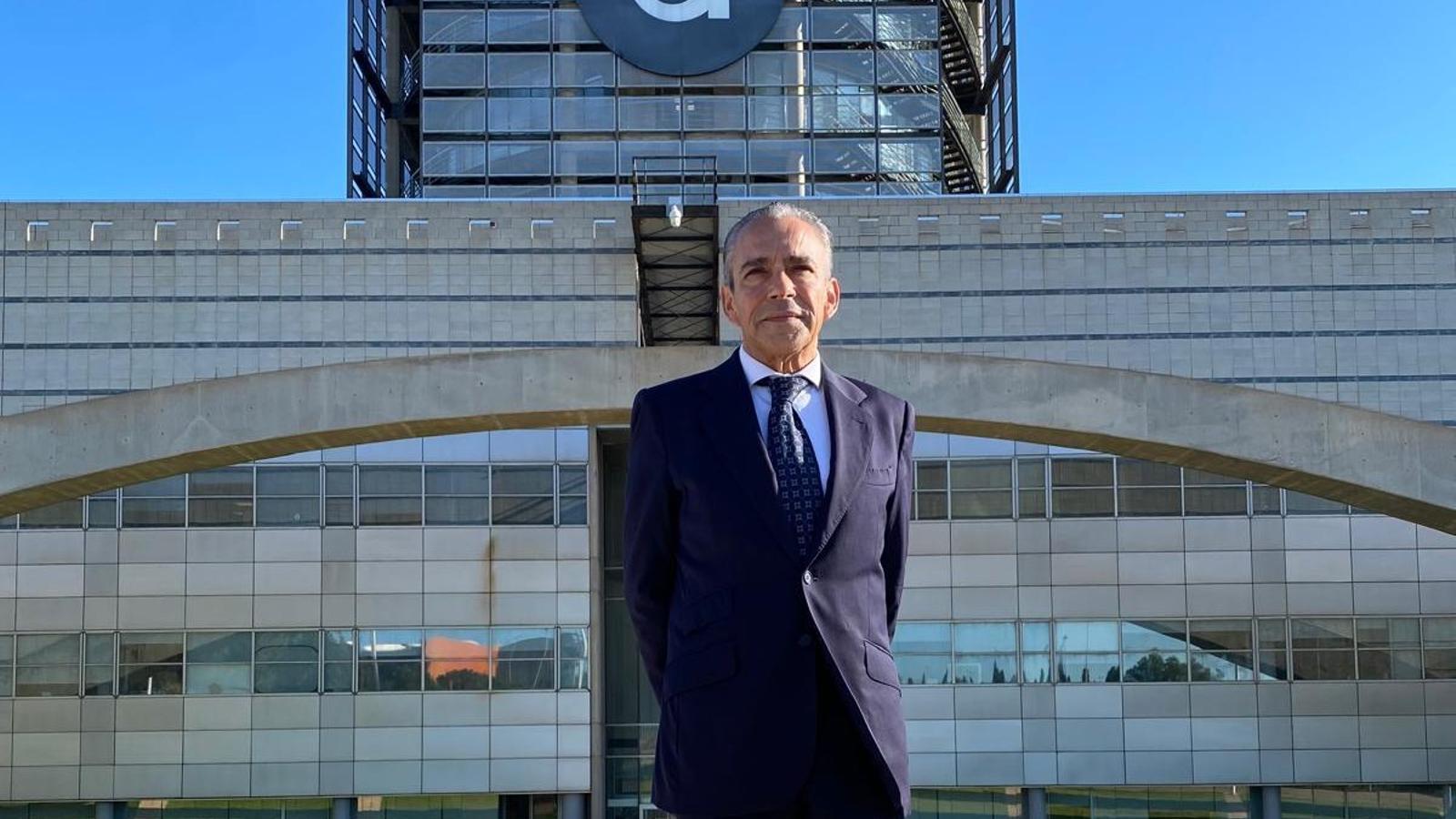
To ensure that À Punt does not alter the course set since Carlos Mazón was invested in 2023, the Valencian government has filled the vacancy left by Vicente Ordaz with Ceballos, who was appointed autonomous secretary of Communication by the new head of the Consell, Juanfran Pérez Llorca. With a degree in labor sciences, a social graduate, and a diploma in labor relations, he held positions of great importance in the governments of Francisco Camps. Specifically, he was the Director General of Labor and the máximo responsible for the Valencian Employment Service (SERVEF). Despite his career in public administration, he is especially remembered for his work in the private sector when he was part of the KPMG consulting firm's team that designed and managed the extinction ERO with which Canal 9 was closed in 2013. This is the same role he played as the main negotiator for the Port of Valencia with the stevedore unions during a period of high labor conflict. A resume that raises the question of whether the PP and Vox plan to reorganize an entity still pending organization with competitive examinations that would stabilize a staff that has remained provisional since 2017 and formed through temporary employment pools.
To compensate for his lack of experience in the communications sector, Ceballos will inherit the team that accompanied Ordaz and which comprises the general director, Francisco Aura; the head of news, Josep Magraner, and the director of programs, Paco Picó. These are three former executives from the old Canal 9. Executives whom the staff of À Punt accused a few months ago of turning the public radio-television into a "transmission belt" for the Valencian government, where "manipulation" of information and the creation of "tailor-made news" are not uncommon. accused a few months ago of turning the public radio-television into a "transmission belt" for the Valencian government, where "manipulation" of information and the creation of "tailor-made news" are not uncommon.
In addition to the informative bias, workers have been complaining for months about the continuous changes in a schedule dominated by sports and festival programs. Also about controversies that last a few weeks. One of the most striking was El debat, directed by actor and former Citizens deputy Toni Cantó. The most unstable, however, is the afternoon magazine, which in April underwent its umpteenth change since Aura's arrival. After the attempts of La vesprada amb tu and the controversial Va de bo –which even aired a video that implied a love affair between the Spanish president, Pedro Sánchez, and the minister Diana Morant–, the new proposal is Està passant, which has nothing to do with the program of the same name on TV3, as the format focuses on coverage of events and neighborhood controversies, some of dubious interest.

Less audience and less Valencian
Of this return to the past, the Audiovisual Council and the Company Committee have complained in recent days, lamenting that the news programs have reduced the time for information in favor of opinion. They give as an example the morning news program, which has gone from three hours to one, including, in addition, a debate panel "that eats up almost half" of the time. In the same vein, they point out that the evening news program has premiered a debate format called Face to face, "which is a copy of "Black or white" from Canal 9". In addition, they recall that when the news programs coincide with broadcasts such as those from the San Isidro fair in Madrid, the channel does not hesitate to shorten or delay them. For the workers, the consequence of this management is a loss of credibility that is reflected in news programs at "historic lows" in audience, already below double digits, and in a channel with a screen share of less than 3% – 2.6% in April, according to data from the consultancy Barlovento–, which makes it the least watched regional channel in the State.
The other great victim of À Punt's new direction is Valencian, which is increasingly less present on its schedule. The stages when almost all the programming was in the native language are now far behind. In fact, the channel is failing to keep its promise to broadcast content such as films programmed in Spanish in Valencian through the dual audio. In fact, according to an official response from À Punt, advanced by El Temps and confirmed by ARA to a citizen who complained about this situation to the Audiovisual Council of the Valencian Community, between October 1st and December 31st, the public channel broadcast 102 films. Of these, 86 were in Spanish and 16 in Valencian. Of the 86 programmed in Spanish, only 22 had the dual option in Valencian.
