A self-managed football club and only in Catalan: the project that Oleguer Presas founded in Sabadell
The La Caserna Football School, which trains 200 young people, bets on non-competitive, affordable, mixed and recreational sport

-
CAT -
CAST
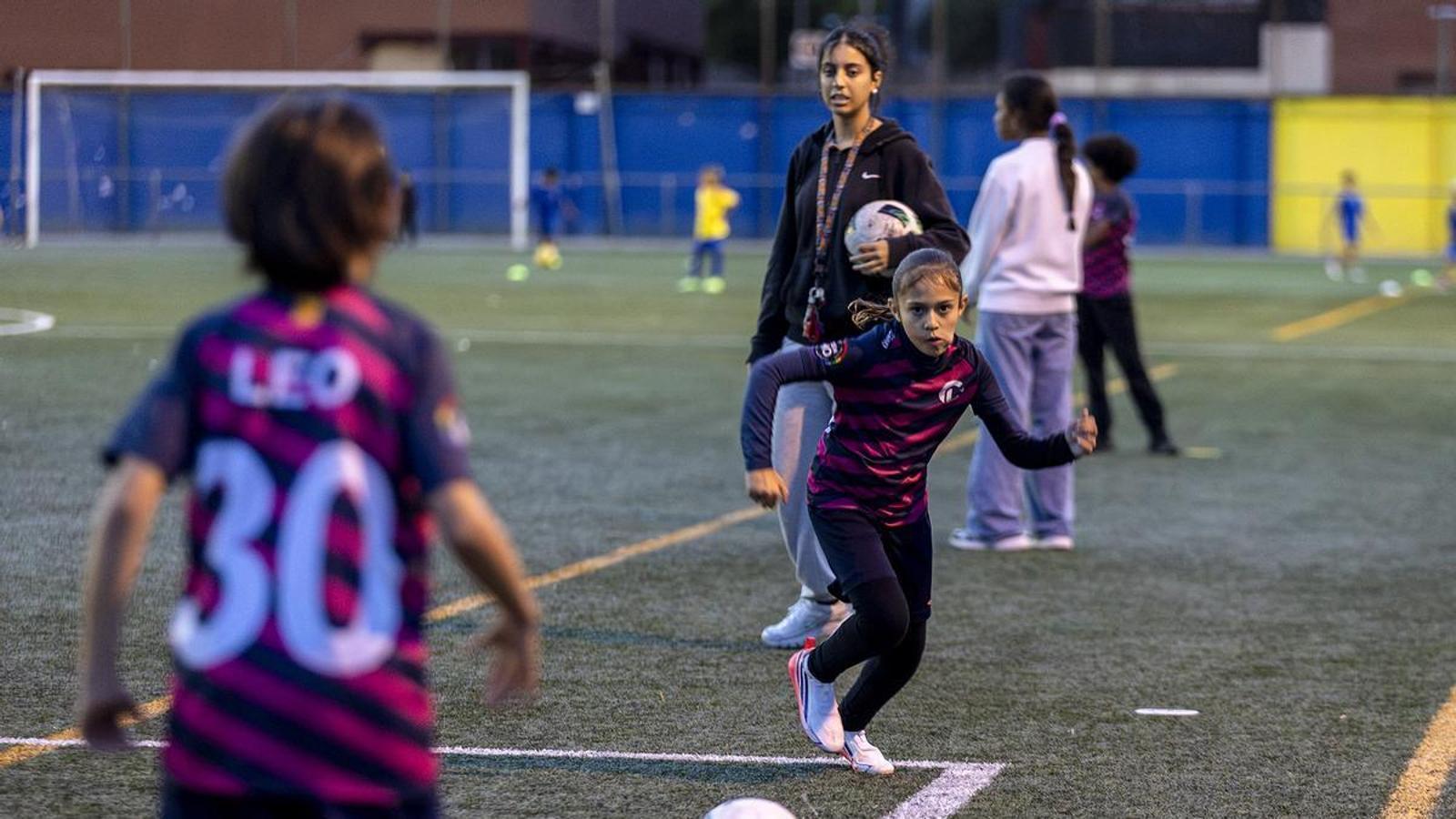
BarcelonaIt is a Tuesday afternoon and it is already getting dark. Marwa, 20, is training a dozen children in a corner of the Ca n'Oriac municipal football pitch, located in the north of Sabadell, which they share with other entities. The La Caserna Football School was born in 2017 in parallel to the citizen platform that occupied the Civil Guard barracks of Sabadell to claim it for neighborhood use. They were a group of activists and parents who intended to play purely recreational football, open to everyone, far from the clubs that select children at early ages. One of the project's promoters was the former Barça footballer Oleguer Presas, who remains involved but declines to appear in photographs because the club is a horizontal and self-managed project, with parents who organize themselves into committees and are even volunteers at the training sessions. “Now we are going to do diagonals –calls out the coach to the kids, and corrects their position–. If I am active, the ball doesn't bounce off me”.
Xavi Ramos is a father who joined post-pandemic, excited because his daughter wanted to play football. The girl quit the following year, but he has stayed in a club that he defines as “an educational space, which does not prioritize performance or competitiveness, but rather coexistence, and which wants to be inclusive, as is very clear with the fee: other clubs cost 700 euros a year, here you pay a maximum of 120, and whoever cannot afford it does not pay”. Today they have about 200 young people enrolled from 5 to 18 years old and nearly 40 trainers, including technicians and volunteers.
Catalan, a requirement for trainers
For a couple of seasons now, some teams have been participating in the Sabadell School Sports Council league to put what they learn to the test. “In football, Catalan is non-existent,” says Ramos, and the surveys confirm it: in Barcelona, 3 out of 4 young people speak only Spanish when they train. That is why one of the pillars of La Caserna since the beginning has been the use of Catalan as a vehicular language. “The cliché that football works as a space for cohesion is true. It is a safe, comfortable space where they feel well welcomed, and this places Catalan in a position of trust and fun,” affirms Ramos. It has even helped some parents, like Dani, to take the plunge and speak Catalan when they have had to volunteer at training sessions, as they are doing today: “The shyness has left me now,” admits this Sabadell native. La Caserna is one of the entities that this Saturday will contribute their successful experience to the MigrAccions congress organized by the Ateneu Barcelonès.

Since the City Council evicted them from the barracks, they train in public schools and fields in the peripheral neighborhoods of Sabadell. Furthermore, since they do not have the barrier of a fee, most of the children they serve are Spanish-speakers. Many encounter Catalan for the first time outside the classroom, in a recreational space. “I don't know any friend who speaks Catalan, only my older brother,” says 11-year-old Alanny, whose parents are from the Dominican Republic, in Catalan. Without being asked, they all identify with the origin of their parents. Ariadna, 10, whose mother is Paraguayan, says she teaches Catalan to her sisters: “I like Spanish more because I feel more comfortable with it, since I have spoken it since I was born.” Keled has arrived from Peru, he does not yet speak Catalan and his immersion is minimal: “We do Catalan one hour a day. In the playground and in the dining room, we don't use it.”

At training it is also hard to get them to speak it, but at the very least they hear it, because Marwa maintains Catalan, a requirement that the coordinators of La Caserna asked of her from the beginning. They have provided her with two training sessions that include linguistic guidelines. She herself also serves as a role model for the students. Daughter of Moroccan parents and a resident of Torre-romeu, she has lived her whole life exclusively in Arabic and Spanish. “The environment hasn’t helped much: throughout my life it has been difficult for me to find Catalanized people and environments. Even at the high school, Catalan wasn't spoken, because the majority were immigrants or children of immigrants,” she says. Now that she is studying electronic engineering at the Polytechnic University of Terrassa, working as a counselor at the La Baldufa recreation center and is a coach at La Caserna is when she has become linked with new environments and speaks more Catalan than ever.
When training ends, they form a circle [sic] to discuss the weekend’s match. In Catalan. “Everything starts with attitude and training,” Marwa instructs them. In the end, a kid comes up to me: “I wanted to tell you that I think this team is very good. Even though we are last in the league, what matters is the friendship.” He turns around and joins his hands in a final cheer: “One, two, three, Caserna!”
