The educational model that does achieve Catalan being vehicular
La Bressola celebrates 50 years with an immersion model that has never lowered its guard and that the Government sets as an example

-
CAT -
CAST
BarcelonaThe Catalan linguistic immersion model, which has weakened over the years and with social changes, is one of the fronts that needs to be reformulated to improve the situation of Catalan. When asked how, the Minister of Linguistic Policy points to Northern Catalonia. "La Bressola has an immersion model that, with 2% Catalan-speaking students, manages to make Catalan the language among equals without adult supervision. If this is possible in its context, it must be possible in other centers," he stated in the last interview with ARA. In Catalonia, only half of 6th graders always speak Catalan with teachers and only one in four always speaks Catalan when doing group work with classmates. Outside the classroom, 60% of students do not use Catalan with their peers. How do they manage at La Bressola to ensure students actually converse in Catalan in the classroom, playground, and dining hall?
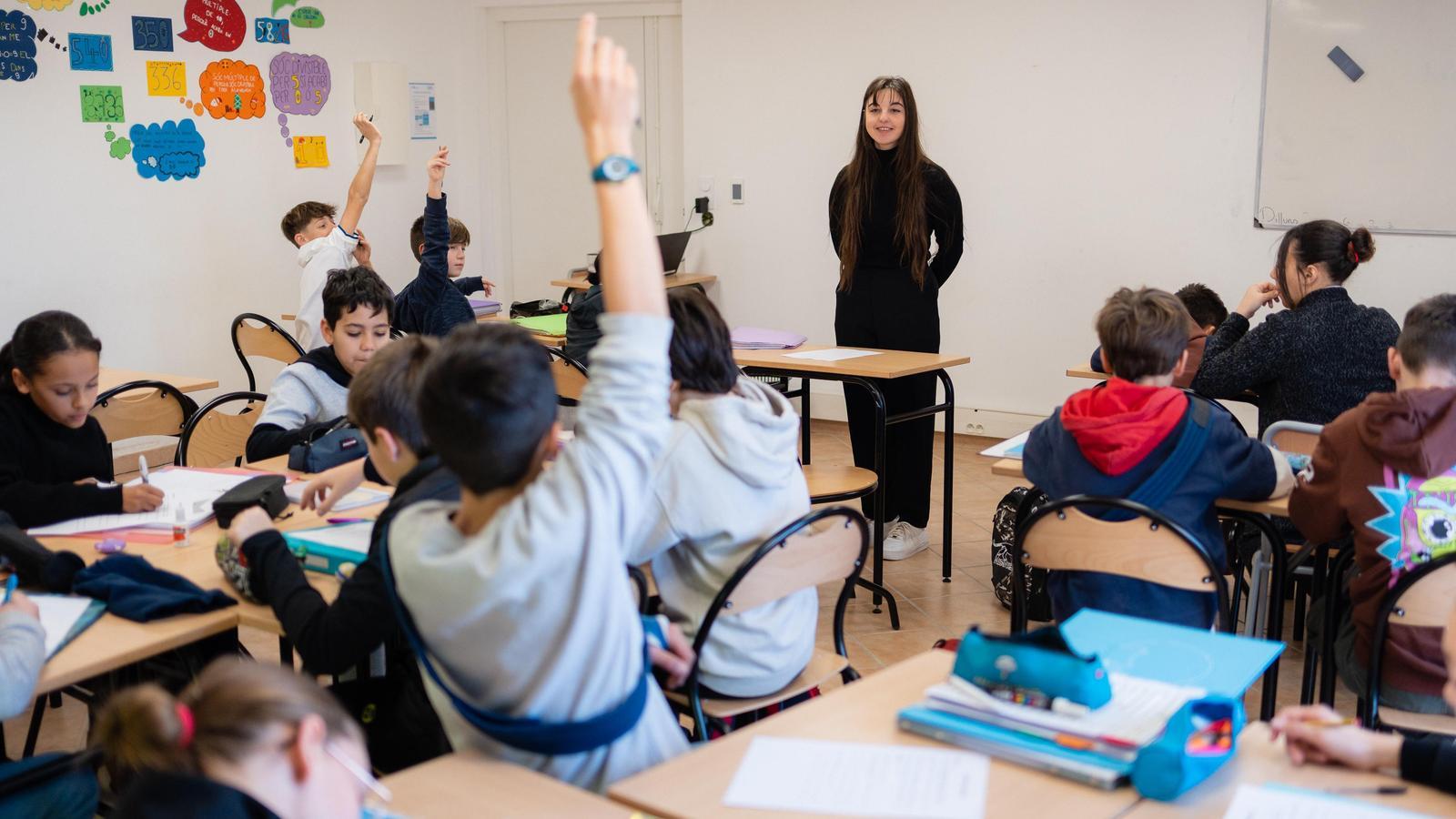
"In our schools, everything revolves around immersion. The spaces, the relationships, the routines are always prepared and designed so that Catalan is alive and used. Our goal is for children to be competent in Catalan, and this means that Catalan should not be the language of the classroom or the content, it must be the language of life," explains Marta Ibáñez, pedagogical director of the Bressola school network. Today they serve about a thousand students in seven primary schools and two secondary centers. "The time a child spends in linguistic immersion in our schools is less than 20% of their waking hours; the other 80% is lived in French. Therefore, our work must be very rich, very rigorous, and very efficient," she points out.
In practice, how do they do it in the classroom? Their model has been consolidated with three strategies. Firstly, verticality. Since La Bressola was a school with seven students, they found that it worked to give the older ones the co-responsibility of teaching the language to the younger ones. That's why they mix children and share classrooms with children of different ages (in three cycles: 2-5 years, 6-7 years, and 8-10 years). "The older ones are recognized as experts and the younger ones want to emulate their linguistic role models. It's like a family structure," says Ibáñez.
Secondly, immersion. It is not about the teacher always speaking Catalan. Immersion is a pedagogical technique for learning a language that is not the initial language of the classroom, so that teachers plan classes to promote linguistic exchange. It is important that students start at 2-4 years old so that they learn Catalan from when they acquire speech, and that they start in classrooms "where there must always be proportionality, so that the entry of these new children does not overwhelm those who already have the language," warns the teacher; that is, that immersion is maintained. The teaching staff must always be present to accompany language acquisition without going through French: if they are in the playground they must sit in the sandbox and if they are eating they must sit at the table. "Teachers must anticipate students' verbal needs and foresee when Catalan might disappear because the child simply does not have the word. If they are playing with the toy kitchen, they must have introduced words like plate, spoon, glass [cup]...", explains Ibáñez.
The third pillar is cooperative work, what we would call projects today, which reinforces the relationship between peers and the autonomy of young people. "Metacognition is greatly encouraged, students' awareness of their own learning process. It is natural to talk to children and for them to self-assess how they are doing in terms of language. They are aware that they are doing something heroic, they speak two languages, they speak Catalan, they are happy and they have a sense of belonging to Catalan culture," assures Ibáñez.
Commitment of parents and teachers
as the educational level increases, the presence of Catalan decreasesHowever, they are associative and state-subsidized schools, they are a choice of the families and, therefore, everyone agrees with Catalan as the vehicular language to achieve a good level of both Catalan and French. Why do they send the kids to Bressola? "On the one hand, because they are small schools with a coherent and humane pedagogical project. Secondly, because there are families who have affective ties with Catalonia. Perhaps the grandparents spoke Catalan and linguistic transmission within the family has been interrupted. Thirdly, there is the cognitive and educational advantage of learning a second language. And, fourthly, they recognize the cultural value of Catalan and think it will help their children when they go to work in Southern Catalonia or to university," says Ibáñez.
With parents involved in immersion as a primary objective, the other determining factor is the alignment of the teaching staff. "Teachers must be trained and consistent with the project. When a new teacher arrives, they are explained the pillars of the house and the first year they are accompanied by a trainer-teacher," says Ibáñez. This is confirmed by the didactics professor at the University of Vic-UCC, Teresa Puntí, who knows the model very well and sends students there for internships. They demand a very high level of oral language from the teachers and provide them with periodic training.
"They are very demanding and have never lowered their guard, because immersion is their reason for being: they were born to increase the social use of the language in Northern Catalonia. It is the most persistent and well-worked immersion reference model we have nearby. They have a waiting list, because going to Bressola is prestigious," assures Puntí, who also teaches linguistic immersion techniques to future teachers at UVic-UCC. "Immersion is not taken for granted, it is always evaluated in weekly team meetings, in all courses and all areas, not just in the classroom," points out the Bressola pedagogue.
Each their own system
On the occasion of the 50th anniversary of La Bressola, which the Government has helped to finance, and aware that its model can be a benchmark for reformulating Catalan immersion, they have promoted a seminar that is touring all Catalan universities: Immersive Tools and Strategies. "The students, who are future teachers, are very aware of the situation of Catalan in Southern Catalonia, they are worried and interested in our model –recognizes Ibáñez–. Each sociolinguistic context must adapt its model. In Northern Catalonia, the language has practically disappeared from homes, streets, and public life, and we have small, associative schools. The context in the Catalan Countries is not the same".
La Bressola also has very concrete challenges. One objective is economic consolidation, so that the aid coming from the Generalitat and other donations are structural and permanent. Another is that La Bressola can finally open its longed-for lycée (which is equivalent to the three years after primary school), to close the circle and guarantee Catalan up to university. Today, 6% of students studying Catalan in Northern Catalonia follow bilingual or immersive education, and 19% have some contact with Catalan, but as the educational level increases, the presence of Catalan decreases.
Another difficulty is the mobility of teachers, who often come from the Principality for a short period. And, finally, there is the intrinsic challenge of a linguistic project in a hostile environment: "That Catalan continues to be a living language in school", says the pedagogical director. For now, there is a waiting list of students and a list of municipalities that aspire to open their La Bressola. "I believe there is a growing interest in Catalan, even in public schools, and there are many entities, cultural centers, and sensitive people who want to recover the social use of the language. The school cannot achieve this without a whole sociolinguistic ecosystem", assures Ibáñez.

