Santi Colominas: "I have received all sorts of offers to buy my Toc al Mar, but I don't intend to retire"
Cook

-
CAT -
CAST
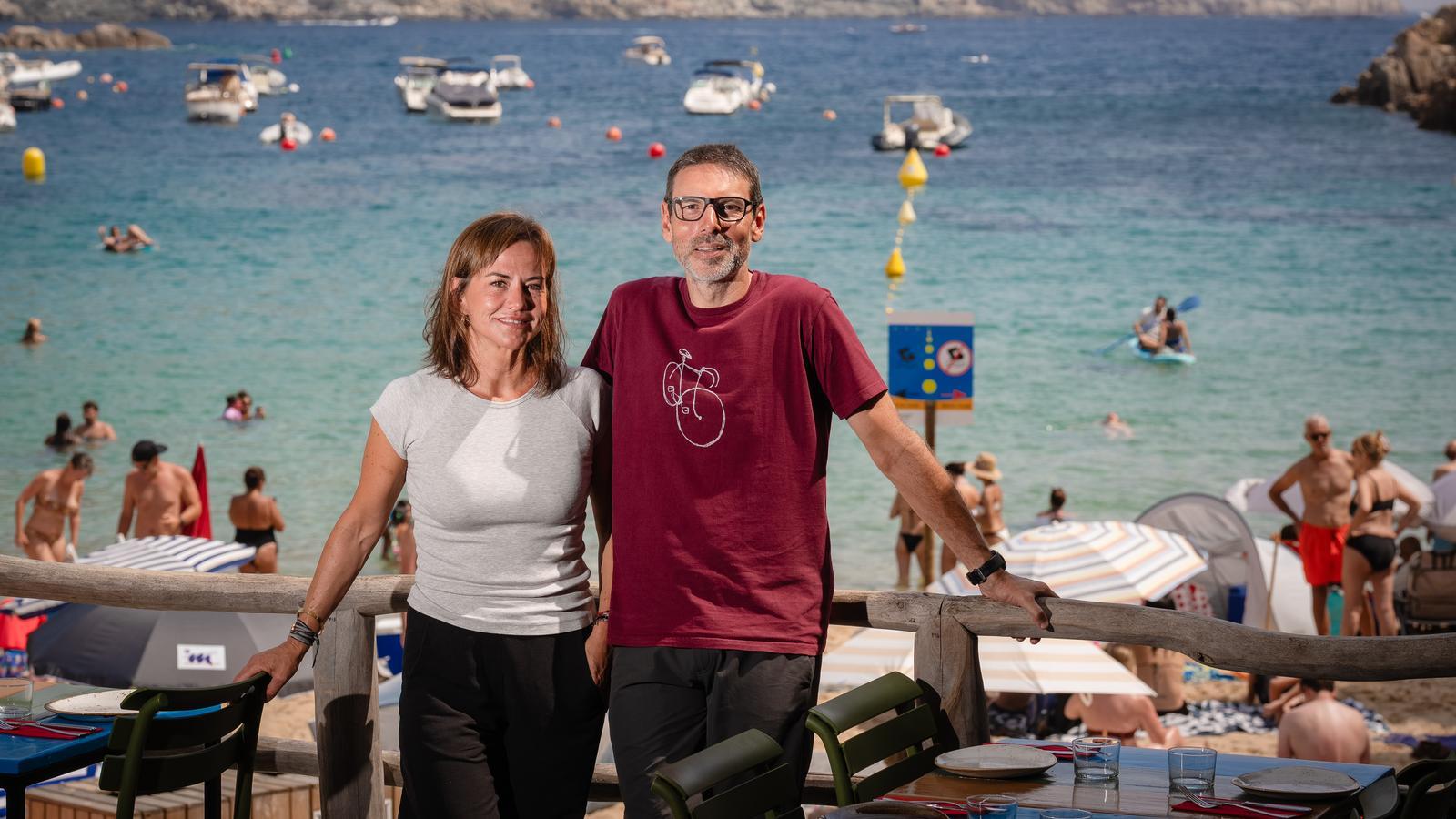
Aiguablava/BegurI interview the chef Santi Colominas (Argentona, 1973) on a summer morning, a few hours before the first lunch shift starts, at 1 p.m. The restaurant Toc al Mar celebrates its fifteenth anniversary this year since it opened in a small fisherman's house during an economic crisis. Santi had spent summers in Tamariu, and when he was offered the proposal, he accepted. For the first three years, he combined Toc al Mar with the restaurant Toc de Barcelona, which was located on Girona street. They were very intense years, with two young children he had together with the head of service and partner, Sandra Baliarda (1972, Badalona). Today, their children have already confessed that they like and are enthusiastic about the hospitality world. They have the succession secured.

When did you decide to close the Toc de Barcelona restaurant, and focus solely on Toc al Mar in Aiguablava?
— When Toc al Mar took off. From the first moment we opened it was liked, because at a time of economic crisis, we created a formula without luxury, without tablecloths, informal, but with very high quality product, which has always been our obsession. At Toc al Mar we have tables that eat sardines with a beer and others that eat lobster with a good wine. We don't make distinctions for anyone, because all options have a place. And do you know what's happening to us now? We have many young people, twenty-year-olds, who you see like to eat and who come to Toc al Mar. I drool over these young people, and I make sure they don't lack anything, because they are the foundation. Young people who like to sit down to eat are our future, and I go out of my way for these kids. I don't usually greet customers much, because that's Sandra's job as head of the dining room, but when I see these young people who come to eat, I might end up sitting with them to talk.
The fishermen from our ports tell me that it is difficult to find sardines; they catch few of them.
— They are in season now, and we always work with local produce. It is true that the temperature of the sea water is changing everything. We are also having problems with mussels from the Ebro delta, production has fallen. It is a year in which the mussel is suffering a lot.
The same as what happened this season with the herons.
— We have not served them. We must have a biological ban on them for years, because there are none, and when there are, they are empty! We cannot serve them to restaurants by making customers pay a high price, because we also pay it, high. A sea urchin costs 1.05 euros, and it turns out you pay and they are empty. That's why we haven't served them. Currently, in the time we live in, tourism campaigns based on a single product cause it to be destroyed in the short and medium term. In the past, a very long time ago, they made sense, because, in addition, they helped to have tourism at other times of the year that were not summer, but now it makes no sense. I repeat: campaigns based on a product are a mistake, because they end up generating speculation with the product.
You have it very clear.
— I am very critical. They have me asthe enfant terrible, but I think I have to say what I feel and see. When they tell me they're doing campaigns for sea urchins or rockfish to de-seasonalize tourism, I tell them that if people don't come in January or February, it shouldn't be the fault of the sea urchins. We have to have a long-term vision.
What do you mean by causing product speculation.
— What has ended up happening with the groupers. Since there are none on the Costa Brava, they end up buying them in Asturias, Galicia, and Portugal. What happens with the grouper on the Costa Brava is similar to the phenomenon of the lobster in Menorca.
What are the signature dishes of Toc al Mar?
— Dishes cooked on the grill, such as fish, seafood, rice. The wood we use is holm oak; we do not use charcoal. We generate the embers ourselves from the wood, and we cook everything on them, including vegetables.
The rice dishes are the main attraction.
— We make them at midday; at night, no. In Ametller Origen supermarkets and also in other restaurants, we sell them as ready-to-eat meals. That is to say, we sell them through both channels, both the catering and the retail. We make paella, black rice, squid rice, surf and turf, Iberian pork. So our competition is ourselves. We also have other ready-to-eat products, such as pâté en croûte, which we make with Albert Boronat, and we sell it in El Corte Inglés's gourmet club; also in other places. Albert puts his name on it; I make it.
Santi, there have recently been evictions of beach bars on the beaches. The latest to receive a notification is La Caleta de Sant Vincenç de Montalt. Bar Boia in Cadaqués had to close. Do you think it could happen to Toc al Mar too?
— Toc al Mar is located in historical heritage that saves us. We start from the premise that we are in a small fisherman's house, and inside we have the business. Furthermore, we pay everything to all the organizations: to Costes de la Generalitat, to Madrid and to the Begur City Council. When the summer season ends, there are no services left on the beach, and it is we who collect the rubbish, offer the toilet. We are open all year round. By the way, I always recommend everyone to come in the autumn, as it is beautiful. In the summer, everything is overcrowded.
It is true that there are many people now. It was difficult for me to park in the parking lot, but the views, the menu, and the option to swim on the beach afterwards are unbeatable. Do you have a change of clothes?
— My sons, aged 24 and 20, have told me they want to continue it. Arnau is working this summer at the Candlelight restaurant with chef Oriol Fernàndez. He has worked at Els Tinars, and has also been in Switzerland. Martina is studying in Madrid, and one day I went to see her and she told me that when she finishes, she wants to continue the business. She has two years of her degree left, and she has already told me that she wants to get involved. She is with us during the summers. We have always told both of them not to get involved if they weren't passionate about it because they know it's a sacrificed profession. We have always worked weekends, entire summers, Christmas. All of this has also made them strong. In fact, Arnau started studying business administration, and one day he told us it was very boring and that he had enrolled in the hospitality school. It took us by surprise.
You have the relief assured.
— I have received all sorts of offers to buy Toc al Mar, but I am not going to retire. We also have very high fiscal and personal pressure. I have been working as a cook for many years, and we have never had the pressure we are receiving now. We have turned small business owners into the villains of the movie when we are doing a great job. The last inspection, which was a labor inspection, I had on June 1st. And there are many in the region too. The restaurants that came out of the carob campaign this year have also received inspections. The year they say they are not participating, they receive them.
The desserts at Toc al Mar are what make me travel miles to see you, too. Desserts with ratafias and sweet wines.
— Bread with chocolate, oil, and salt is a tribute to my grandmother Angeleta, who used to prepare it for us on Saturday afternoons while we watched Tarzan. We would buy the chocolate at the corner store in front of our house, at Josefa's.
To finish, I have one last question for you. How did it come about that you wanted to be a cook?
— The two grandmothers cooked very well at home. Both Grandma Angeleta and Paquita were very good, and my parents' hobby was to sit at the table, to go to restaurants. We used to go to Racó d’en Binu, because I'm from Argentona, and also to restaurants in France. They gave us a broad gastronomic culture, but it was a family drama when I told them I wanted to be a cook. They sent me to a private school in Tona to study baccalaureate, and when I finished, the administration made them go and told them: “If you have a son who knows what he wants to be when he grows up, why don't you let him do it?”. The phrase convinced them, and then I enrolled in the hotel management school in Barcelona, where I met Sandra. I went back and forth every day from Barcelona to Argentona. Soon I started working in restaurants, I traveled a lot, and finally Sandra and I opened El Toc, in Barcelona.
How good are Francesc and Francina from Racó d’en Binu!
— Nothing has changed. It's the same as when I used to go as a child with my brothers and parents. I love them. For me it is haute cuisine from fifty years ago, which they continue to make with the same decoration, tableware, cutlery, and the same people do it. They are great!

