Evan Gershkovich: “Russia decided that it needed me as a hostage and accused me of being a spy”
Journalist and author of the book ‘Esta tierra hermosa y maldita’
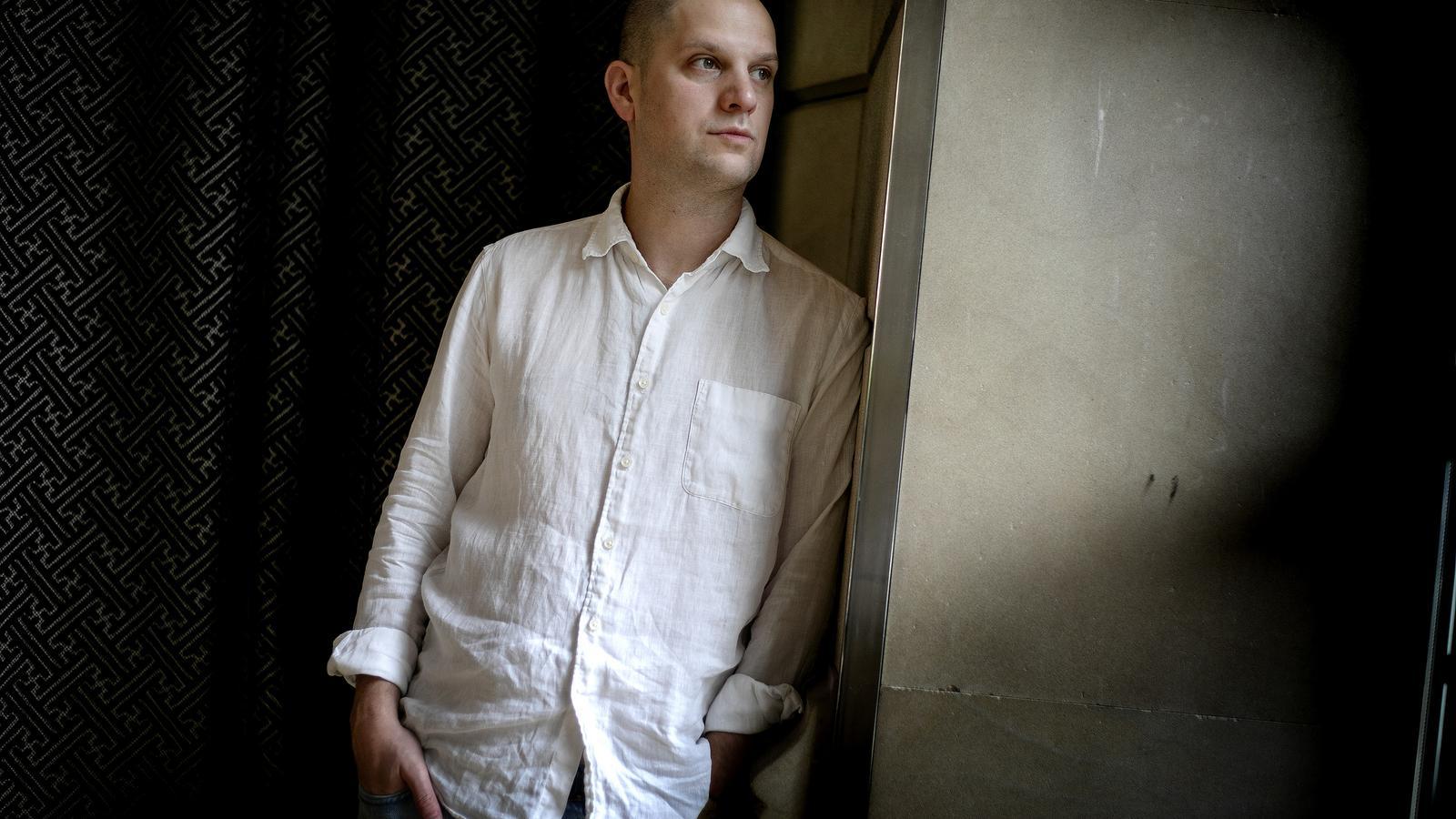

-
CAT -
CAST
Barcelona“Welcome to our humble theater”. That was how journalist Evan Gershkovich (New Jersey, 1991) greeted his parents the first time he saw them during a court appearance in Moscow. He had been locked up in Lefortovo Prison, in the Russian capital, for two months. And he still had fourteen more to go behind bars, until a complex, high-level chess game was resolved, with which the Kremlin managed to repatriate Vadim Krasikov, a murderer serving a life sentence in Germany.
While Gershkovich—the son of Russian parents exiled from the USSR—was working as a correspondent in Russia for the The Wall Street Journal, the Russian secret services set a trap for him and arrested him, falsely accused of espionage in March 2023. He was the first Western journalist convicted for this reason since the Cold War. After 491 days in prison, he was released in the largest prisoner swap between Russia and the US. Now he recounts his experience in the book This Beautiful and Damned Land (Debate), which he presented in Barcelona as a guest of Cidob.
Starting in 2018, it became increasingly clear that Americans were no longer untouchable in Russia. Arbitrary detentions and hostage diplomacy intensified. But it seems you didn't feel you were in danger.
— There is a great distinction between simply being American and being an international correspondent. This is what we were asking ourselves during the first year of war: Is the risk for correspondents growing? We thought maybe 2%, 3%... But no. When they arrested me was when I realized they had raised the bar. Correspondents used to have a quasi-diplomatic status, but that has changed, because I am no longer the only one. Yuki Imai, a Japanese journalist, was detained three weeks ago accused of espionage. Once they have crossed the red line of arresting a correspondent, it is as if they no longer have any problem doing it again. The key is: from which country are they willing to detain people as hostages to later exchange them?
At any point did you think there was a real possibility of ending up in prison?
— A couple of weeks before my arrest, a colleague from another newspaper was called by the Foreign Ministry and told that they would not renew his permit because they did not like what he was publishing. They had changed the rule and were reviewing the accreditation of foreign journalists every three months. And before the full-scale invasion [of Ukraine] they expelled a Dutch journalist, a British journalist, a Japanese journalist... There was a leap, and we thought there might be a probability, but a very small one. When they arrested me, it was not exactly a total surprise, but it was a shock.
In the book you argue that, before you were detained, you had violated Russian censorship laws practically every time you published an article about the war in Ukraine. But you were arrested for a crime you had not committed.
— It is an argument to say that the law in Russia is arbitrary. All the correspondents who are in Russia, when they write any article, are violating the censorship law. They simply apply the law arbitrarily when they need to. They decided they needed a hostage and that they needed to present him as a spy, so they applied the law to do it with me.
Your first day in prison, you turn on the television and see that they are talking about you on Russian television. What goes through your mind at that moment?
— I turn off the TV. That first day I am too scared. Being a journalist, you are an observer, but nobody asks anything about you. You watch the movie, but you are not part of it. It was a difficult thing to face. The next day I do watch the program, and one of the presenters says: “Although it may seem cynical, we have accumulated exchange token forecasts.” And, as a rational journalist, that calms me down. I began to see signs: they are not interrogating me, they are not torturing me, they are taking me to Moscow. In the first conversation with the investigator, the topic of exchange lists comes up. I think: okay, it is not a fun situation, but at least it won't last long. But the emotional part is really difficult. What I explore in the book is this kind of split personality disorder that begins when I start to inhabit my Russian side more.
In the first days in prison, you highlight the relative comforts and kindness with which you are treated. Did you feel guilty about the difference in treatment compared to other prisoners?
— I am not sure I felt guilt. I had a kind of survivor's guilt at the end, when they sentenced me and I knew it didn't matter what the sentence said, because I was going home. And the other prisoners in the corridor, political prisoners who had to spend fifteen years in prison, were encouraging me. It is horrifying to think about what Ukrainian prisoners of war or Russian political prisoners are going through. But I never felt guilt because we were in prison for different reasons. The only reason I was there was to be part of an exchange. In other words, I should not have been in prison, to begin with. If you are a Russian political prisoner, if you criticize the state, you sort of know the risks you are running. It's not that I don't feel bad for them. But I did not have a feeling of guilt about the fact that my mattress was thicker. I did feel it at the end, when I was convinced that I had a way out and the rest were staying there.
Were you surprised by the treatment you received?
— When you have been reporting on these cases for years and know how they can treat people, you expect the worst. When I am arrested, I am afraid: will they torture me? It is logical that I was, because I knew that this was happening. Yes, I think at first it surprised me, but then I saw the point. They arrest a correspondent for the The Wall Street Journal. In part, they do it because they need a lot of attention, a wave of rage in the United States to try to make the exchange agreement work, which is what happened. It is a journalist, who will probably write about what is happening to him. I saw that they were trying to use me to show a kind of human face. They are very calculating and treat different people differently.
How would you describe the situation of independent journalism in Russia? The feeling among some foreign correspondents is that they still have a certain margin to practice journalism that Russians do not have, but that there are red lines that cannot be crossed to avoid being accused of espionage.
— I think it is a wrong way to think about it. Independent journalism in Russia has been dead since 2022. You can go to prison for ten years if you say that the war [in Ukraine] is a war and not a special military operation. Yes, there are Russian newsrooms in exile in Europe and they use anonymous Russian reporters on the ground who still report. And there are still foreign correspondents and they believe they are safe. Because, of course, Russia will not arrest all international journalists. They can report, but the idea that they are safe just because they do not publish anything confidential or sensitive is not real. As soon as the Russian state needs them, they can accuse them of being spies if they want.
Sometimes, from the West, Russians are criticized for their lack of response to the war in Ukraine. You know Russian society well and you were also constantly exposed to Russian propaganda for more than a year. Can you understand it?
— There have been people who have protested. Some went out to protest against the mobilization of September 2022 and they were arrested and sent to the front line in Ukraine. It is very easy to criticize it from Barcelona. Yesterday [Wednesday] there were people demonstrating here in Barcelona. But they were not put in police vans nor were they sent to the trenches in Ukraine, where they are killed by Ukrainian drones. A teenager I met in prison is serving a double-digit sentence for spray-painting an anti-war slogan. Is it rational? No. Is it heroic and brave? Absolutely.
There is little room to protest...
— Putin established the rules of his regime very quickly. After the horrible chaos of the 90s, there is a boom in oil and gas, and life improves. But he makes it clear to people that they cannot enter politics if they do not want to end up in prison for ten years. And people think: I cannot get involved politically, but I can have a good life. And that is how the system is for years, long before the full-scale invasion. In the book, I use the word apathy to describe it, although some Russians have criticized me for it, because they say: “Isn’t it rational to try not to get involved in politics if you know you could end up in prison for ten years, or murdered or poisoned?” It is important to remember what the control system in Russia is like. The question of who is responsible for the war is very complex. I always give the example of my girlfriend, Masha: she was born in 1995; when Putin becomes president, she is five years old. When she decides she wants to be a journalist, in 2010, Putin has already been in charge for ten years and Anna Politkovskaya has already been murdered for reporting on the regime. Masha takes a great risk to try to do independent journalism. Until in 2022 she has to leave her country and leave her family behind. She has sacrificed many things. Meanwhile, the Germans were voting for Angela Merkel and Olaf Scholz, and Germany continued buying Russian oil and gas after 2014, when Russia had already invaded Ukraine and had taken Crimea and eastern Ukraine. And for eight years we were happily swallowing their oil and gas, which was financing the war in Ukraine. Were we not also responsible, in some way?
Some of the inmates you spoke with at the Yekaterinburg prison told you they had hope that the regime would fall. What could trigger a revolution against Putin?
— When you live in an authoritarian regime that seems very stable, it feels like it will be there forever. And when it no longer exists, it is very easy to look back and find the factors that caused its collapse. Putin is 74 years old, he seems quite healthy. It seems he has control over the country. But, what if in two years Russia loses more territory in Ukraine and the people start to be unhappy with the army and the security services? Or if the economic recession ends up being so great that Russians, despite all the risks, rise up and protest? Or if Putin dies tomorrow from a heart attack? We cannot predict it. What is clear is that he will not relinquish power.
A few months after being released, you read Everything Flows, by Vasily Grossman, about a prisoner who is released from the gulag and has to readapt to life outside. How has this process been for you?
— I was in prison for sixteen months; it has now been more than two years since I have been out, and I finished the book in March. It has taken me more or less the same amount of time to recover. First it was therapy for post-traumatic stress, then regular therapy, and then writing this book. That helped me a lot.
What has been the most difficult thing?
— At first, it was a very overwhelming sensation. As if I had returned from the International Space Station. I had been isolated and suddenly, there were many people. I had panic attacks when there were crowds. And it was also like going from kindergarten to adulthood all at once, because an institutionalized person has no will. They follow orders. They are told what to do. Suddenly, you are learning to make decisions again, to know what you want, to say no. I couldn't get used to normal life. I would lose my nerves if my schedule didn't follow the exact order it was supposed to. Or if I was in the office writing and suddenly someone walked in without knocking, it would upset me, because I was used to guards suddenly entering and searching the cell.
Do you think you will be able to return to Russia?
— It will have to be when this government is no longer there. Putin is 74 years old and I am 35. There is probably a possibility, but we shall see. If I can return there, it will mean that it is a better Russia.

