"Wearing a headscarf means not being integrated?": Catalans who are children of immigrants speak out
The young people of the second generation defend the hybrid Catalan identity and the need to have an inclusive country project to combat the extreme right and save the Catalan language

-
CAT -
CAST
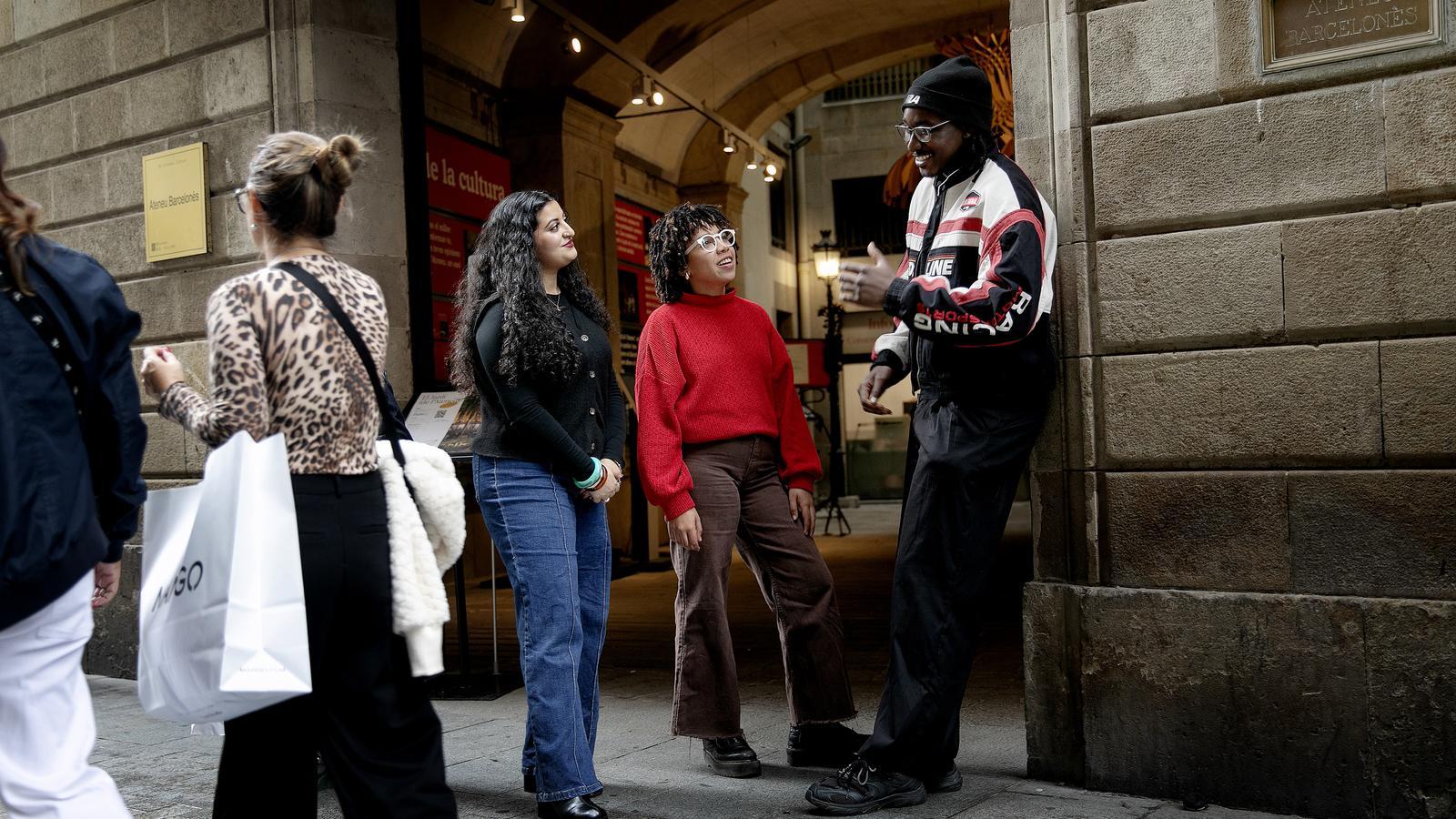
BarcelonaWe meet in the garden of the Ateneu Barcelonès, a cultural bastion and epitome of Catalan identity where Maria Bouabdellah Shaimi, Chayma Rachdi Mennana and Badembo Diaby never would have thought they would be invited. They are children of the migratory wave that has made Catalonia grow at a dizzying pace to 8 million people, but above all, they are three young people of Generation Z who live with the contradictions of a hybrid identity, with one foot in Catalan culture and the other in their family origins. The Ateneu has invited them to the MigrAccions congress (from November 19 to 21), which aims to serve as a laboratory for experiences of cohesion to address the effects of demographic changes, such as the decline of the Catalan language or the rise of xenophobia. With them, we talk about this and about the process of approaching Catalan identity. What does it mean to be Catalan for the children of immigration? Is the language enough? What prejudices do racialized Catalans experience? Who validates them as Catalans?
But where are you really from?
In defense of a hybrid identity
The shortest question is the hardest to answer: where are you from? The three young people find themselves at different moments in their identity definition. On one hand, Badembo Diaby (Alcarràs, 2001), son of Senegalese parents and a truck driver, is full of doubts: “I don’t know where I’m from. When I’ve wanted to be from here, they ask me: «But where are you really from?». And when I say Senegalese, they tell me no, that I am Catalan because I was born in Alcarràs. And the same thing happens to me in Senegal”, he explains. On the other hand, the journalist Maria Bouabdellah Shaimi (Vic, 2002; raised in Banyoles), daughter and granddaughter of Moroccan immigrants, does not hesitate: “I feel Catalan above all else, and of Moroccan origin, even if it was hard for my grandmother to understand”.

In between there is Chayma Rachdi Mennana (Barcelona, 2001), also the daughter of Moroccans, who embraced Catalan identity later in life: “I identified with my neighborhood, La Mina, before the country. Now I tell you that I am a Catalan daughter of immigrants, but ten years ago I wouldn't have done that, because they had always treated me like the Moorish girl. As a child, they didn't want to play with me and they always asked me «where are you from?», even though I went to Morocco one week a year”. The feeling of otherness and the constant reminder that they are from outside is a shared experience: “At school, the Black and Moorish kids go over there and the others here. It’s not said, but you see it when they don't choose you to play soccer. At 7 years old I thought: «What have we done wrong?». And you ask yourself: «Where do they want me to be from?»”, explains Diaby. A year ago she co-founded the entity Afrolegacy to have a voice of their own among the people after episodes that hurt them, “such as kicking our children out of the library saying they smelled bad or a documentary blaming immigrants for poor school performance”.
Immigrants, until when?
The long road to Catalan identity
“I have inherited the migrant status of my parents without ever having migrated”, says Maria Bouabdellah with her Banyoles accent, who was an early content creator in Catalan, one of the popular faces of the children’s channel SX3 (Mood Z and Ràndom) and now works as a scriptwriter at 3Cat. “The immigrant label is infinite. When will I stop being a daughter of immigrants or the second generation and be Shaima and be Catalan?”, wonders Rachdi. White foreigners have an easier path to avoid prejudice. “It is a question of color —states Diaby—. I am tired of asserting myself and having to prove that I am from here”. It is one of the contradictions they live with: the desire to stop talking about migration and the need to continue making their reality visible. “This will end when we stop being perceived as racialized people by the system and society”, explains Rachdi. In a country where 25% were born abroad and three out of four have migrant origins, diversity should already be perceived as the norm.
However, the children of immigrants themselves admit that encountering Catalan identity is a process. For Rachdi, it has involved overcoming the trauma of racism, claiming her rights as a citizen, and building bonds with organizations and people who share her struggle. "It is a lot of work compared to another person who is born here and is automatically read and accepted as Catalan," she observes. External validation and recognition as a political subject on equal footing have been the keys to connecting with Catalan identity. She now works on anti-racism awareness and as a technician for the Prometeus educational project.
All three claim the right to be everything. "Hybrid identities have always existed. Nationalisms have made people believe that they must be 100% one thing to fit into their model of society, of state, but a person can feel Catalan and practice some traditions or others...", explains Rachdi, who holds a degree in humanities and human rights and globalization.
If you don't eat pork, are you not integrated?
Skin color and religion condition the migrant's status
The word integration grates on them. “I don't know if I am integrated. What does it mean to be integrated? If I speak Catalan, am I already from here, and if not, am I not? Being Catalan is not an exam to pass. If integrating means living, studying, working, and paying taxes here, then we are super-integrated. My father has been doing it for 30 years,” suggests Badee Diaby. According to a survey by Plataforma per la Llengua (2024), 55% of citizens link Catalan identity to the Catalan language and culture, and 34% to an administrative matter. “I believe that the language is inseparable from being Catalan, but time and space must be given. There are also people just passing through who find it difficult to feel Catalan,” opines Bouabdellah, thinking of his grandparents, who are now returning to Morocco. Re-emigrations are a differential factor of the latest migratory waves and influence rooting and cohesion, because they require a constant effort, for example, in teaching Catalan—in 2024, 276,000 immigrants arrived in Catalonia and 147,000 left, more than half.
According to the CEO (2024), 88% of citizens want immigrants to adapt their customs. For children of immigrants, who already have Catalan incorporated because they have been educated here, this adaptation sounds like a desire to erode family culture. “I am Catalan, but I am still Afro-descendant and Muslim. Is a Muslim integrated or not? Does going out in a djellaba or going to the mosque mean not being integrated? If you don’t eat pork, it turns out you are not integrated,” criticizes Diaby. “The problem is that we have to fit into a Eurocentric model of whiteness to be considered Catalan or a citizen. It doesn’t matter what you do, what you speak, what you study, because as a Muslim woman I am not integrated in a non-denominational country!”, laments Rachdi.
How well you speak Catalan
The racialization of Catalan, a self-sabotage
“People are surprised when I speak Catalan,” relates Diaby. In Banyoles and Alcarràs, twenty years ago, it was obvious that they would speak it: “In the towns of Lleida, Spanish was not spoken. I didn’t learn about it until high school. Now it is a bit different,” states the young man, who speaks Mandinka at home but Catalan with his siblings. From La Mina, Rachdi, whose mother tongue is Darija, had a different perception: “It’s not that we don’t want to speak a language. It’s that due to historical segregation, Spanish predominates in the neighborhood. The image of Catalan is something alien or elitist, because we only hear it at an academic or institutional level and we think it has nothing to do with our more peripheral identities,” he explains, aware that the language has more to do with the postal code than with social class. At the same time, he denounces the structural racism that also exists in education.
—Many children of immigrants don’t even imagine themselves doing a better job than their parents —says Bouabdellah.
—At high school, we used to say: “If in the end we’ll end up working with fruit, just like them”. The system drags you into it —points out Diaby.
—There are specific expectations about you: that you won't do baccalaureate or you won't go to university. But if you stand out a little, then you have to be the perfect immigrant —adds Bouabdellah.
—Because you are exceptional, you are the “good migrant” —labels Rachdi.
—I claim the right to be mediocre, like everyone else —the journalist asserts.
The children of immigrants live one reality at home and another outside, and in adolescence there is a rupture “either towards the family or towards society, and that is when they renounce Catalan culture and shut themselves off”. Bouabdellah has seen this when giving talks at schools, and believes that support is needed during this stage. She had it easier because her mother, who arrived here at age 14, “had already broken many taboos” and paved the way for her, although there are still conversations she avoids with her grandparents. “Being part of a community has weighed on me, but it hasn’t conditioned me,” she states. For her, the bonds and values she found at the youth club were essential for her sense of belonging in Banyoles: “There must be a mutual effort: you put yourself in the uncomfortable situation of feeling out of place and it is important that the organization opens up and includes you. At the same time, meeting people is the best social elevator, because you have more tools to prosper,” she says.
There are entire generations of racialized Catalans whom many Catalan speakers continue to address in Spanish. It is a self-sabotage of the idea of linguistic normalization and a sabotage of the educational efforts invested in spreading Catalan. The racialization of Catalan as a language of white people is a tic that bothers them: “If we want to save the language, let’s start here. Because if you don’t speak to me in Catalan, I will surely continue in Spanish so as not to enter the loop of ‘how well you speak it’”. So address me in Catalan first,” asks Diaby.
Who will save Catalan?
Between intercultural dialogue and the rise of hate speech
The rise of the far-right and hate speech concerns them. “It scares me not only as a racialized woman, but as a democrat. I am afraid that access to rights for the most vulnerable people will be hindered,” explains Rachdi. Because precisely these rights and these public services are what have allowed the children of immigrants to have a better quality of life than their parents. “Yes, we will have more opportunities, because we have more rights and because we have suffered the sacrifice of our parents,” affirms Rachdi. “But with inequalities: the name is key, the photo is key, the hijab is key when it comes to accessing opportunities. People will have to start accepting that people of migrant origin are not just here to do precarious jobs,” warns the Barcelona native. That the social elevator works also takes root.
The demographic change does not stop: almost half of young people aged 25 to 39 are born abroad and half of the babies born in 2025 had mothers born outside of Catalonia. Civil society and public services have not known how to react in time to the pressure on the Catalan language and identity. The three young people empathize with the fear that Catalan culture will be diluted, but they see that it is precisely the exclusionary discourses that accelerate the residualization of Catalan, the opposite of what they claim to defend. “The «vete a tu país» is very dangerous because it makes immigrants close themselves off more. We must claim that this is also our country and that there are Catalans who are not white and that is fine,” defends Bouabdellah, who has served as a benchmark for many racialized young people since 3Cat.
“If rights are claimed for everyone and a shared project for the country, we will be the ones who preserve the language. I know it is not liked and that everything changes very quickly, but we are the present and the future. If people do not see Catalan identity as their own because they do not treat us as Catalans, perhaps there is a risk,” warns Chayma Rachdi. It is not enough to be the note of color: “Migrants are talked about to manage them, to criminalize them, or from paternalism. Having a scapegoat is not the way to build a society where everyone can live better. There must be other narratives and alternatives, and everything depends on knowing each other,” states Maria Bouabdellah.

“Catalanism has always united those who arrive and those who were already here. Today, a political force is pitting them against each other,” warns Isona Passola, president of the Ateneu Barcelonès. For this reason, in the face of the rise of the far-right, this entity and the IEMed have organized a congress on migration, language, and culture called MigrAccions (November 19, 20, and 21) to explain successful formulas for promoting language and social cohesion that can be replicated throughout the country. The commissioners are Aurora Madaula and Xavier Godàs. The program opens with the documentary A-Relats by Passola herself, and includes the participation of about 70 speakers and representatives of organizations from all over the country: from the CE Júpiter to the illustrator Nadia Hafid, from the Migrantour project to the rapper Babaflow, from the National Award winners with the Jande seal to the Joves Units del Poble-Sec. According to Madaula, the congress will be “practical and positive, looking at needs and not hiding problems.”
The goal is to connect Catalan culture and discourses on Catalan identity with the streets. “Organized civil society can provide solutions,” states Isona Passola, who believes in the need to link newcomers to Catalan identity. “We have to offer a country. It is important to talk about rights, but let’s not lose the notion that we can only generate Catalan society through fusion in a common framework of relationships with newcomers,” states Godàs.
During the afternoons of the week of the congress, the Ateneu heads out to the Plaça Vila de Madrid with the L’Arrabassada podcast, debates, and concerts by Rumbamazigha with Peret Reyes and Riborquestra with Gemma Humet.
