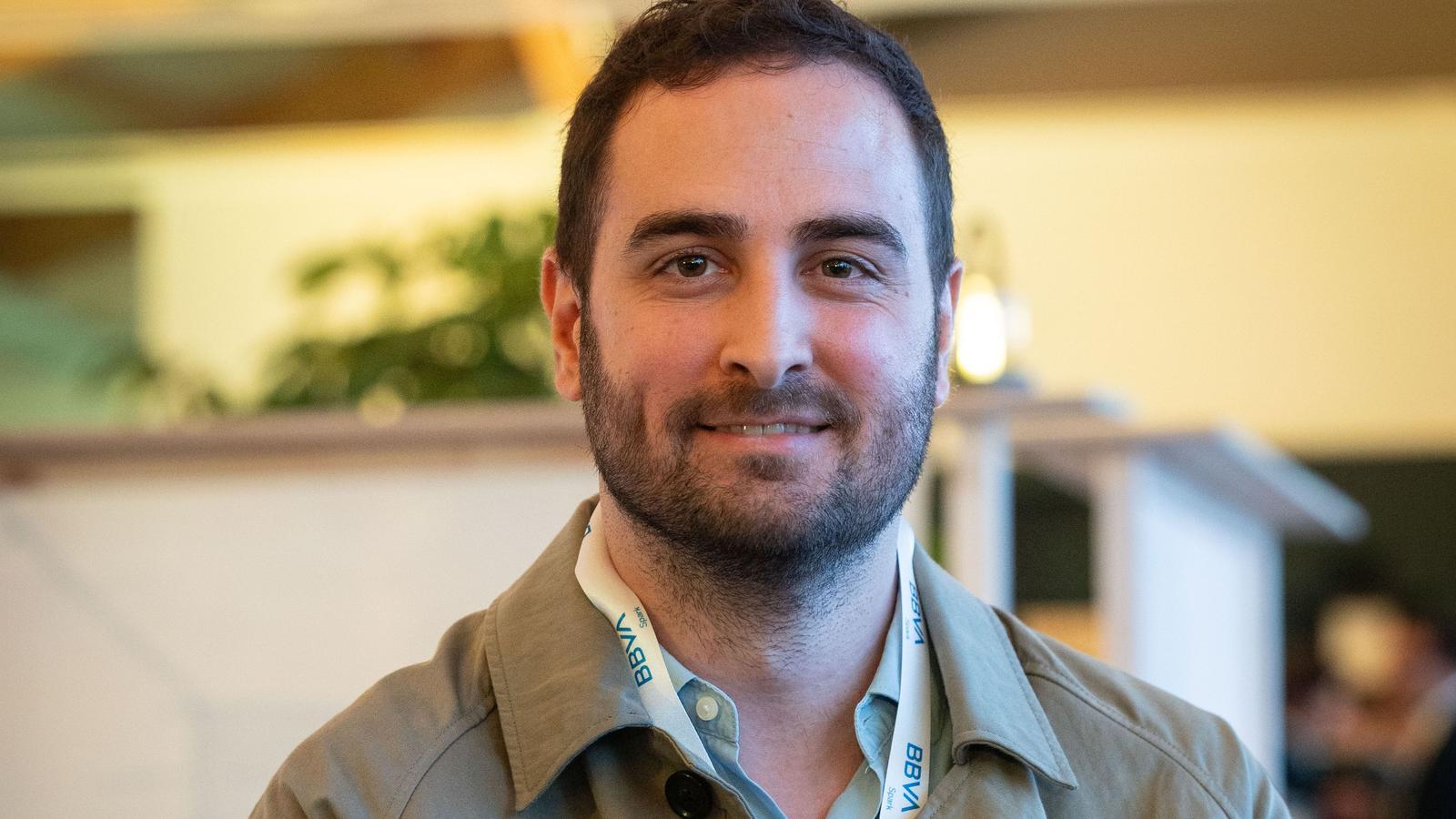
Xavier Sans: "Soon we won't even carry a mobile to pay, biometrics will be enough"
CEO of Frekuent
-
CAT -
CAST
Frekuent is a Catalan technology company specializing in digital payment solutions for businesses and automated services, with a presence in Europe and Asia. Its technology allows payment by card or mobile phone in vending machines, coffee machines, laundromats, service stations, or electric vehicle charging points, among other establishments. In addition, it offers sales management and loyalty tools to help companies better understand their customers and incentivize new purchases. It was one of the companies invited to the latest edition of the BBVA Spark Summit, the bank's summit for the startup ecosystem. Its CEO, Xavier Sans, highlights the bank's support for technology companies like Frekuent.
What did you think of the experience?
— The truth is that it is very positive. BBVA is leading the sector and its support benefits the expansion and growth of companies like ours.
At Frekuent you started by offering micropayment solutions. What led you to become a digital payment and customer loyalty platform?
— We have only been paying with cards for a few days. Before COVID, many of us still used cash. The pandemic greatly accelerated digitalization; perhaps it advanced it by five years. If we look at it, Apple Pay didn't arrive until the end of 2017, and its adoption in society was progressive. At that time, there were still many establishments and services where one could not pay by card or digitally, especially when it involved small amounts. Like at the office vending machine to grab a coffee. So we asked ourselves how to digitalize them. That is how Orain Technologies was born. The company still keeps this name, but a year ago we presented the rebranding of the commercial brand to Frekuent. The name refers to frequency, to recurring and frequent payments, which are precisely our field of activity.
Are we talking about 100 million transactions per year?
— These are early-year figures, but every year we multiply them by three. We started with vending machines, which perhaps were the most trivial example, but also one of the most complex. We had identified nearly a hundred sectors to which we could provide solutions and currently we already cover more than twenty. We have even incorporated new ones, because, whether we like it or not, society, companies, and businesses tend to be increasingly autonomous and automated. And that is without mentioning artificial intelligence and AI agents, which will accelerate this transformation even more.
I remember that not long ago you could not pay for the metro ticket with a card.
— In fact, there are studies stating that 70% of services are still to be digitized. But now we are not only digitizing these everyday sectors, but we are also generating new ones. For example, we have started to equip some Hop-on Hop-off tourist buses with devices so that tourists can have a device from which to buy a ticket for the Sagrada Família, Montserrat, or whatever it may be, right from their seat. We are also incorporating this into hotel room home automation where, apart from turning on the lights and air conditioning, one can also pay for checkout, book room service, a taxi or whatever it may be. It is what we call Edgelands, a concept of edgecommerce. What we are trying to do is integrate physical payment into people's lives and not only so that they can pay on the shop's device, but also online. And this, I insist, with AI agents will happen much more.
Offer sales management and loyalty tools. How does it work?
— We try to offer an end-to-end, comprehensive solution. We start with the device, which we manufacture and design ourselves here in Barcelona, and continue with the entire payment process, the business management software, and the terminals. Furthermore, we incorporate a loyalty and user management layer. For example, if you have a coffee every day, you can turn that consumption into a subscription, but at a physical point of sale. We are used to online subscriptions, like Netflix or other platforms, but why can't we have a subscription to get coffee? Or to consume electricity at an electric vehicle charger?
Give me an example.
— This has been evolving. We started with a prepayment application that already incorporated, in itself, a loyalty component. But this model has also evolved a lot. Today's applications are no longer like the ones from a year ago: they are increasingly simpler and more invisible to the user. We have gone from needing an application that you have to download to being able to make the payment directly with a credit card or mobile phone, without intermediate steps. For example, you could contract a subscription for twenty coffees a month with a discount or get one for free every ten consumptions. Here there is a lot of room for imagination and marketing. But the underlying concept is that we must reward recurrence and loyalty.
Given that we have already gotten used to not carrying cash.
— And perhaps in some time we won't even need to carry our mobile to pay. With AI agents, payments will be able to be made automatically, following rules and preferences that we will have previously established. We will continue to need some identification system, but we will not have to intervene directly in each transaction.
How will this be?
— Right now we are already beginning to see this model in online payments. For example, you can ask an artificial intelligence assistant to buy you a bowl. The tool searches for the different options on sales platforms, compares them, and can even manage the purchase and payment for you. Translating this model to physical commerce is much more complex. In an online purchase, everything happens within a digital environment, but in a physical store, it is necessary to establish a system that allows identifying the buyer and connecting them to the point of sale to authorize and execute the payment. This requires developing a technological infrastructure that is still being built and on which we are already working. Initially, this identification will probably be done via mobile.
And what if it's not with the mobile?
— In the future we will be able to use other systems, such as biometrics. It may seem futuristic and complex, but it is an evolution that is closer than we think.
