
Survey conducted by YouGov among 1,221 people aged 18 or over with the right to vote residing in Spain. The interviews were carried out online between October 26 and November 2, 2026. It is a sample designed to represent the electoral population according to sex, age, region, and vote recall in the 2023 elections, with subsequent weighting to the results. For a simple random sample of 1,221 interviews, the maximum theoretical margin of error is ±2.8 percentage points with a 95% confidence level.
The strong rise of Vox guarantees an absolute majority of the right on 29-N
Sánchez has very few options of being the first force despite the drop of the PP
14/11/2026 - 19:20 h

-
CAT -
CAST
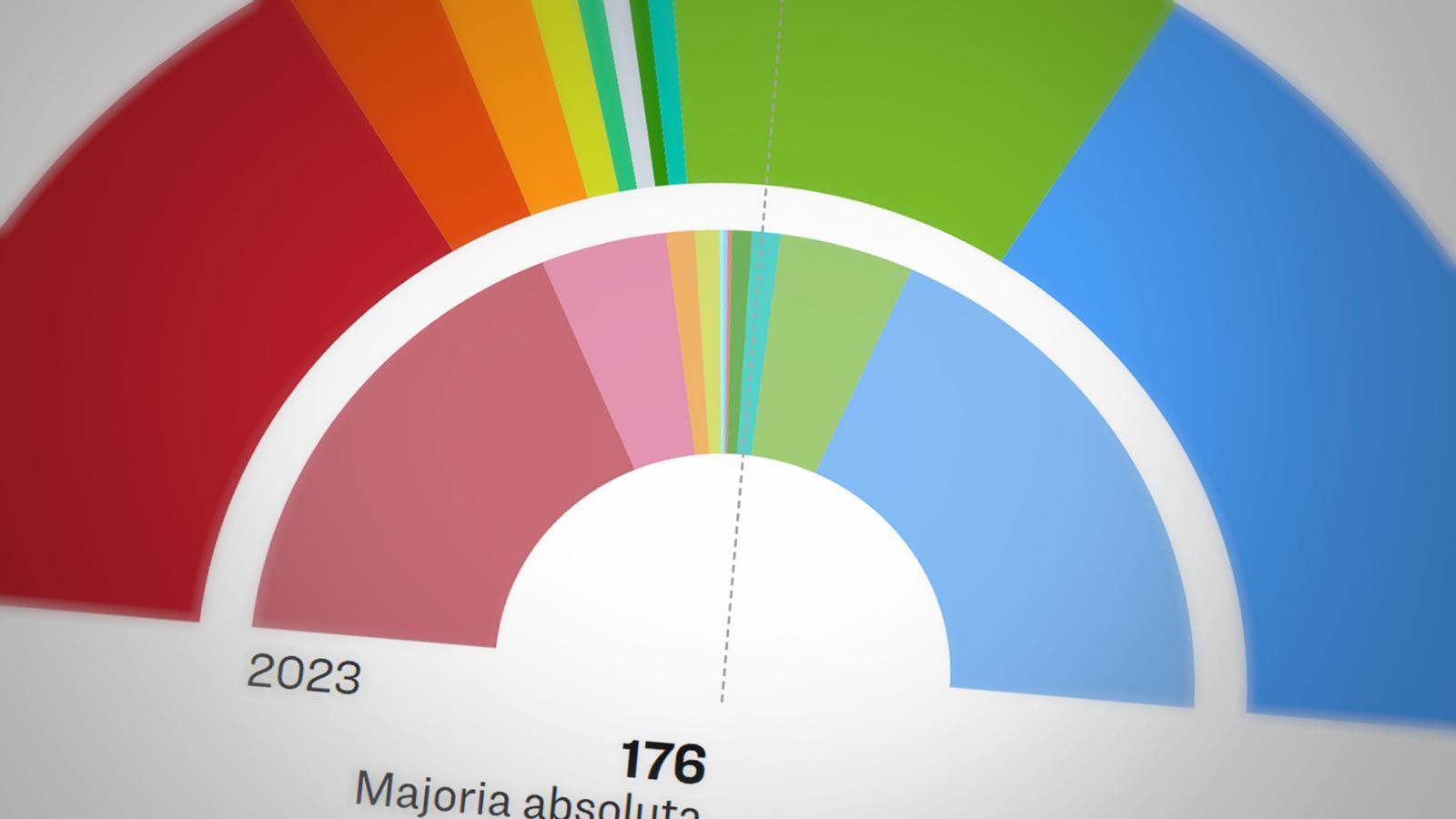
BarcelonaThe magic potion that has kept Pedro Sánchez in La Moncloa for eight years is starting to run out, but the Spanish president still trusts in scraping the last drops remaining in the pot. The electoral campaign for November 29 has begun with all forecasts against the continuity of the government, and not because of the strength of its main rival, the Popular Party. This Sunday, ARA is publishing its poll, conducted by YouGov, which points to a meteoric rise of the far right: Vox would obtain 72 seats (the range varies between 64 and 80), 39 more than it achieved in 2023. Santiago Abascal would be the key for an Alberto Núñez Feijóo on the decline (who would end up with 120 out of the 137 he had, with a range of 112 to 130 deputies) to become president. The consolation for Sánchez is that there are still two weeks left, even though the PSOE is far behind the PP. For now, Sánchez would be left with 104 deputies (96-113), 17 fewer than he had until now. The lead of the Popular leader is nearly four percentage points over his main rival (29.6% of the votes for the PP and 25.9% for the PSOE).
The right-wing majority would rise today to 192 deputies, sixteen above the absolute majority in the Congress of Deputies, with Vox reaching 20% of the votes, a historic result for the extreme right, surpassing the 15% and the 52 seats from November 2019. The transfer of votes between the two parties is evident. Vox would take 16% of those held by the PP, which in absolute numbers could represent more than 1.3 million people, and the Popular Party 12% of the extreme right's (about 360,000). That is to say, the positive balance for Abascal's party would be 1 million votes in this comparative analysis. Furthermore, it is the party with the most loyal vote and probably also the one that has it most mobilized at this moment.
Regarding the formation that represents the minority partner of the state executive, Ada Colau's Broad Front continues to fall, dropping from the 31 Sumar deputies of 2023 to the 19 (12-25) it would obtain now. Podemos aims for a single seat, although statistical models point out that it is most likely to be left without parliamentary representation. In fact, practically 30% of the voters who trusted Sumar three years ago would now switch to the Socialist Party. The assessment that citizens make of the Spanish government is very low (a 3.3 on a scale of 0 to 10), which makes it difficult to think that the strategy of continuing to approve new social decrees until the elections will end up reversing the demoscopy.
Although it is unlikely, depending on the combinations in some provinces, the Broad Front could even fall below ERC, which only runs in Catalonia, and which would recover the strength of four years ago, when it won the general elections in the Principality twice. The republicans would exceed 10 deputies and, in the best of cases, would reach 15, matching the results of November 2019, when they surpassed one million votes. Junts, on the other hand, would continue in a negative dynamic and would drop to 4 deputies (3-6) in an election in which its main rival for the pro-independence right-wing vote, Aliança Catalana, is not running. In an interview with ARA this very Sunday, the candidate for the Junts party, Miriam Nogueras, trusts, however, that the demoscopy will fall short and Junts aspires to be decisive once again in the next Spanish Parliament. The absolute majority of PP-Vox would make it impossible.
As for the rest of the parties, EH Bildu would surpass the PNB in seats (7 to 4) –it already did so three years ago thanks to the one in Navarre– and formations such as Adelante Andalucía (4), the BNG and Coalición Canaria have their presence in the lower house practically guaranteed. Precisely, the growth of left-wing sovereignist formations contrasts with the decline of state formations located to the left of the PSOE.
Without a pactometer
If the trends are confirmed, the night of November 29th will be, for the first time since 2011, without a pactometer. The right and the far-right would add up to a comfortable majority to limit the configuration of the future Spanish government to a negotiation between the PP and Vox. They already have experience in regional and municipal governments. They had it in the previous electoral cycle until Vox engaged in an arm-wrestling match with the Popular Party by leaving all the executives, and they have had it again in the current one, both in Extremadura, and in Aragon, Castilla-La Mancha and, more recently, in Andalusia.
The relationship between the two parties has been improving over time. The truce is strategic. Vox and the PP have a non-aggression pact to avoid having their fratricidal wars force them to put the cava back in the fridge. They are governing together again in the autonomous regions and are preparing to do so at the State level without opposition from their electorate. In fact, the ARA survey shows that PP voters have overcome their reluctance to make agreements with the far right. 82% of conservative voters approve of Vox joining a PP government and only 11% are against it.
“The experience of the first term in the autonomous communities was not good,” Feijóo said this week on El hormiguero. “But in this second one, it is,” he added. In the opinion of the Popular leader – who, according to the survey, is also the public's favorite to become president –, “Vox is complying with its councilors and vice-presidents, budgets are being approved and there is government stability.” Feijóo, who reached the party presidency uncomfortable with the approaches to the far right of some of his barons, has ended up understanding that the only possibility of reaching the Moncloa is to go through an alliance with Vox that puts an end to the Sanchista resistance.
Technical sheet
