A 200-year-old vinegar and a sweet made with chicken: a millenary gastronomic culture
We visit Sile, a fishing enclave near Istanbul, where life goes more slowly and the rich soil gives wonderful fruits and vegetables
-
CAT -
CAST
Sile, TurkeyOn the journey that separates Istanbul's ultramodern airport from Sile, the small coastal town about 70 kilometers from the city, there is a constant gaze that appears everywhere. We find it on flags and banners. It is that of Mustafa Kemal, better known as Atatürk. If the father of all Turks is an ever-present figure, today even more so. It is August 30th and they are celebrating Victory Day. In 1922, the Turks defeated the Greek forces at the Battle of Dumlupinar, a key military milestone for the birth of modern Turkey. But talking about the 20s of the last century is like talking about the day before yesterday, considering the past of the land where we find ourselves. The town of Sile itself, which also gives its name to the district, already existed in 700 BC. Since then, they were already a fishing village facing the Black Sea. With a lighthouse that has guided sailors since the Ottoman period. This region, now turned into a summer retreat for people from the great metropolis, preserves many things intact: its forests, the quality of the products offered thanks to the rich soil, and the weight of craftsmanship. Here, a historical event that happened more than a hundred years ago is younger than the yeast with which Mrs. Fatma makes her vinegar, which is 200 years old.
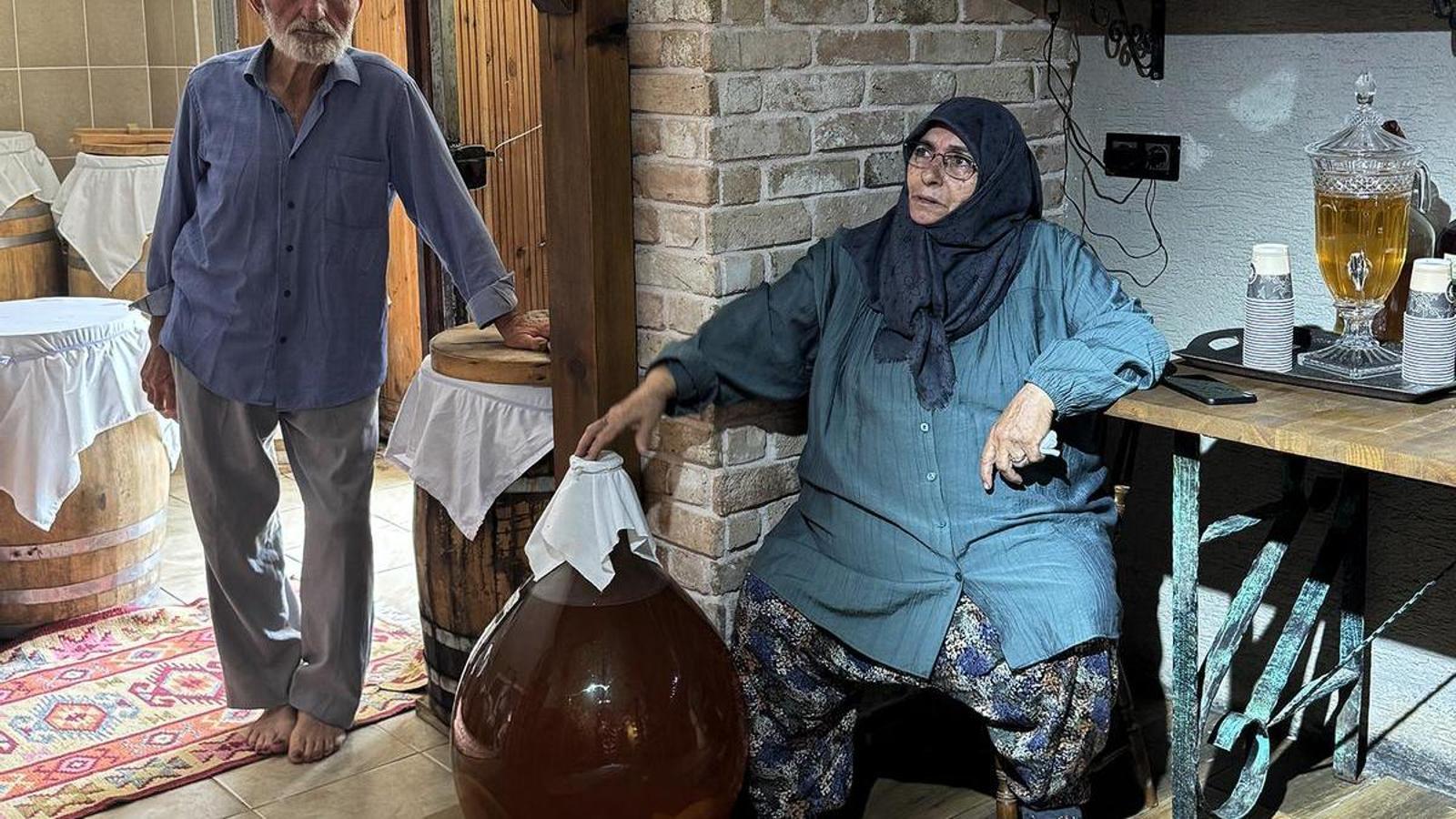
The sign says “Fatma Hanim Sirkeleri”, which means “Mrs. Fatma’s Vinegar”. She is Fatma Çetin, she is 70 years old and has been making vinegar for 52 years. When she got married, she learned from her husband's grandfather, who was 100 years old, and from her in-laws, who also made it. Since then, it has been her trade, which she has practiced diligently and in an artisanal way. Fatma wears a headscarf tied under her chin and is no more than a meter and a half tall. She introduces her husband and children, who will one day continue the business. She makes an extraordinary product. She has more than 60 varieties. With fruits, with plants, and with honey. All around her, wooden barrels full of vinegar with sloes, red basil, or turmeric are going through their process. Fatma opens one, pushes aside a dense layer of scoby (the colony of bacteria and yeast that does the work), and shows the fruit that is infusing. There are also demijohns with apple cider vinegar and honey. The apple cider vinegar has been aged for two years before being mixed with the honey. And at the same time, the liquid in this demijohn, which she tips to let us taste the vinegar, is 11 years old. This particular vinegar earned her an award from Slow Food. A distinction that hangs on the wall. She also has a photograph from this year with the country’s president, Recep Tayyip Erdogan, presenting her with an award. Mrs. Fatma, with her small stature but vast knowledge, produces 12 tons of vinegar a year.
During the visit to Mrs. Fatma, there is Álvaro Clavijo, chef of the famous restaurant El Chato in Bogotá, which has been considered the best in Latin America by The50Best list and has been invited to cook these days at the restaurant Casa Lavanda, a benchmark in the region that we will also visit. He asks her if he could have a bit of her yeast. And she, generously, gives him some in a bag. While it is true that if the yeast has reached 200 years, it is because someone else shared it before. Perhaps one day archaeologists will investigate how a Turkish yeast ended up in Colombia.
The warmth and the earth
We go down to the port of Sile. There is all kinds of fresh produce, such as figs, but mainly there is the catch of the day. In front of the fish stalls, shiny and well-presented, the buyers wait. It is bonito season. They have it in large quantities. Clavijo and the Turkish chef Emre Sen cannot help but buy one and make sashimi right there at the stall, under the attentive and curious gaze of the fishermen untangling the nets on the boat, and that of the sellers at the fish stall who watch with curiosity the enthusiasm of the two chefs cutting the fish. Emre Sen is proud of the product they have in the region, he knows that the quality of the ingredients found here is one of the reasons why, millennia later, they are still here.

Emre Sen runs the kitchen at Casa Lavanda, a boutique hotel that is a kind of paradise. His cuisine has well earned a Green Star and a Michelin Star. It is not near the sea; rather, it is in an inland wooded area, flanked by chestnut trees, oaks, and slate constructions. This enclave is an island of peace where the inhabitants of Istanbul propose marriage – there is a bench in front of a reservoir where, if you wait with the patience of an ornithologist, you might see a marriage proposal – they also get married there and spend the weekend. The name Casa Lavanda is given by the lavender that surrounds the property, which has a good swarm of insects buzzing around. This hotel was – and is – his parents' home. Ahmed and Feryal Sen ended up here in 1991, fleeing from the intensity of the city. Here you can see one of the contrasts of Turkey. In a conservative area, a free space makes its way where they have a good wine list, led by the exceptional sommelier Alp Açık, who unveils an as interesting as it is unknown range of high-quality Turkish wines. Open-minded people come here and they organize international events, such as the four-hands meal with Álvaro Clavijo, which will bring people from the capital to enjoy a unique night. Now and here, nothing suggests that a good part of his compatriots do not drink a single drop of alcohol. Not even rakı, the national liquor of Turkey. They offer it to you as a sign of hospitality and it is difficult to refuse. The dialectical battle over whether it should be diluted with water or if ice should be added can last all night. This aniseed drink is similar to the Greek ouzo.
While we share the rakı with the Sens, they explain that they planted the trees themselves, and that they have grown at the same time as their children. Feryal Sen's personality can be seen everywhere. She is an artist, and her paintings are all over the property. Her good taste also appears with the piles of pumpkins everywhere, or with the details when setting the table. Any notion of hospitality that we may have had until now will fall short once you have tasted Turkish hospitality. The Sens have made this place their home, and they share it with the guests, who feel wrapped in this warmth. A fire that is kept burning by the chef Emre Sen from the stove, and his brother Ekim Sen from the engine room of the business.
The most luxurious area of the hotel is the vegetable garden. About 2,000 square meters of biodynamic agriculture that supplies the hotel's restaurant. Emre Sen shows it off with a gleam in his eyes. The various types of tomatoes, aromatic plants, edible flowers, or the last strawberries. Also a cherry liqueur that is fermenting. All of this makes the meals tasty and light, starting with breakfast, which here is also a matter of state. It begins with tea, served in tulip-shaped glasses, and ends with Turkish coffee. This coffee, with the grounds included, allows them, if you find someone who knows how, to predict the future once you have finished it. It must be left to cool, and then turned over. If you dare, of course. The drinks are accompanied by homemade jams, honey, olives, cheeses, simit (a ring-shaped bread coated with sesame seeds), börek (a type of stuffed pastry), tomato and cucumber salad, menemen, scrambled eggs with tomato, red pepper, and spices.
By the roadside
Very close to Casa Lavanda we find a simple roadside place famous in Sile for its traditional breakfasts. It is called Gonca Abla'nın Gözleme Evi. There you will see diligently how its workers make the teapot steam, strategically placed over the wood-burning oven. And how with their skillful hands they prepare the gözleme, the Turkish crepes, filled with cheeses, potatoes, spinach or meat. They stir the thin dough and shape it into a square that they will place on the griddle. In a moment they will be ready. There is also a sign where they proudly explain that they have one of the national desserts, a version of our rice pudding in which instead of rice there is chicken breast. It is called tavuk göğsü and before anyone can judge it, it was introduced to the Anatolia region by the Romans and was a food worthy of sultans. It is a surprising sweet and very rooted in Turkish culture.
Another place to stop is at Tadım Gözleme Evi, a kind of cozy cabin that houses a family restaurant specializing in Bosnian recipes. They make mantis and Bosnian börek, in both cases it consists of a crispy pastry baked in the oven and stuffed. It is served with a sauce and spices to the consumer's taste. Bosnians are a very large community in the country due to major migratory movements following the fall of the Ottoman Empire.

But beyond the cuisine, we cannot leave Sile without talking about its cotton. These are garments known for being cool and very durable. Of great quality. It is hard to walk around here and not end up buying a piece. The cotton is woven here, with looms that were brought from the United Kingdom in the 70s. From there, they begin an artisanal process: they work the fabric and take it to the sea, where they submerge it and subsequently leave it to dry on the beach. This, they say, is the secret to the quality of this cotton. On the garments, once made, there are women who add embroidery or braid fringes. We leave a shop selling this wonderful clothing, after visiting the workshop. And once again, eyes watch us from the shop window opposite. It is Atatürk again. And looking closely, the local craftsmanship and its centuries-old customs make one think that the Sile that lived with him must not be so different from the current one.
