The buried truth of Fígols: new testimonies dismantle the official version of the mining tragedy
A former executive denies that a cigarette caused the explosion and the company's lawyer admits that today "he would have lost the trial"
-
CAT -
CAST
BergaJosep Vilalta was taking off his sweater when he felt a strong gust of air coming from inside the gallery. He had arrived at the workplace only a few minutes earlier. The guard had just warned one of the mechanics not to delay: a broken pillar could cause the ceiling to collapse at any moment. It was hot. Everything seemed normal. Suddenly, however, a second gust accompanied by a large fireball scorched everything it found in the gallery. "I was left like a rubber doll," recalls, even today, the miner from La Pobla de Lillet.

Vilalta had just been struck by the blast wave of a firedamp explosion. An explosion that should not have happened. Instead of acknowledging the failure, the company constructed a narrative to protect itself. An official version that, fifty-one years later, is beginning to crack.
“Everyone here is dead”
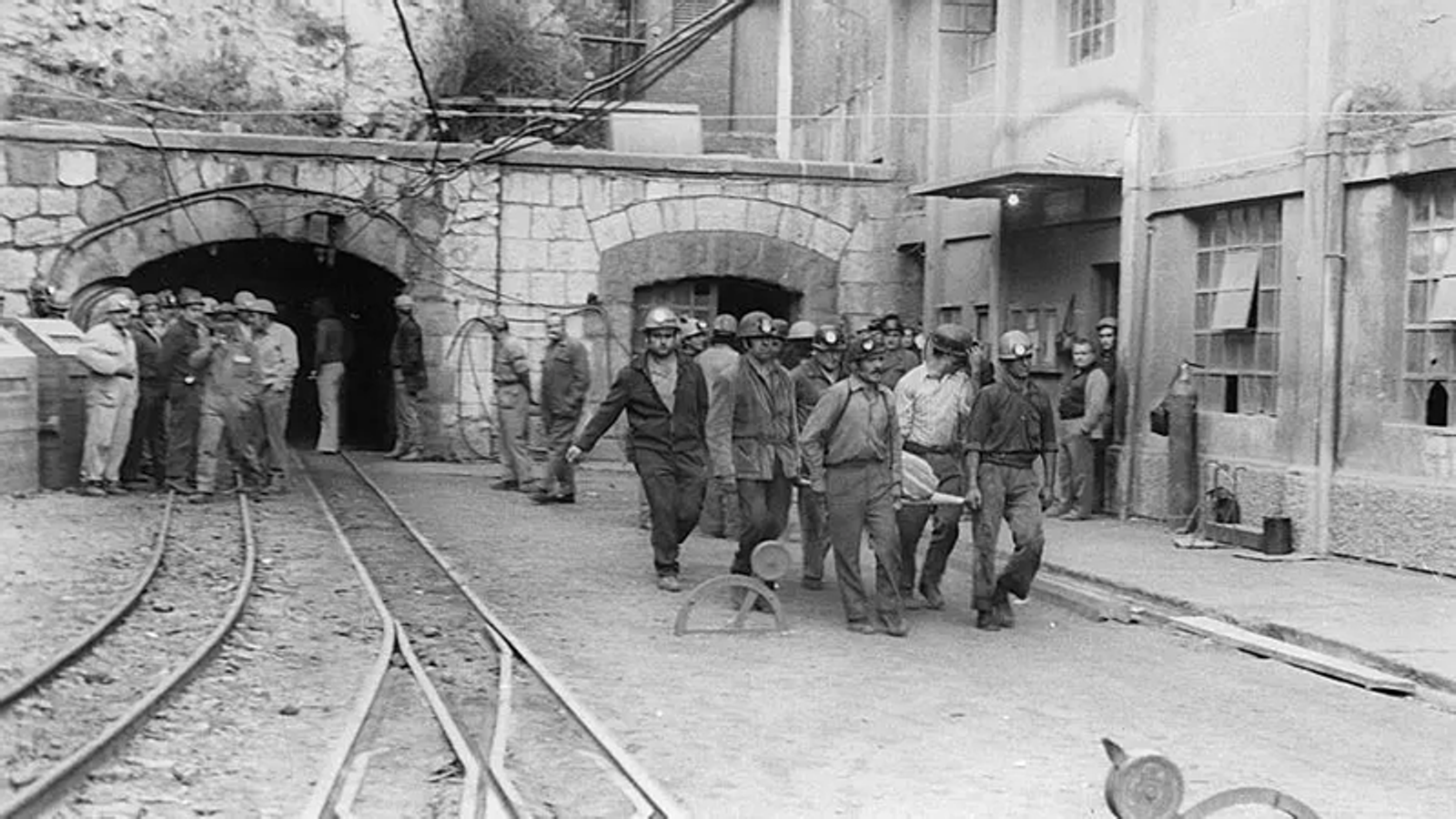
It was Monday, November 3, 1975. It was a few minutes before nine in the morning. Under the mountain of Fígols, in Berguedà, the workers were resuming their routine after two days off for All Saints' Day. When they started up the machinery, however, the tragedy was unleashed: a spark caused a pocket of firedamp to explode. Invisible, odorless, and lighter than air, this flammable gas had become a deadly trap.
Inside there was no light and the air was unbreathable. Vilalta was on the ground. “The first thing I thought was that everyone there was dead, and me too.” Despite the burns, he moved forward, feeling the walls until he found the coal conveyor belt. It was still moving. He began to shout and some companions went to look for him. “I am 70 years old and I still remember the smell of burnt skin”, explains Pere Andrés, who was 19 when he was notified to participate in the rescue.
The toll was devastating: 28 workers died instantly and two more, days later, as a result of their burns. Only four survived. The explosion thus became the third most serious accident in the history of Spanish mining and the second with the highest number of casualties in Catalonia. The first was also caused by a firedamp explosion in the Berguedà region: in 1944, at the Clara mine in l'Espà, where 34 people died.
The tragedy shook a region that lived off coal and had Carbons de Berga, owned by Fecsa since 1967, as its main company. It was modernizing the operation to increase production. Level 09, which had been in operation for 23 days, was equipped with self-advancing extraction systems and was classified as a first-category operation. Therefore, officially, it was not prone to firedamp. However, on November 3rd, thirty miners died due to an explosion of this gas.
“We didn't know there was firedamp”
“A regrettable misfortune.” That is how Manuel Portis, director of the company since 1972, described the accident. Carbons de Berga attributed the explosion to an inexplicable event: it had occurred in a non-gassy mine. A classification that allowed the tragedy to be presented as unpredictable and to rule out negligence. “We had never detected firedamp, nor did we think it could exist,” declared the CEO, Joan Hernández Arbós.
More than half a century later, a prominent engineer and former general manager of the company, who prefers to remain anonymous, continues to defend this narrative. Although the presence of the gas is indisputable, he denies that its existence was known: “We did not know there was firedamp.” But underground, the reality was different. “In 1953, the mine was classified as non-gassy. Since then, it has not undergone any review. For 22 years, this classification was maintained when the entire basin is gassy. They knew that,” summarizes Txema Gómez, son of a victim. Vilalta agrees: “Did we all know and they didn’t?”

Admitting that there was firedamp in a first-class mine would have forced them to invest more in safety and downgrade its category. For that reason, not only did they not acknowledge its presence, but they also did not accept that Ángel Monferrer, in charge of checking for the existence of gases at the operation, had not entered the gallery on the morning of the accident.
“With the place ventilated, there is no such thing as an explosion”
The miners knew that firedamp could appear, but as long as the air was circulating, they did not perceive it as a threat. If the gas had accumulated, something had failed before the explosion. And this is where its origin lies. "With the place ventilated, there is no explosion worth mentioning," states Agustí Quesada. Although he had only been working at the Fígols mining complex for four months, he remembers that the lack of ventilation was common. "It was essential," insists Andrés.
Carbons de Berga claimed that the fans had been working. Contradictory. With good air circulation, the gas does not accumulate. But the same manager who had not entered to inspect the galleries claimed that the auxiliary fan in the disaster area was working. And Manuel Portis, who spent the day in the office, denied that the ventilation had stopped. However, Joan Segado ensures that he found them stopped when he went down to rescue his colleagues.
Josep Maria Antràs, the lawyer who defended the company, receives us at his office. He does not deny the presence of firedamp and considers it "logical" that "if there were no people for two days, the fans would not be running." Vilalta is categorical: "With the fans running all night, the firedamp would not have been there." And, like him, Cristina Villalonga: "You can have whatever systems you want, but if you disconnect them, what good are they?". She was almost five years old when she lost her father.
“On the 3rd, there was no smoking in the mine”
Two months later, a report by Carbons de Berga suggested that the explosion could have been caused by a cigarette. In September 1976, the Technical Qualification Commission of Mines also supported this hypothesis. Segado considers it surreal: “They couldn't find a pack of cigarettes and a box of matches there. Everything was burnt.” And he adds: “They found matches there, but we used gasoline lighters.”
Thus, the responsibility was shifted onto the miners. “The blame lies with those who died. They couldn't do anything anymore,” laments Josefa Fernández, widow and mother of Cristina Villalonga. The version preserved the image of a modern mine and exonerated the company from guilt. “It tried by all means to pass the blame onto the workers,” admits Antràs.

Five decades later, the explanation encounters a contradiction. The former executive avoids commenting on the accumulation of firedamp and the causes that provoked it. But regarding the cigarette, he is conclusive: “On the 3rd, there was no smoking in the mine. I can attest to that.”
“A David versus Goliath struggle”
A week after the accident, the judge opened proceedings against four managers of Carbons de Berga for the death of thirty workers. The management faced possible criminal liability, but the Fecsa subsidiary had resources and influence: “Fecsa was Fecsa. It is as if you were fighting Endesa now,” asserts Andrés.
To avoid conviction, the company offered 1,300,000 pesetas per widow in exchange for dropping the charges and renouncing any legal action. In September 1976, the agreement was signed. Since then, in the region they would be known as the golden widows. Fernández still remembers it: “We were treated very poorly, both the living and the dead.” For his daughter, it was “a fight of David against Goliath”.

The criminal proceedings were closed and the case was archived following the application of the general pardon of November 1975 to the defendants. In 1978, seventeen widows maintained the claim through labor channels, but in January 1981, the ruling once again favored Carbons de Berga. Antràs acknowledges the company's advantage: “It was a time when there were regulations that favored my defense. There was a blatant scheme that favored companies”.
“These things happen”
Fifty-one years later, the arguments of Carbons de Berga have cracked: the mine was not so safe; the state of the operation had not been checked before the shift entered, and a former executive refutes the cigarette hypothesis. However, when asked if the accident was foreseeable, he responds with a blunt “these things happen”. But things happen for a reason. A firedamp explosion requires a prior accumulation of gas. What had failed? It is here that the piece that Carbons de Berga never wanted to place in its narrative is still missing: the stopping of the fans.
Thirty miners died in a workplace accident and the company did not answer for the decisions made. Antràs acknowledges it now, from a distance: “Now I would have lost the trial with complete certainty.” The fact is that the case was not decided only inside the mine, but also in a judicial and political context favorable to large companies. And it is here that Fígols ceases to be just a story from 1975.
The tragedy of Fígols forces us to look at what happens when one party imposes its version and the other tries to understand the facts. The families have been asking for a long time for the truth to be known. “This accident has been closed as operation 09”, summarizes Villalonga. But what he is demanding is not to reopen the case. It is something simpler: “We already know that the mine is dangerous and that there can be accidents. But what happened is negligence. And if you screw up, at least accept it”.