Claudio Hoyos: “When the war between Ukraine and Russia began, I found myself with insults and they asked me to change the name of El Filete Ruso”
Restorer

-
CAT -
CAST
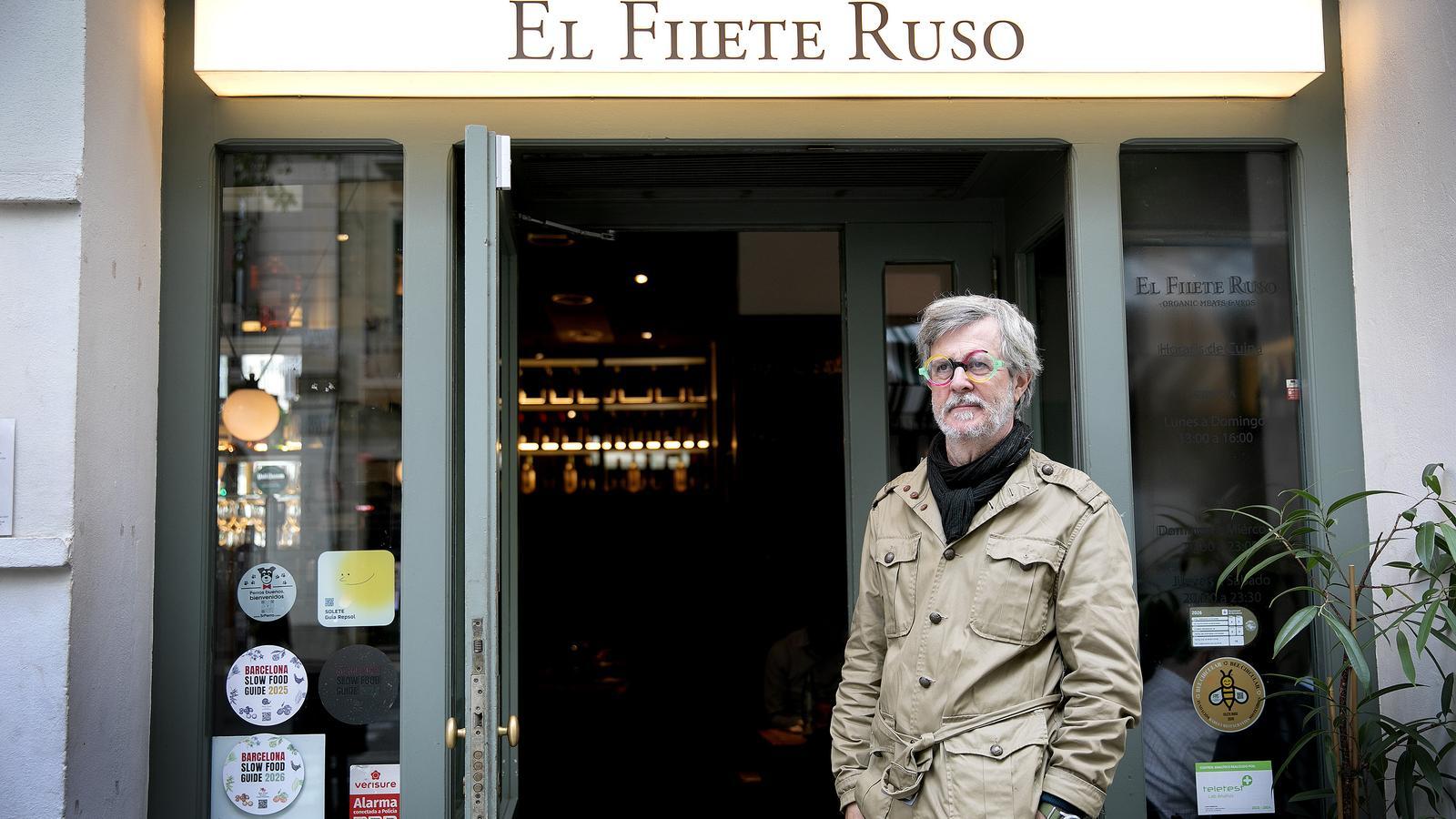
BarcelonaI interview restaurateur Claudio Hoyos (Barcelona, 1968) at his restaurant, El Filete Ruso (c. Enric Granados, 95), one midday when all the tables are full, including those on the terrace. We review his career as a restaurateur, which began at La Burg, which was considered a pioneer in quality burgers. Then came El Filete Ruso and, later, El Mercader de l’Eixample, which has not been his for a few months now. He is now focused only on El Filete Ruso, which also has food trucks with which he goes to a large part of the festivals that are held in Barcelona.

Has the Filete Ruso always been linked to the principles of slow food?
— Yes. I started with the chef Enric Millà, and we opted from the beginning for organic, locally sourced products. I have the Slow Food Barcelona certificate, which I renew every year. I think we were among the first to make organic and locally sourced meat burgers and steak tartares. We opened El Filete Ruso in 2010, with meat dishes especially, but now we have many seasonal vegetable and fish dishes. Now, that it is autumn, mushroom ones. Look, from the blackboard I have already erased the fig salad, because they are already finished. I buy all the vegetables from the Parc Agrari del Prat: from Viladecans, Sant Boi, from the company Soulblim.
If I ask you about the bread and the cheese, you will tell me whose they are.
— I will tell you that the bread is from the La Fabrique bakery, in Poblenou, which is the only one that is 100% organic. The cheeses, from Pinullet, in the Gràcia neighborhood, which is an urban cheese shop. And I'll mention the eggs, which are organic, from Calaf. I can tell you everything and show you the delivery notes.
El Mercader de l’Eixample was another restaurant you had, on Mercader passage, in a very beautiful building.
— I couldn't handle everything, and I must say that the staff, the taxes, everything is complicated. The catering for El Filete Ruso involves a lot of work. We also have a restaurant inside Fira de Barcelona, which is called Fileteando. And I am on my own, I mean that I am not a big company, nor a fund or anything. I am a shopkeeper, and as a shopkeeper I have to be on the front line.
Do you think there is a wave of restaurant closures in Barcelona?
— Yes, and more will close. There are too many restaurants in Barcelona.
Explain yourself.
— When I opened on Enric Granados in 2010, I estimate there were about forty restaurants. Now, in 2026, there are twice as many.
That is why there is the Enric Granados neighborhood association.
— We are forced to close an hour earlier than they close in other places. We have to close at 11 pm on weekdays, and at twelve on the weekend. The Guild has won an appeal against this provision, but it will be long.
We were talking about the number of restaurants in Enric Granados. Near El Filete there are some meat-based ones, like yours.
I have a more open menu since we opened. We have traditional dishes. Many vegetable dishes. I have brought many dishes from El Mercader's menu, such as the Barcelona cannelloni, grilled squid, fricandó with fairy ring mushrooms... So I have a mix of traditional Catalan cuisine dishes, plus the usual ones from El Filete Ruso, where we have always worked with the best meats from Catalonia, always organic. I buy them directly, and after so many years of dealing with them, we know each other well.
El Filete Ruso has shown that you can eat top-quality food there at a price that does not exceed standards. How have you achieved that?
— For ethical reasons, because I like offering quality at a good price, because I offer what I would like to eat myself in a restaurant. El Filete Ruso is a restaurant that was born with hamburgers andtartare steaks, and now I have added many more. I have not wanted to raise prices. Ah! I have added pork llibrets to the menu, which are a classic of Catalan cuisine, with organic Catalan shepherd's cheese and organic ham. It is a 100% Catalan dish. As are also the chicken croquettes from the La Torre d’Erbull supplier, which we make ourselves at the restaurant. We have been making them ourselves for seventeen years.
I will ask you what I was telling you before in another way. What profit margin do you have with the restaurant?
— I surely have less margin than if I worked with other foods, but I want to demonstrate that it can be done, that one can work with local and organic producers and have a restaurant that works.
What type of client do you have?
— Very local, tourist and especially, expats, the expatriates. The latter are new; ten years ago there were none. Since I consider myself a shopkeeper, I stand at the door of the restaurant, and when I see them stop to read the menu I have at the door, I start talking to them. I have traveled all over the world, I manage with languages and I explain the dishes they can eat.
A few years ago, the UN released a report recommending a reduction in meat consumption. Did you notice anything at the restaurant as a consequence of what it said?
— No, it is also true that we have many other options: not just meat. And people who want meat know that they will find very good quality. The UN report recommended eating less of it, and for it to be good, which is what we prepare. At El Filete you can eat a meat dish with a roasted vegetable escalivada from the Parc Agrari, with a pumpkin salad, and all together is what is recommended: good meat, combined with vegetables.
I am asking you for the name of the restaurant.
— It is breaded meat. Before, it was a preparation of minced meat with parsley, all breaded and fried, which was very well known; older people used to tell me they knew what it was. It was the burger of the past, so to speak. Apparently, during the dictatorship, it was called filete nacional, because the Francoists did not want to pronounce the word Russian. When the war between Ukraine and Russia began, I faced insults; they asked me to change the name. They asked me if I was Russian. They would call us on the phone, and one day one of the cooks, who is from Cameroon, answered the phone, and they started saying things to him. To him, who is from Cameroon!
Did you consider changing it?
— No, I added a subtitle to it, but mainly thinking about the people who thought we only served meat there.
Why do you think hamburgers are so popular?
— Because we eat them with bread, and it is substantial, it nourishes. When I decided to enter music festivals, I thought that the people, who are stuck there listening to music, needed to eat well. I looked at what was being sold, and I saw that no one had the meat that I offer. It is of quality, it gives energy, and it can be eaten easily with your hands. What we have done is demonstrate that it is not junk food.
One question I have left to ask you: if you run out of meat, salad, or vegetables that you had during a service, what do you do until the new orders arrive?
— We take breaks in the kitchen. We explain to the customers that these dishes are not available. We don't go out to buy food until we receive the ones we use ourselves. Also, don't think that at El Filete Ruso we serve three thousand meals. During the week, at noon, we must serve about ten hamburgers, at €18.50. At a fair, when we go to the fairs, then the figure fluctuates between one hundred and fifty and eight hundred a day. On a weekend, at El Filete Ruso, about sixty or seventy. We have many other dishes besides meat. On the other hand, at the fair there is only the meat.
To finish, Claudio, what do you have left to do?
— I am fifty-eight years old; I have a few years left until I retire, but it is true that I do not have as much energy as when I started. I do not have family, I do not have children, so when I retire, I do not know what will happen to the restaurant.
