When science opens letters closed centuries ago
Chemistry, physics and artificial intelligence allow discovering texts that seemed lost forever

-
CAT -
CAST
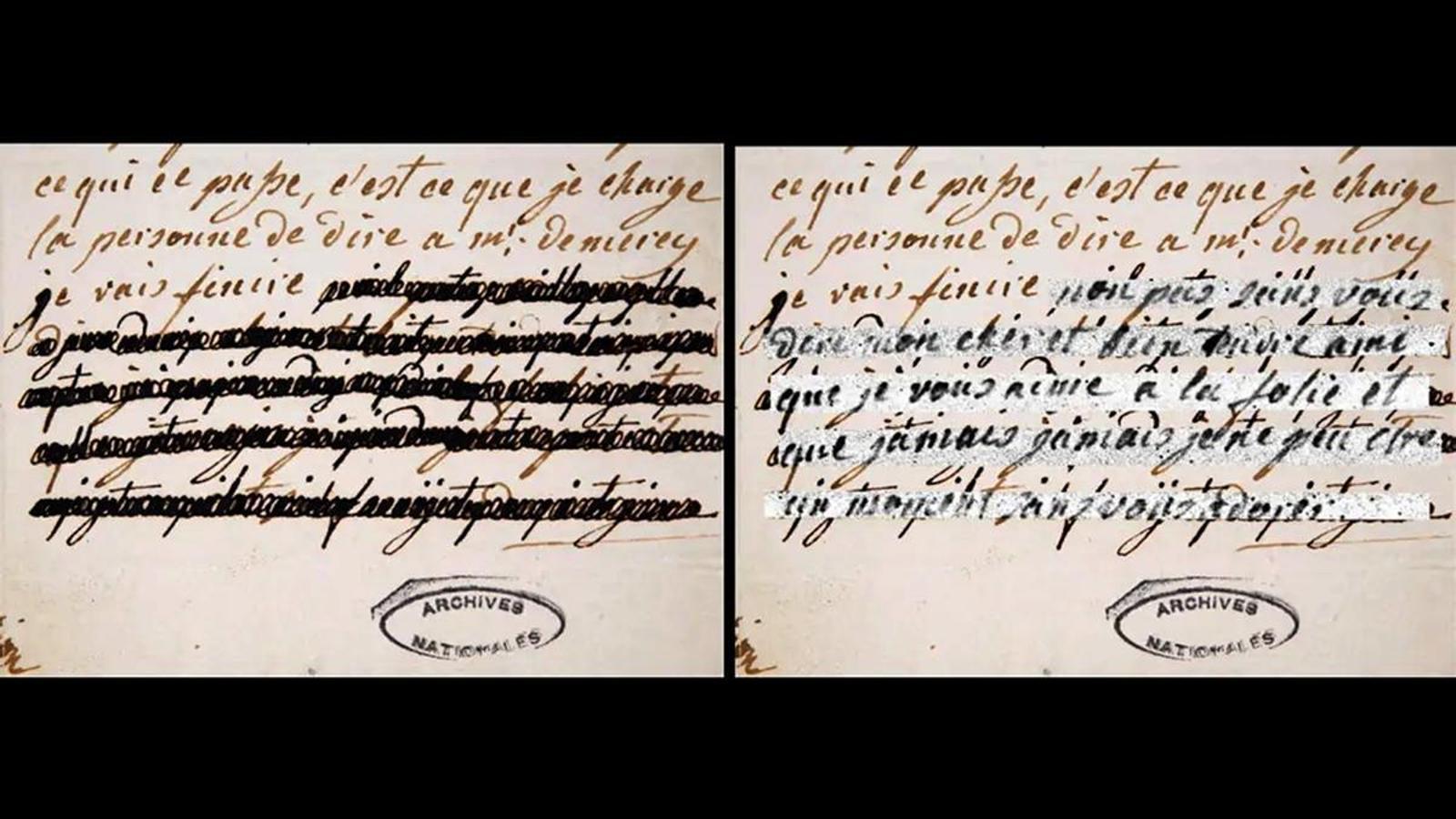
Who crossed out and why some passages of the letters that Queen Marie Antoinette sent to her favorite, Count Axel von Fersen? And what did these paragraphs say? While she was imprisoned at the Tuileries, the wife of Louis XVI wrote, between June 1791 and August 1792, nearly 50 letters to the Swede Von Fersen, a military man and ambassador, who a year earlier had helped organize the frustrated flight to Varennes of the members of the royal family.The French National Archives, owners of the letters, tried for years to figure out what those parts hidden under black ink said. They even resorted to police forensic units. But it was all in vain until they requested the services of Anne Michelin, a chemist at the Centre for Research and Conservation in Paris. In October 2021, she and her team published the results in the journal Science Advances.The hidden paragraphs seem to support the theory that Von Fersen, in addition to being Marie Antoinette's favorite, was her lover. This is implied by fragments such as “not without you”, “you, whom I love and will continue to love”, “you make my heart happy” or “tender friend”, with adverbs such as “madly”, which denote romantic passion. It is not surprising, then, that someone wanted to prevent these paragraphs from being read. It was believed to have been a relative of the queen, but Michelin's team also found the answer: it had been Axel von Fersen himself.

How were they able to discriminate between the scribbles made by the censor and the words underneath? And how did they know who had done it? Physical and chemical analyses are the key. The most widely used inks since the Middle Ages are the so-called iron-gall inks. They were obtained from oak galls, which are protuberances produced by parasites that attack the trees. They also contain gallic acid, which gives rise to salts of various metals. Different inks have different compositions or different proportions, and each metal, such as iron, copper, or zinc, has a characteristic footprint. Therefore, if to the naked eye we only see dense scribbles, with analysis methods the layers can be separated. The authors used X-ray fluorescence-based spectroscopy, in which X-rays are directed at a sample. This causes emissions characteristic of each chemical element. In this way, it was possible to discern the strokes that had been written by Marie Antoinette and the scribbles that someone had made over them, because the composition of the inks was different.There was a second question left to answer: who was the censor? This seemed much more difficult, but it turns out that Count Von Fersen made copies of the letters he sent to his probable lover. And the ink of these copies and that of the scribbles is identical and different from the one used by Marie Antoinette. Thus, it was the count who wanted to hide the most compromising paragraphs of his correspondence. For two centuries he succeeded, but finally, chemical analysis shed light on the entire text.Reading certified letters without opening them
When a text appears almost erased, when it seems that the content of a document has been lost forever, it is likely that traces have remained that will allow discovering what it said. It is only necessary to find the non-invasive technique that helps to draw the profile of the chemical residues to know what it said –in fact, it still says–. And this has been done with documents from very diverse eras, not only on paper or with metallic inks.This has been done with clay tablets with cuneiform texts and, furthermore, protected. The Sumerians introduced a system of confidentiality and security with sealed envelopes that protected the tablets. This certified the validity of the document as long as the seal remained intact. The envelope only contained a brief summary of the subject it dealt with.We said envelopes, but at that time paper was not known, so this wrapping was made of the same material as the tablets: clay. How to read clay tablets through a clay protection? One of the tools can be a scanner that penetrates it, but they usually weigh several tons. A team of researchers from the University of Hamburg and the synchrotron of the same city came up with the idea of trying to build a smaller and transportable machine. And thus arose the ENCI (Extracting Non-destructively Cuneiform Inscriptions) tomograph. Tomography allows obtaining very thin slices of the human body or of whatever object it may be. In May they described in Heritage Sciencehow they applied it to tablets preserved at the Louvre Museum and the Museum of Anatolian Civilizations in Ankara, Turkey. This has eliminated the frustration of Assyriologists, who had thousands of letters in front of them that they could not read because they were protected with such secure envelopes.The rolled and burned papyri of Herculaneum
In 1752, a library was discovered containing more than 1,800 papyri that had been buried in Herculaneum during the eruption of Vesuvius in the year 79. They were rolled up, but also crushed and deformed by the weight of the collapsed buildings and the lava, and carbonized by the fires. Their lamentable state did not prevent experts from attempting to unroll some of the documents, with more good will than success, which caused even further deterioration.In this case, identification is difficult, because at that time a black carbon ink was used, obtained from burnt elements, such as animal bones. This made it impossible to distinguish between the ink produced by carbonization and the carbonization caused by the eruption itself and the fires.In 2023, Brent Seales, from the University of Kentucky, created the Vesuvian Challenge, which offered nearly two million dollars in prizes to whoever contributed to reading the Herculaneum papyri in a non-destructive way. In three frantic years, breakthroughs have been made thanks to X-ray tomography and machine learning.What has been done is a virtual unfolding: a synchrotron source, with a definition of 2.4 micrometers –millionths of a meter– has allowed the acquisition of trillions and trillions of data. Studying the folded papyri has been like putting a contortionist through a scanner, obtaining images of their body in very thin slices and interpreting the lesions and the place where they are found.In the case of papyri, how can the numerous images be differentiated? This is where artificial intelligence, and specifically machine learning, comes in. Several researchers trained these systems to distinguish within the internal structure of the scroll what corresponded to the fibers of the support and what to the texts. And among the latter, to separate them by documents and layers.
