Visit to the North-Catalan maritime laboratory where underwater photography was invented
The Biodiversarium, in Banyuls, is the museum of the Oceanological Observatory, created in 1882 and which hosts stays of more than 600 university students each year
-
CAT -
CAST
Banyuls (Roussillon)Just past the border between the Costa Brava and the Vermilion Coast begins the most protected stretch of sea on the Roussillon coastline. It is a zone where navigation is prohibited and even an exclusion area where divers are not accepted. It is part of the Gulf of Lion Natural Marine Park, between Cerbère and Leucate, which covers more than 4,000 km2 of French coastline. It is the area with the coldest water in the entire Mediterranean.
After the cape and the beach of Perafita, at Cape Rederís, there is a zone totally off-limits to boat traffic, fishing, shellfish harvesting, and scuba diving. This area gives life, four kilometers further up, to the Oceanological Observatory of Banyuls, historically known as the Arago Laboratory. Founded in 1882 by Henri de Lacaze-Duthiers, a zoologist from Paris specialized in the study of corals from the Balearic Islands, it is still today one of the major French research centers on life in the Mediterranean.
Every year it hosts stays for more than 600 university students, the majority from the Sorbonne in Paris. For this reason, a decade ago a large hostel with a restaurant was inaugurated to house them, as well as an aquarium that serves as a museum and exhibition of the constant work being done in the laboratories. It is the Biodiversarium, a space, in the words of its curator, Pascal Romans, that aims to be "more than an aquarium: a scientific mediation tool to connect the general public and schoolchildren with research work".
Whoever has already been to Oniria, in Canet-en-Roussillon, might think that the one in Banyuls is a small version of the journey from the Canigó to the tropical jungles proposed by this new-generation aquarium, which has also just opened an immersive part. But the Biodiversarium is designed above all to disseminate scientific work, always from a very interactive perspective and above all to understand what is changing within our sea. "Science must be shared. It must not remain locked in laboratories," says Romans.

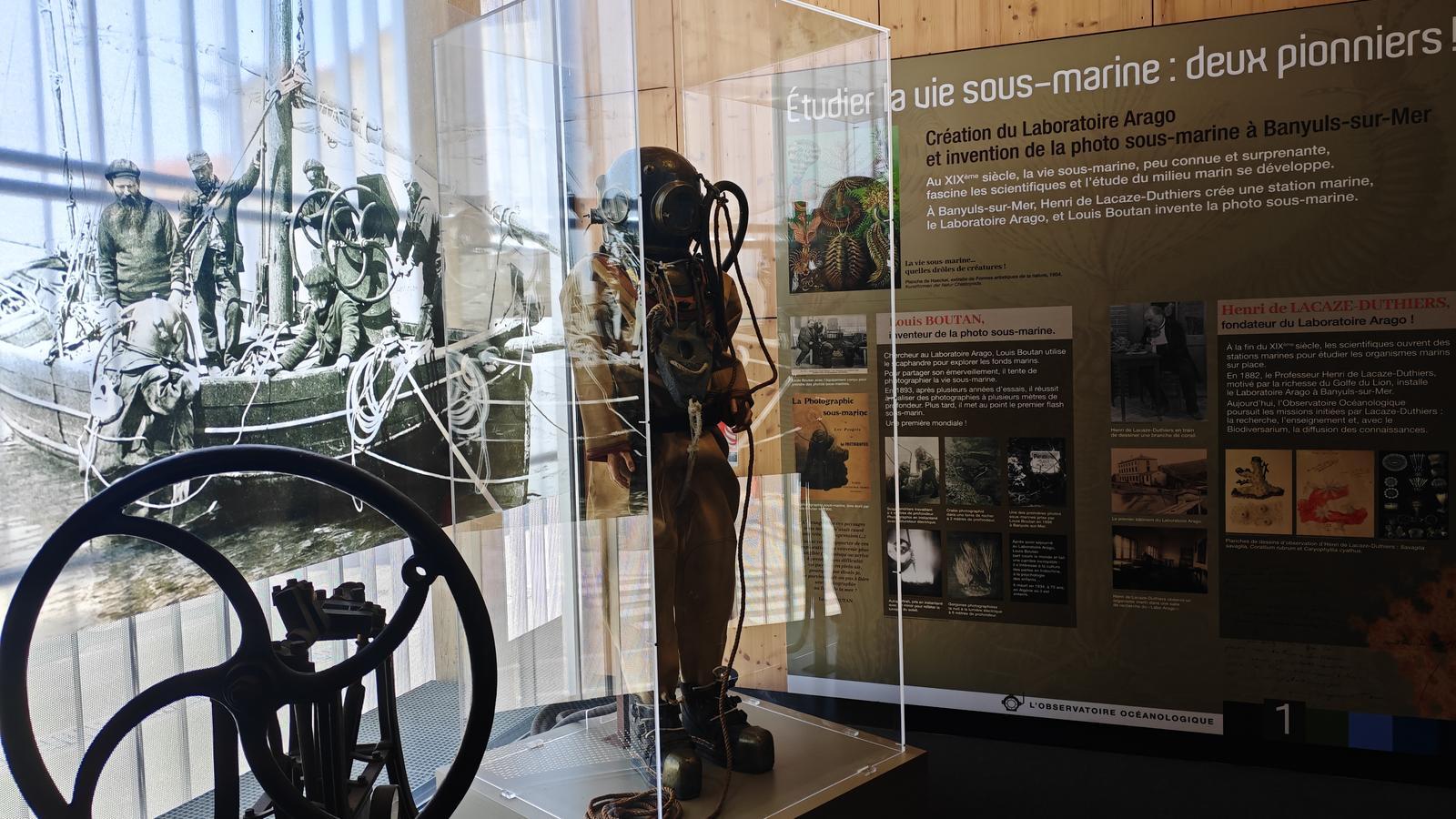
It is surely what best explains why it was in Banyuls where underwater photography was invented in the 19th century. The reason the laboratory was set up in one of the last villages on the French coast was because it was the area closest to the Balearic Islands, from where Lacaze-Duthiers had corals brought to study them in detail. In Paris they arrived in poor condition and he wanted a base as close as possible to the Mediterranean islands. But this breeding ground for researchers meant that just eleven years after the center's inauguration, Louis Boutan invented the first device that allowed for underwater photos and took the first selfie on the seabed.
With the Catalan llaguts that are still repaired and preserved today in the bay of Paulilles, they used to anchor and go down to great depths. It is one of the particularities of the area, with a great drop-off that reaches up to 2,000 m in depth and a mountain range, like that of the Albera, just 30 km away. Corals, such as red coral, continue to be researched, but now there are new areas of study, such as the effect of climate change, the toxicity of sunscreens in the sea, or the use of marine lichens for cancer treatments.
Return to the wild
The peculiarity of the aquariums is that the animals do not live there forever, but between three months and a year, depending on the species. Then they are returned to the wild. Only the rays born in captivity from parents born in captivity stay there. At the Biodiversarium, the species are distributed among aquariums based on depth and each one represents one of the ecosystems of the area. An interactive space where more than 3,000 school students pass through every year.

