Julià Bernet: "We have a cheese trolley all year round, and we serve the Ninot, the winner of the Làctium competition”
Cook

-
CAT -
CAST
Vilafranca del PenedèsI interview the chef Julià Bernet (Olesa de Bonesvalls, 1992) at his restaurant, Vilagut, in Vilafranca del Penedès. Vilagut is about to turn seven years old since it first opened its doors and has become a benchmark for good cuisine for the capital of the Alt Penedès and also for the country. There are dishes that everyone highlights, such as the roast cannelloni and thepithivier, which is the round puff pastry pie. I especially highlight the wine and sparkling wine list, which shows appreciation for the nearby landscape, for the twelve Catalan denominations. It is also a menu designed for different budgets and to be tasted by the glass: with the Coravin, everything is possible. Let's start by talking about the dishes you cook.
I have seen on the menu that you indicate where the local produce comes from, mainly from the Penedès.
— I bet on Penedès produce, which I combine with my passion for nouvelle cuisine. The stocks –the broths, the consommés–, I make them in the French style and I fuse them with our local food.
What is the result of this combination?
— I try to let the product take center stage. If we have a good pularda, from the Penedès, I won't make a pularda with other things, but rather it will be a good pularda dish. It will be the star of the dish.
You speak to me about nouvelle cuisine as a benchmark. What would you say is the new Catalan cuisine?
— I would say that is exactly what I do: make the food shine, so that the dishes are not just a mixture of different foods. I think the most important value of the new Catalan cuisine is the defense of local food producers. I must say that we also have food from outside, such as pigeon, which is from France, or some pieces of wild fish, which are from Galicia, but the priority is that it is always local.
Therefore, the new Catalan cuisine would be to use local food products and cook them so that they stand out on the plate.
— And give them contemporary cooking methods, with less fat, adapted to our times. My grandmother used to cook a delicious veal with sauce, but today I would find it very hard to finish the dish.
Why?
— Because it was a caloric, hearty dish, with a lot of protein, very potent. As catering professionals, I think we must strive to cook our traditional dishes in a more elegant way.
Did you work in France?
— No, I was trained in restaurants in the surrounding regions. I studied cooking at the Sitges School of Hospitality, but I didn't finish it, because I immediately got a good job opportunity and started working. I started in Olesa de Bonesvalls, in a restaurant, which I thank for teaching me to love cooking and to ensure the customer left happy when they walked out the door. If they tell you they liked it when they leave, it comforts you and helps you to love the profession. Later I went to many other restaurants, such as Cal Ton, in Vilafranca itself. This October it will be seven years since I opened Vilagut.
I have seen that you have ravioli on the menu.
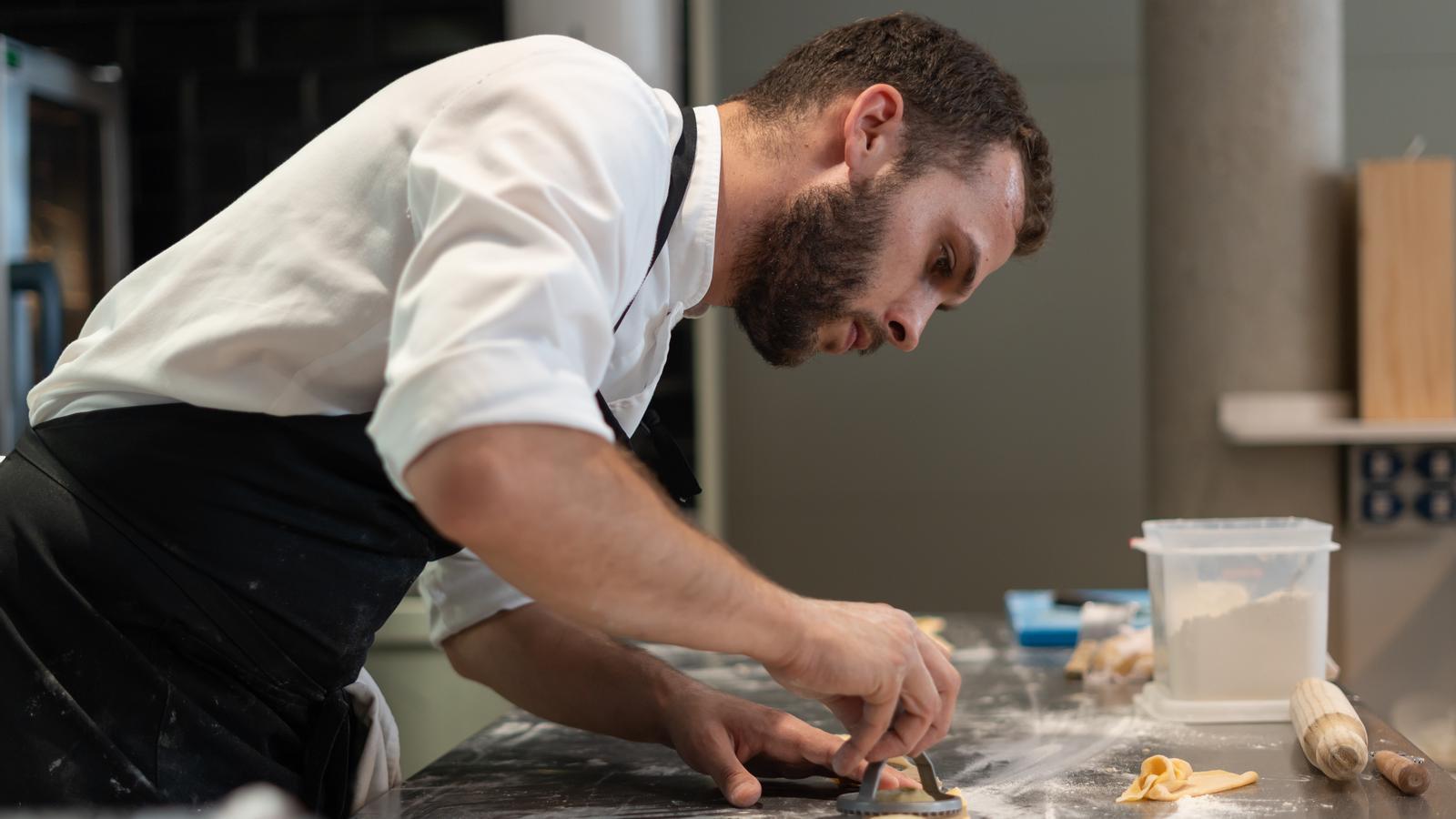
— We make the pasta ourselves, and I don't know how many hours we spent until we achieved the pasta we like. We spent two months making pasta every afternoon until we arrived at the one we make today, which makes us feel proud. We change the filling according to the season. This September and autumn it will be mushrooms with hazelnuts. In winter, hare à la royale. And we serve them with an Albufera sauce.
Explain to me how you make the Albufera sauce.
— It is a highly reduced chicken consommé, and I add aromatic herbs from the Penedès. To make it, I start with a very clarified water consommé, which means I skim it as much as possible so that it remains a very clean broth, without any hint of bitterness. Then I reduce it and, therefore, only ten percent of the broth I had prepared in a large pot remains. The herbs, such as thyme, give it freshness.
The wine and sparkling wine list is very elaborate. It conveys appreciation for the Penedès region, especially.
— It is the work of Àlex Herrera, the sommelier, who does a great job of research, visits wineries, conducts tastings and is always looking for new wines and sparkling wines. He has great ambition to discover new wines, to know how they are made. We have three hundred references; the majority, Catalan.
Today I ate Norway lobsters as a first course. They were large pieces.
— They are from Llafranc. I buy the prawns especially in Vilanova, Palamós, Dénia. I have suppliers who bring them to me, because, for me, with the work there is at the restaurant, it is impossible for me to go to the ports. I am also a father, and I take care of the meals at home.
What dishes do you make at home?
— Routine dishes: meatballs with ratatouille, soups, cream soups. They love soup. I prepare it at home like a quick broth. I put cold water in a pot, add the bones, which provide collagen, and bring it all to a boil. The bones I put in are the knee, pork backbone, lamb shank, and chicken carcass. When everything has boiled for forty-five minutes, then I add the vegetables: lots of celery leaves, a couple of leeks, and three carrots. Nothing else. And with these vegetables, we count another hour. If we wanted to make a Christmas broth, then starting from the second hour is when we would add the chickpeas, black pudding, and the meatball. The thing is, this broth I make at home, I also clarify it; I remove the foam, which is my obsession, so that it is clear. When I have finished, I strain it, and I boil the pasta in the resulting broth. The vegetables, mashed up, we also eat with a drizzle of extra virgin olive oil.
In autumn, which dishes will you prepare at Vilagut?
— Poultry consommé, foie gras appetizers with sliced porcini mushrooms and lemon oil, because I think porcini mushrooms go very well with these ingredients; the bouillabaisse with baby cuttlefish. We serve it in two courses: first, we put the baby cuttlefish and the green beans on the plate, and then we pour the broth over them. I also have a cheese cart, in autumn and all year round, which is supplied to me by those from Xerigots. We serve the Ninot, which won first prize at Làctium.

The cannelloni are also one of the great dishes at Vilagut.
— For the local festival, for Sant Fèlix, we served many of them. It is a very traditional dish of ours, yes, which we have changed very little. The filling, a little bit, because we are refining it more and more each time. We make it from a roast of chicken, beef head and foot, pig's trotters, rooster, and also offal, like chicken livers. We make a kind of galantine out of it. We try to make the most of all the ingredients. Look, let's go to the kitchen and I'll show it to you. Everything is on this platter. At the four corners of the platter, I have placed a tomato, cooked with the rest of the ingredients, which is a trick from the cook Carme Ruscalleda, so that it retains its moisture well. I cook all the ingredients with a little dry rancio wine and a little more cream. At this moment, I have decided not to make so many dishes, but rather to delve deeply into the ones I do make.
They must have told you that with a restaurant like yours you should be in Barcelona.
— They have told me, yes, but I do not want to go there, because I live in Vilafranca. Here I have my family and since our work involves many hours, I could not work far from home.
Are you confused with the producers Júlia Bernet, from Corpinnat?
— Constantly! I still remember the first date with my partner, when I ordered this Corpinnat. She thought I was the one who made them. The Corpinnat is Júlia Bernet, named after Xavier's eldest daughter.
To finish, Julià, how do you see yourself in the future?
— With Vilagut, continuing to offer the pairing menu where I look for a lot of flavor in the dishes and for the client to leave happy. The price is 70 euros, and 50 more with the pairing. We have many returning clients. And we have a novelty, which we are just starting now, the Vilagood.
What is Vilagood?
— It is the establishment for takeaway food. It is the place where you can take home dishes that we also cook at the restaurant.
