Europe must not relax

-
CAT -
CAST
This month, from Vancouver to Brussels, a great cry of joy could be heard when American voters resoundingly rejected President Trump's policies in the midterm elections. How should Europe and other historical allies of the United States respond to this important political shift?
They must redouble their efforts to strengthen resilience, independence from Washington, and closer cooperation among themselves, acting as if it were likely that an even worse version of Trump would arrive at the White House on January 20, 2029.
And, if the next president of the United States is an internationalist Democrat, Europe, including the United Kingdom, and middle powers like Canada, Japan, and Australia would be prepared—at least with some of the fundamental elements—for a reformed and more sensible liberal international order, which the United States could join again.
Europe's dependence on the United States is so deep-rooted, and the internal problems of European countries are so great, that now there will be a strong temptation to relax and exclaim: “Ah, in the end, the United States is back.” European leaders know that they should redirect a significant part of public spending toward the defense of their countries. But, with an aging population, generous welfare states, high debt levels, and the rise of illiberal, nationalist, and populist parties, they fear that if they do so, they will be ousted in the next elections. It is much easier to cling to the hope—however unlikely it may be—that the good Uncle Sam of the post-1945 era has returned, once again extending his security umbrella over his European and Asian allies.
Well, that is not the case. The United States will never again be what it was for much of the last 80 years: a liberal leviathan, according to the expression coined by Princeton academic G. John Ikenberry. Europe must not wait for a mirage of the past.
Although the American wallet will be in the hands of a Congress dominated by Democrats, Trump will continue to direct American foreign policy for the next two years. He may be a leader in his final phase, but –making use of an extensive interpretation of the already broad executive powers of a United States president, and now spurred on by his new chief of staff, the hardliner Stephen Miller– he will be a leader of gigantic proportions, in the style of Godzilla.
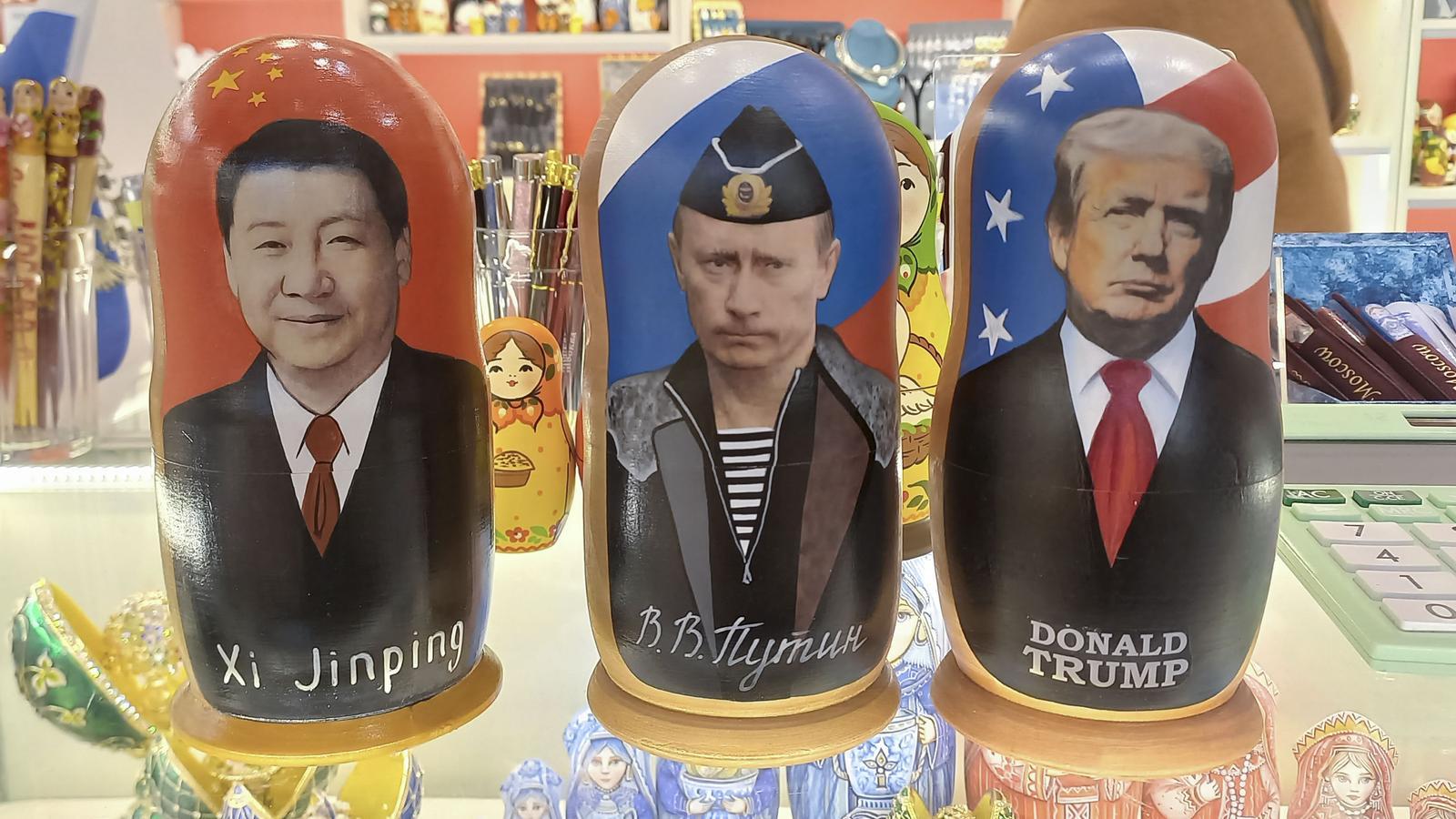
Some pundits –resorting to a comparison already much worn out between the Yalta conference of February 1945 and the summit last Thursday between Trump, Russian President Vladimir Putin, and Chinese President Xi Jinping– might feel the temptation to apply the famous phrase by Karl Marx: “The first time as tragedy, the second as farce”. But this has been worse than a farce.
For Putin, the summit has made his old post-Soviet dream a reality: that Russia be treated as a legitimate equal of the world's superpowers, deciding, along with them, the fate of countries of lesser weight. “What was wrong with Yalta? What was so bad about it?”, he exclaimed with a triumphant air in a press conference after the summit.
Trump referred to Putin as “my friend” and said it was “an honor to be with Vladimir”. And he signed a trilateral statement criticizing the International Criminal Court in The Hague, which has issued an arrest warrant for Putin, accusing him of being responsible for war crimes in Ukraine. Regarding the negotiations to end Russia's war against Ukraine, Trump appeared clearly satisfied to discuss the issue with the Russian and Chinese autocrats, bypassing the Ukrainians and the rest of the Europeans.
Putin’s army continued to bomb Kyiv while the three leaders met in Shenzhen, China. It is difficult to express in words the profound rejection that most Europeans –myself included– feel toward this American president’s betrayal of Ukraine, a European democracy fighting bravely for its own survival.
Congress, now under Democratic control, may approve a new aid package for Ukraine, but Trump could veto it. Europe, together with Canada and other partners, will have to continue bearing the main burden of military and economic support for Ukraine. Europeans are facing an intensification of Russian hybrid attacks against their own countries, and even the possibility of direct aggression by Russia against some corner of the European territory of NATO.
In the medium term, nobody knows what the United States will be like after January 2029. The midterm elections were a vote against Trump, not an enthusiastic endorsement of the Democrats. The next president will have to face significant internal limitations when it comes to making commitments abroad; among others, a runaway national debt. It is likely that the so-called restrainers (or restrainers) will have influence in shaping future Democratic foreign policy.
The long-term argument –which advises acting as if an even worse version of Trump were to win in 2028– is, at the same time, the most interesting and the most important. Putin’s large-scale war against Ukraine has made it clear that we are already living in a post-Western world. Until now, Russia has been able to resist strict Western sanctions because it counts on powers such as China, India, Turkey, Brazil, and South Africa, which continue to maintain habitual relations with it in both the economic and political spheres.
For the first time in more than 200 years, these countries located beyond the transatlantic core of the West possess, as a whole, enough wealth and power to provide a counterweight. If liberal democracies around the world want to defend their shared interests and values—and rescue, through reforms, what remains of the liberal international order—they must extend their gaze beyond what has traditionally been defined as the West. They must increase their own resources of hard power (hard power), as well as their economic power and their soft power (soft power), and strengthen direct ties between them, instead of functioning simply as spokes of a wheel that has the United States as its central axis. This is precisely what the Prime Minister of Canada, Mark Carney, has been urging other middle powers to do. And Europe, when it acts in a united manner, is a great power.
A reconfigured international order in this way would likely also be more liberal. The essence of liberalism lies in the imperative to limit and distribute all kinds of power. Therefore, in theory, the idea of the United States as a liberal leviathanhas always been, in a sense, a contradiction in its own terms, even though, in practice, it has worked quite well.
If Europe and other democratic partners succeed in building a version of the liberal international order that is more distributed and multipolar—or, at least, some of its elements—the result could be, at the same time, more liberal and more resilient than a system that depends excessively on a single superpower. If, additionally, the most powerful country in the world rejoins this framework in 2029, the resulting alliance could be, in some respects, even more solid than it was a decade ago, before Trump began swinging his wrecking ball.
This, however, would require a dose of humility—a scarce commodity—in Washington. Just like the British, but even more so, Americans struggle to accept the possibility of participating in international agreements that they do not lead. At a minimum, the United States should not pretend to be the leader in all areas. In fact, they should be grateful not to have to be.
It must be said that this is the most favorable scenario. Europe is entering an intense electoral cycle—the next turn is Spain's, on November 29—and, if populist nationalist parties prevail, they will dedicate themselves more to dismantling Europe than to unifying the world. If that happens, we could even witness a reversal of roles after 2029: an internationalist and liberal United States facing a nationalist and illiberal Europe. But, if Americans can steer the situation back on course through the ballot box, Europeans can do so as well.
Copyright The New York Times
