The tourist complex of Trump's son-in-law that has made Albania explode
Jared Kushner's project in a protected area of the country has triggered a movement that demands the resignation of Prime Minister Edi Rama

-
CAT -
CAST
A narrow strip of land, an isthmus, separates the Nartë lagoon from the waters of the bay of Vlorë, at the southern end of the east coast of the Adriatic Sea. In the widest part is what we call Zvërnec: a peninsula or an island, a forest, and now also a symbol that has transcended this corner between the lagoon and the point where two seas meet, and which has resonated throughout the world.
At first there was the fauna. This space is the habitat of hundreds of species, among which are the flamingo, the Dalmatian pelican, the sea turtle and the Mediterranean monk seal. Together with the lagoon, Zvërnec is part of the ecosystem of the delta of the only wild river in Europe, the Vjosa, a national natural park that stretches across hundreds of kilometers into the interior of Albania and up to northern Greece.
One day in January 2026, a line of black vehicles appeared, crossing the forest along a difficult dirt road. In April, heavy trucks, excavators, and bulldozers began to be seen, which started the construction of a road. Later, a fence was erected, and then, a considerably high barbed wire fence, which separated the widest part of the isthmus, with its forest and its dunes, from the world.

The Deal
In the line of black vehicles was Ivanka Trump, the daughter of the President of the United States and wife of Jared Kushner, a real estate developer and improvised diplomat. What was she doing in Zvërnec? That same night she was received in Tirana by Edi Rama, the Prime Minister of the Albanian government, who stopped attending the Davos Forum to welcome the first American damsel. They were up to something.
It was not the first time that Ivanka Trump traveled to Albania and met with the head of government. In 2021 they had dinner together in Durrës, and it is said that it was there that the first conversation took place about the possibility of building a tourist complex in the country, more specifically on the small and uninhabited island of Sazan. Different versions disagree on whether Kushner was present at the dinner or not. But in any case, Ivanka Trump met with the Albanian prime minister, with whom she spoke about Sazan and about the fact that it would be Kushner who would build the tourist complex. Or perhaps the first visit of Ivanka Trump to the country was the one she related to an influencer in a recent interview? That she was sailing on her yacht and when she saw the island of Sazan, she jumped into the sea, swam to the island and climbed barefoot to its highest point, where she was amazed by the views? It is hard to believe that she climbed barefoot along the steep path full of rocks and thorns, but well…
In any case, in February 2024, the Albanian parliament—where the government has an absolute majority—approved a series of amendments to the law for protected natural spaces. These changes opened the doors for so-called strategic investors to build in these types of spaces. Shortly thereafter, Kushner posted on Instagram the general outlines of a tourism complex project in Albania, with an investment of about 4 billion dollars. Towards the end of the year, almost immediately after his father-in-law was re-elected president of the USA, the company involved in Kushner's project gained the status of "strategic investor" from a state commission led by the prime minister. In January 2025, the commission approved a construction permit for a luxury tourism complex in Zvërnec for the company.
The trigger and the explosion, or the awakening
In May 2026, the inhabitants of a town near the area surrounded by the barbed wire try to cross the fence and stop the construction work. They have spent years in court because they aspire to acquire ownership of the land, without success. One of the gathered men was about to cross the first obstacle when two guards hit him, knocked him down, and dragged him along the ground, in the presence of the police, who did not intervene. The scene goes viral.
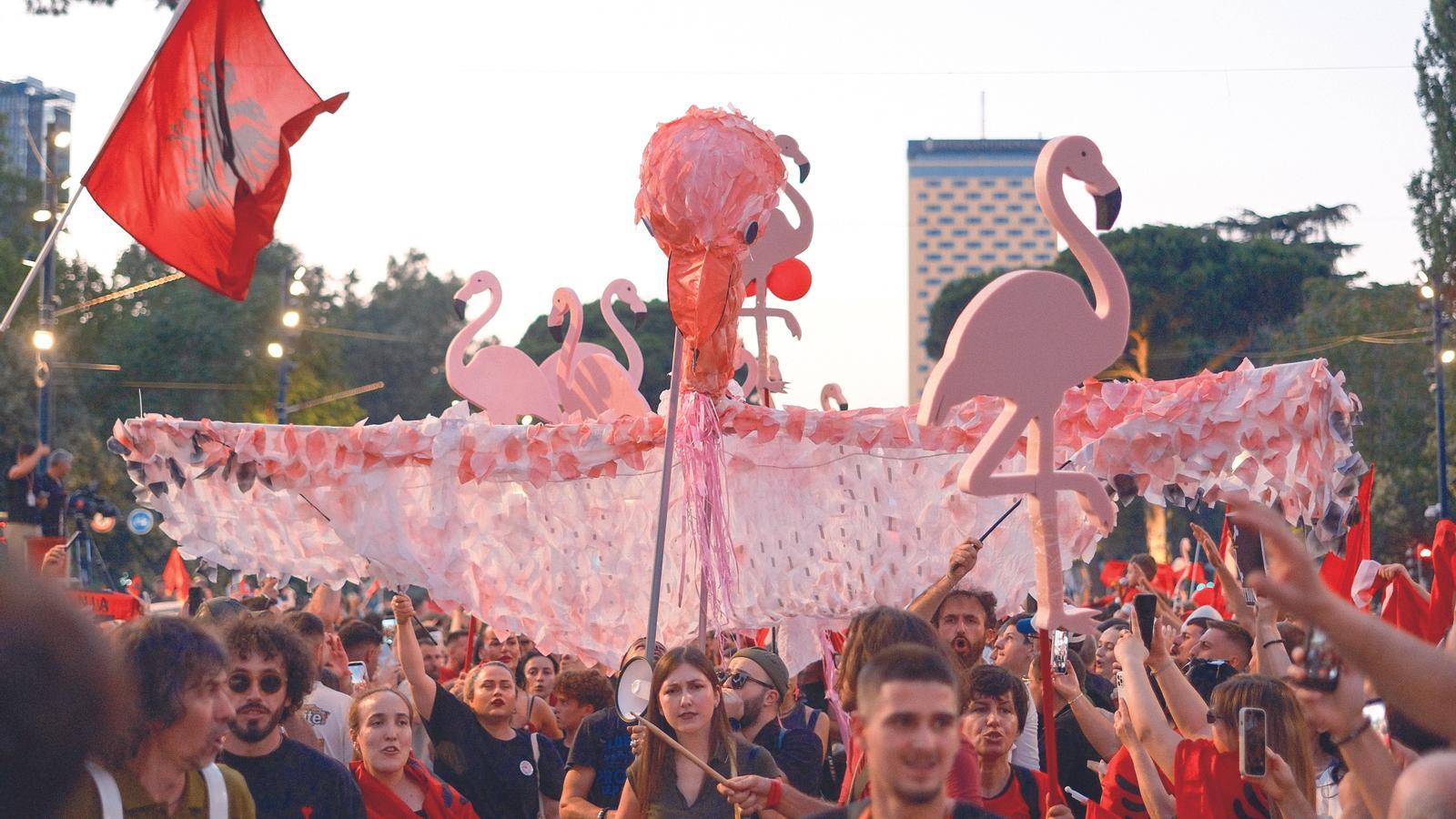
It was the straw that broke the camel's back, the trigger that set off what is now known as the revolution of the flamingos. The government's response to calm the situation was the suspension of the regional police chief. Insufficient. The protests by a small group of activists in Zvërnec were followed by a chain of demonstrations in the capital.
The focus of the demands gradually expanded. The government slowly became the main target of the protests. At the Zvërnec scene, a series of the country's problems were intertwined: environmental protection, but also arbitrary violence, lack of transparency, and the issue of land ownership. The involvement of the Trump family, at the same time, fixed the attention of international media on Albania, a fact that strengthened the protests.
The flamingo revolution is a spontaneous movement, without leaders or representatives. And ideologically heterogeneous: there are people from the left and the right, nationalists and environmentalists, religious people and defenders of LGBTI rights, traditionalists and hyper-moderns. Also opposition militants, especially from the left-wing party Lëvizja Bashkë, formed mainly by young people with university education; but in general, it consists of unaffiliated members of civil society. It is a heterogeneous movement also regarding the participation of different social sectors: of class, of interest groups, and of age. From this last perspective, the presence of young people stands out above all, from a generation that suffers the constant hemorrhage of emigration and sees itself expelled en masse, faced with a huge lack of future possibilities in their country. Famous figures of the Albanian diaspora, such as the writer Lea Ypi and the singer Dua Lipa, have shown their solidarity. At one point, a space has been created for children to play and draw with chalk on the boulevard tiles. The symbiosis of the revolt with peace, and a sudden and abrupt awakening of civil society after a long lethargy. Isolated individuals who now recognize themselves as part of a community.
The protesters quickly reached a consensus on clear demands: the resignation of Prime Minister Edi Rama; the formation of a technical government; an electoral reform; the annulment of laws that damage the environment and the natural wealth of the nation, and a new social pact, especially regarding health and education.
The reaction of the establishment
In Albania, the political class is composed, essentially, of two main parties, which have alternated in power since the beginning of pluralism three and a half decades ago. One is the Socialist Party (SP), a reformed heir of the communists, in power for thirteen years. This party, theoretically left-wing, follows clearly neoliberal, and increasingly authoritarian, policies. Despite being part of the Socialist International, the party leader – Prime Minister Edi Rama, who participated in the Summit in Defense of Democracy, which Pedro Sánchez organized in April in Barcelona –, maintains a close or very close relationship with figures such as Giorgia Meloni, Benjamin Netanyahu, Viktor Orbán or Donald Trump. Also, several exponents of the SP have been convicted of corruption and others, among whom are two former deputy prime ministers, are under indictment for the same reason.
The other main party, the Democratic Party (PD), is right-wing in theory and in practice. Led by former president and former prime minister Sali Berisha, over eighty years old, who is burdened by the same sins as his brother party and enemy. Before the protests of the flamingo revolution began, the PD organized demonstrations in front of the government presidency, but with far fewer participants and with violent actions, using Molotov cocktails, vandalizing, and setting fires. A symbiosis of aggression and powerlessness. And a guarantee for the long life in power of the socialists, who have found it easy to present Berisha as the bogeyman of adult fairy tales.
Thus, in the face of spontaneous, peaceful, massive protests that also identify the opposition leader as part of the political evil, Prime Minister Rama has lost control of the narrative. In his initial responses, amidst insults and mockery directed at the protesters and those who sympathized with them, he declared that the protests had been incited by Greece: the country, he claimed, feared the competition that Albania could pose in tourism thanks to a resort complex that would be the pearl of the Mediterranean. Later, he insisted that it was a hybrid attack from Iran, for which he would soon present the relevant evidence. The Prime Minister has continued to explain the protests as the result of foreign enemies' intervention seeking to destabilize the country. Russia, Serbia, once again, without any proof. Berisha, for his part, was initially against the protests, emphasizing that they opposed the country's economic development. Later, upon seeing that the protests were not stopping, he positioned himself in favor.
Mutual resonances
During the first days of June, at a time when protests were growing, a new actor entered the scene. Artur Shehu, a businessman residing in Miami, suspected of international drug trafficking and under investigation by the Special Structure Against Corruption and Organized Crime (SPAK), an Albanian judicial body that acts with the sponsorship of Washington and Brussels and, therefore, with unusual independence from the executive power. Shehu is listed as the person who, in the capacity of owner of the land in Zvërnec, sold the land for the construction of the tourist complex of Kushner's company. From the SPAK's investigations, it came to light that the document according to which Artur Shehu is the owner of Zvërnec, an Ottoman cadastral certificate from the year 1318, is a forgery. On June 10, the SPAK issued an arrest warrant against Shehu for charges of drug trafficking and document forgery.
On June 18th, Zvërnec –as a matter of environmental protection– arrives at the European Parliament. (Albania is a candidate country for the European Union). Europe issues a resolution calling for the repeal of the 2024 amendments regarding protected natural areas and also the moratorium on construction in these zones until the law is changed. The legal changes requested by the European Parliament have not yet been carried out.
Hubris
In June of this year, The Albanian Files was published, a book that compiles the writings of 68 highly renowned foreign architects who have created projects in Albania in recent years, including Pablo Bofill. The book was intended to serve as propaganda for Prime Minister Rama, the author of the preface. However, the reality has been different. According to the Dutch journalist Vincent W. J. van Gerven Oei, “The publication of The Albanian Files has provided new evidence that some foreign architecture firms are strongly linked – through direct access, which they themselves admit to having, to Prime Minister Rama's monopoly of power over the Albanian territory – with a criminal enterprise that includes drug trafficking, money laundering, the oligarchic appropriation of land, and the destruction of Albania's landscape and natural resources.” The SPAK is investigating the origin of this money.
During the month of July, while protests continued with force, Albania witnessed another episode of glamour and what we could call the hybris of power: the concert by rap singer Kanye West. The concert had been announced months ago by the government's propaganda apparatus, and it was emphasized that everything was supported by private investment and not a single euro of the state budget would be spent. Since half of the tickets remained unsold and the concert was in danger of being canceled, the council of ministers decided to take 4.2 million euros from the state reserve to buy the unsold tickets and distribute them for free. This amount is more than double the annual budget of the Ministry of Culture for all performing artists in Albania. The concert was broadcast at the same time the usual protest was called. After the concert, the prime minister received the rap star, an admirer of Hitler and friend of Trump, in his office and gifted him a copy of the book.
From all these attitudes, it could be deduced that the prime minister maintains absolute self-confidence in the face of the protests. In reality, based on several of his actions, he seems rather stunned or frightened. In an attempt to regain control of the narrative, he has replaced the contempt for the protesters with a curious strategy. First, by making a distinction between “the flamingos”, benign and sincere and, therefore, respectable, and “the crows and ravens”, who are calling for his resignation and whom he links to the external enemy. In this way, he seeks to establish what the opposition, or rather the people, should be like. He claims to be willing to dialogue with “the flamingos”. There is a problem, however: the unanimous consensus among the protesters in favor of his resignation. With whom will he dialogue?
The next step consists of determining the content of the dialogue. According to Prime Minister Rama, the protests have been caused by rising expectations, which have come about thanks to the good work of his administration. In other words, the protests, in which it is unanimously demanded that the head of government resign and answer to the law, are a success of the government.
The continuation…
How will the flamingo revolution continue, taking into account that the stance of both sides, the government and the outraged citizens, is refractory to the other?
Throughout the month of July, as nightly protests continued in front of the government presidency, it happened several times that hundreds of demonstrators surrounded the Parliament and threw eggs at the PS and PD deputies and also at their cars, which were coming and going. The police responded by deploying a special forces unit equipped with drones that monitored the situation from the sky. The police officers were also hit with eggs by the protesters, and in some cases also with stones, at the hands of teenagers from the poor areas of the periphery. The police's counterattack—or rather, the attack—was markedly disproportionate. In addition to the use of high-pressure water cannons, tear gas, and pepper spray to clear a path for official vehicles, there were brutal beatings of protesters, even after they had been thrown to the ground, tied up, and immobilized. Dozens ended up at the police station or in police vans, where they were harassed and mistreated, even when it came to young girls, as in the case of the artist Elsa Paja, whose hand they injured.
Will there be direct political consequences? It is difficult to foresee. Be that as it may, the revolution of the flamingos has already created a social capital, with which any government that Albania has in the future will have to reckon.
Tirana, August 17, 2026
Bashkim Shehu is a writer and translator. He is the author of Angelus Novus (Siruela, 2017). This article was published in Spanish in issue 79 of the magazine La Maleta de Portbou in its expanded version.
