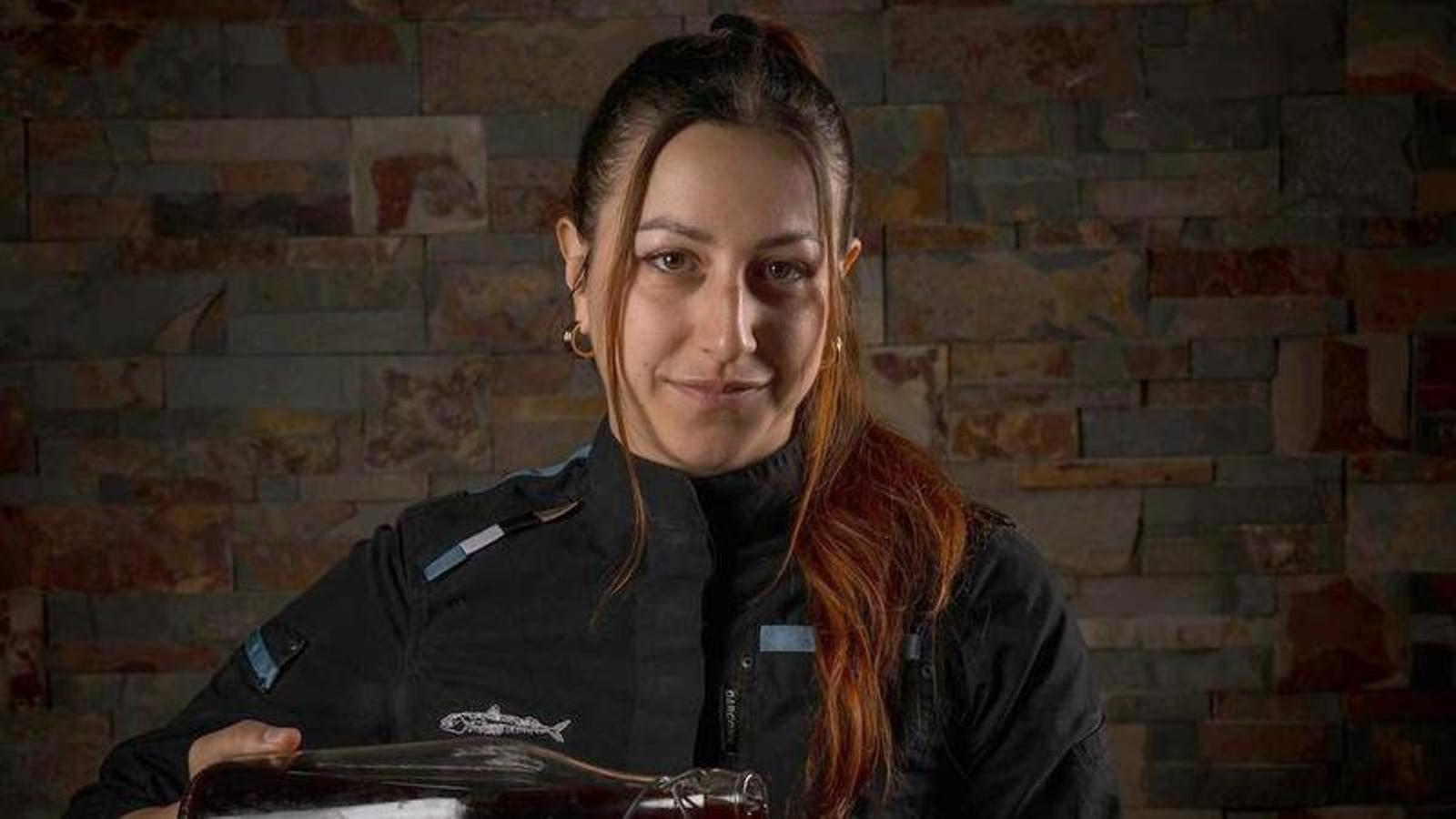
Giulia Gabriele: "We have made a sausage with the amberjack and its semen, which gives it a very good texture"
Co-owner of Fishology

-
CAT -
CAST
BarcelonaI am interviewing Italians Giulia Gabriele and Riccardo Radice, owners of the Fishology restaurant (73 Diputació St.), one afternoon after the lunch service. They opened the restaurant just five years ago and last year they received a Michelin star. Their passion for fish and sustainability has made them a benchmark. So much so that the restaurant has become too small, and for this reason they have already thought about moving to a larger space. They will open the new Fishology in March of next year and will continue to offer the tasting menu they currently serve, but with changes, which they already hint at for us.

Did you meet while you were studying?
— We were both born in the same area of Italy, between Switzerland, Milan and Piedmont, and we met at hotel school, known as istituto alberghiero. I specialized in dining room service and, in parallel, I did a master's degree in pastry.
Why did you decide to specialize in fish?
— Me, for sustainability, and Riccardo, because he is passionate about them. Riccardo's grandfather was a fisherman; his grandmother cooked fish very well as well as many other recipes. I, on the other hand, arrive here through sustainability techniques, many of them ancestral. Thus, at Fishology, we have merged the two cultures.
In Barcelona, in Catalonia, is there a culture of making the most of fish?
— No. And when we opened, in 2021, we already thought that we had a 50% chance that people wouldn't like it, because what we do is very different. Our job has been precisely to raise awareness and inform the diners, in addition to offering them dishes. People know that every part of the pig is used, but for fish, they didn't think so.
You can also make the most of fish entirely.
— Yes, and that is why we make sausages, which we have been preparing since we opened. Since this summer, we have taken a step further: we are marketing them. We have made them available for sale through our website, the restaurant's website. People can also come to the restaurant to buy them. If they are ordered online, it takes us one day to prepare the packages.
Which cold meats can I buy from you?
— Bonito fuet, meagre chorizo, swordfish sweet ham, tuna ham, trout pastrami and a type of smoked bacon made with swordfish. They are charcuterie because we follow the same techniques used for meat ones; only that we make them from fish.

How are you doing that?
— We fillet the fish, and we use the loins for the dishes. We keep the bone, the meat from the tail, and the head. With cod and tuna there was a tradition of doing so, of using everything, but with the rest of the fish, not so much. And we also use the offal, such as the liver, heart, swim bladder, roe, and the milt of male fish because they add a lot of flavor.
In Japan it is common to use it.
— Yes, cod milt and tuna milt are common in some dishes. In Japan, in the best sushi you can find cod milt. We have made a sausage, inspired by a currywurst from Germany, with amberjack and its milt, which gives it a very good texture. We now have on the menu a bluefin tuna kebab with all the parts. We do not force the fishing; we proceed as we have the fish.
Do you always have the cold cuts?
— The classics, yes, like fuet and chorizo, ham, lardo, pastrami, because we produce large batches when we have the fish. We also like to experiment, because now we have made a sausage with little tunny fish and mushrooms. We have also prepared a black pudding with mushrooms and sea asparagus.
I had never tasted anything like it.
— When we arrived in Barcelona, we saw that there was an avant-garde culture, of product, but little variety when it came to choosing products and even less in working with their parts. The challenge is to work with the parts of all fish and with unknown fish, and not just with red prawns. We believe that the chef has a fundamental role in the sustainability of food. A conger eel itself requires a lot of labor because it has many bones, but we do not give it up because it is a good fish.
How do you cook them?
— When we arrived, we saw that you cooked the fish grilled, fried, on the barbecue, or in salt. We have added more techniques; we cook it on a charcoal grill, with a wood smoker, steamed, at low temperature, and then we follow ancestral techniques, such as curing, salting, pickling, and fermenting. Depending on the flesh and fibers of each fish, a different cooking method is needed. Otherwise, we miss out on eating it in the best possible way.
Fishmongers are closing in the neighborhoods. Supermarkets are selling packaged fish fillets. What do you think?
— We understand that it is convenient to buy a tray of fish at a supermarket, but we need fishmongers. We ourselves need them; it cannot be that they disappear.
At Mercabarna you have opened a space to work with the fishmongers.
— We opened it in the month of September. It is a warehouse that we have rented, where we work with the parts of the fish that the fishmongers at Mercabarna do not want. Without leaving the market, we begin the transformation process. We could say that at Mercabarna we have our research laboratory and at the restaurant we prepare the dishes for the tasting menu. It is easier for us to access the less noble parts of the fish by being at Mercabarna. There, we work together with someone from our team, whom we are training.

Will you be making special cold cut packages for Christmas?
— Yes, we will make some packages of the six classic Fishology cured meats. If someone hasn't been to the restaurant, if they buy them, they will be able to get to know us with this tasting that we are preparing.
How much does the tasting menu cost?
— There are two proposals, one for 115 euros and another for 140, which include between eight and ten preparations, which are actually landscapes, as if it were a journey through the seas, through the coasts that inspire us, such as the Costa Brava. We cook it and make everything, including an algae honey, which we use to accompany our blue fish sobrassada.
You said you use the small parts of the fish. The eyes too?
— Yes, we use it to make ice cream, like mint flavor. Instead of using gelatin, we use the eyes of some fish, which give us the same result. However, they are crushed. We understand that it is hard to eat fish eyes. We also use fish skin, from swordfish, to make a porchetta, which is very typical in Italy.
Finally, two questions. In Italy, have they not told you to open a restaurant just like the one you have in Barcelona? And the second: what will the new restaurant be like?
— Italy is very traditional with its gastronomy. We cannot imagine a restaurant like the one we have in Barcelona working. It is true that it now seems that Italian gastronomy is changing, but we do not plan to leave Barcelona. To continue, at the restaurant we have on Diputació street we can serve between seventeen and eighteen diners; in the new one we will have more capacity. We will continue to offer the tasting menu, which can be tasted in different spaces. It is the new project we have, which excites us. We even want to inaugurate it on the same day we started at the Diputació street location: March 19th.
