A great reputational crisis: Maldon salt flakes lose their touch of authenticity
The controversy over the origin of part of the crystals questions the artisanal narrative of a centenary brand

-
CAT -
CAST
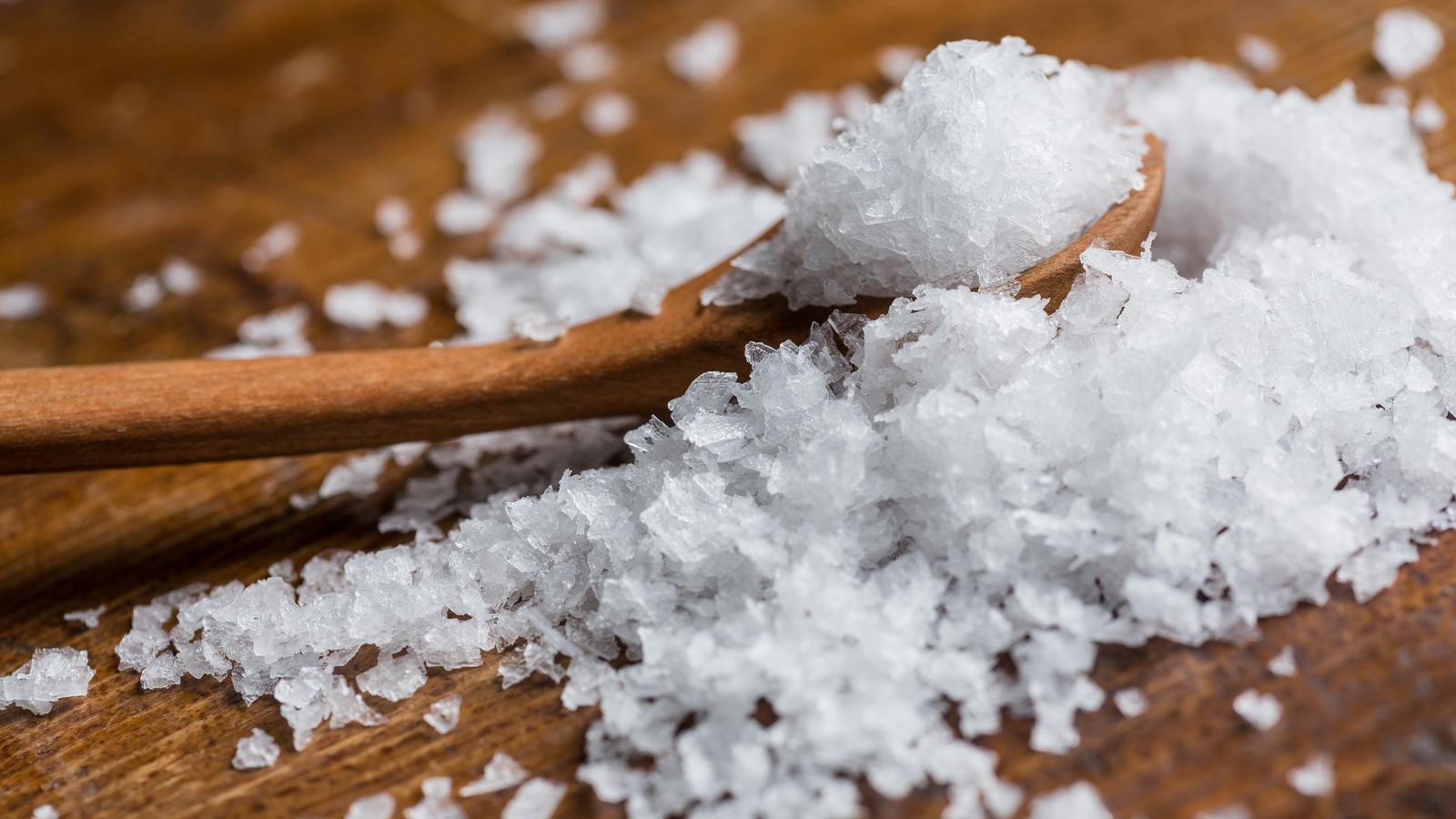
LondonAt any supermarket in the United Kingdom, at the Sainsbury’s chain, for example, a 250-gram box of Maldon salt costs 2.85 pounds (approximately 3.41 euros). The price per kilo, nearly 12 pounds (14.30 euros), is much higher than that of common salt. In part, this is explained by the gourmet status of the brand,its centenary tradition started in 1882 in Essex and the image of an artisanal product associated with the waters of the Blackwater estuary (about 65 km northeast of London) and its unmistakable pyramid-shaped crystals.
Maldon salt—like the salt flakes from Añana (Basque Country)—is considered an exquisite product not because it has extraordinary nutritional properties or a chemical composition very different from common salt. It is, above all, a question of texture, of the production process, and of the value they bring to the so-called “gastronomic experience.” The crystals, light and crunchy, break in the mouth and release salinity in a different way, which makes them especially appreciated for finishing meat, fish, or vegetable dishes. A kind of decoration that, furthermore, provides a final touch, of contrast or of reinforcement of the taste of the dish.
The very fragility of the pyramidal flakes of Maldon salt contrasts with the solidity of the narrative that the brand has built over generations in the kitchens of the best restaurants and households of the world. A narrative that, however, has been called into question following a journalistic investigation by the weekly The Observer, which has provoked a controversy dubbed in the United Kingdom as the “great salt war of 2026.” According to the newspaper, Maldon uses rock salt imported from Germany to produce its famous flakes.
Three days in October
During three days in the month of October, journalists from the publication observed how several trucks were unloading large sacks from the German mining company K+S at the Maldon facilities, near Goldhanger (Essex). Based on this in situ observation, the media outlet calculated an approximate volume of deliveries of about fifty tons per week. Far from being a food safety or chemical quality issue – sea salt and rock salt are basically composed of sodium chloride—, the debate has centered on the origin of the ingredients, information transparency, and the consistency between what is communicated as a brand image and what the consumer receives.
Maldon has not denied the use of foreign salt. And it has defended that there is no deception. The company has argued that for more than one hundred and forty years it has applied a traditional technique known as salt-on-salt. The procedure consists of enriching seawater with natural rock salt to achieve a brine with the optimal degree of salinity for crystallization. Subsequently, it is heated in large open vessels until evaporation favors the formation of pyramidal flakes, which are harvested by hand. The company has informed that the rock salt comes from deposits originated millions of years ago due to the evaporation of inland oceans and seas that became isolated. Therefore, from this point of view, it would also be sea salt and it retains the characteristic taste, texture, and artisanal method.
Despite this argument, the company modified its website following inquiries from The Observer. And for the first time it had to detail the salt-on-salt process. It even admitted that its explanation had not been accurate enough. The controversy has widened even further when the Cornish Sea Salt Company, linked to the waters of the Lizard Peninsula (Cornwall), acknowledged on the website The Grocer, that it combines local brine with natural salts from other European coasts to favor crystallization and mineral profile. These details, however, did not always appear on the packaging.
The impact on public opinion has been made clear in a survey by the aforementioned The Grocer, a trade publication of reference in the United Kingdom for the food, beverage, and fast-moving consumer goods sector. 42% of those surveyed stated that the Maldon case has made them lose the desire to buy it, and that 11% would not pay the usual price. 47%, however, would continue to buy it.
Another key element of the controversy is a legal loophole existing in the United Kingdom, where there is no specific regulatory definition that specifies what can be sold under the sea salt label. In fact, the British Food Standards Agency (FSA) and the consumer protection services of the county of Essex had already investigated the Maldon procedure in 2019 and 2020, and concluded that there were no grounds to take any action. The regulations, therefore, do not seem to support the consumers who believe they have been misled. But the legality of a practice does not necessarily solve the problem of trust generated.
This fact contrasts with the 2017 closure of the Scottish company Hebridean Sea Salt after an investigation detected 80% imported salt and it was considered that there was consumer deception. For its part, the Welsh producer Halen Mon has highlighted that it uses exclusively local seawater protected by a protected designation of origin that offers more guarantees than simple commercial claims.
Promise of authenticity
Based on these facts, the writer and design and architecture critic Stephen Bayley has analyzed in the newspaper The Daily Telegraph that a brand is fundamentally “a promise” and that the appeal to the “artisanal” has spread diffusely even to large fast-food chains, such as McDonald’s or Dunkin’ Donuts, without clear regulation to set its limits. The search for authenticity explains the success of products such as sourdough bread, artisanal cheeses, cold-pressed olive oils, natural wines, or spirits from small distilleries. In a world marked by globalization, cross-border supply chains, and distrust of an increasingly virtual and technified reality, knowing the origin of a product and the conditions in which it was made has become part of its value and, therefore, of the price that the consumer is willing to pay.

The French concept of terroir –the influence of soil, climate, and geography on the characteristics of a food– is called into question when raw materials circulate around the world without the packaging clearly identifying their origin. Salt also carries a long symbolic and historical burden: from the preservation of food and the origin of the word salary, linked to the Latin salarium and the remuneration of Roman soldiers, to the meanings of purity and hygiene in Jewish, Christian, and Muslim traditions.
Today, as Bayley pointed out in his article, in a pinch of salt one can read a whole world. An assertion already demonstrated by Mark Kurlansky in Salt: A world history, an exciting essay that explains the history of humanity through a seemingly modest product that for centuries has been a determining factor for the economy, politics, and power relations: salt has driven trade routes, made cities grow, fed armies, and sustained empires, but it has also been the object of monopolies, taxes, and social conflicts. And today it continues to generate disputes, even if they are of a different nature: regarding cooking, the value of craftsmanship, and the authenticity of the narratives with which products are sold.
